A few months back in another forum a thread was posted pointing out the advantages of coupling lenses when producing low(ish) magnification ( 1X - 5X) macro images. When using lenses( as opposed to Microscope objectives) for magnifications above 1X extension, in the form of bellows or Extension rings, is the most common approach. The key advantage in this approach is, so long as you remain within the lens' optimal magnification range, you can vary the magnification by changing the extension.
For me there is one rule of physics I am always fighting with: Light Diffraction. Both my cameras start to see Diffraction at apertures just over F6 and it is a noticeable artifact after F8. I have therefore tried to clean up my macro lens stock by having fast lenses.
Using extension changes the effective aperture and quickly brings diffraction into play. I understand this is the formula for calculating the effective aperture when using extension:
EF= M(NF+1)
EF: Effective aperture. M: magnification. NF: nominal aperture(what the lens is set to)
For a lens at F4 set to 2X magnification by extension the effective aperture is F10 which is outside the optimal range for both my cameras.
Coupling lenses involves reversing a short focal length lens and mounting it via a coupling ring( usually costs less than US$6.00 with postage) to a longer length lens( I may refer to this lens as a tube lens later on). This provides a set magnification which is calculated by dividing the focal length of the longer lens by that of the lens mounted on it. For a 40mm on an 80mm we would see 2X magnification and the effective F stop is calculated by this formula:
EF = M(NF)
At F4 the formula tells us the the effective aperture of a coupled lens system would be F8. The two stop difference in comparison to extension, does result in a noticeable difference in IQ( image quality. So if a fast lens ( say 2.8) can be used then it is possible to come in under the DLA for both my cameras. At 2 X magnification with a 2.8 aperture the effective F stop would be a very comfortable F5.6.
Noting the reported advantage I was taken with the concept and with experimentation immediately proved one often stated issue: simply finding lenses that can be successfully coupled together. Some lens couplings produce extremely small image circles that do not even cover a Micro four thirds camera sensor.
I have a variety of lenses for normal photography as well as a set of lenses for coin photography. So over the last few weeks I have tried different combinations. I quickly confirmed one rule... you cannot pair couple lenses where both have deeply in-set front elements. At least one, or better both, must have front elements that are right at the front of the lens body. It seems that the closer the front lens elements of the two lenses( to be coupled) can be placed the larger the image circle.
In my lens bag I found the following lenses produce workable( but not necessarily ideal) combinations:
Reversed lens: Schnieder Kreuznach APO Compnonon S 40/2.8 HM works with:
1. Minolta MD 135 F2 ( a high resolution manual focus lens that is hard to find and is expensive, coupling with the 40mm sees some slight vignetting on a full frame sensor.
2. Minolta MD 200mm F 2.8. ( a moderately priced lens US$200-$400)
3. Schnieder Kreuznach 210/5.6 large format Enlarger lens. This lens worked best with the SK 40mm absolutely no Vignetting, however flarelack of contrast in the center of the field was an issue.
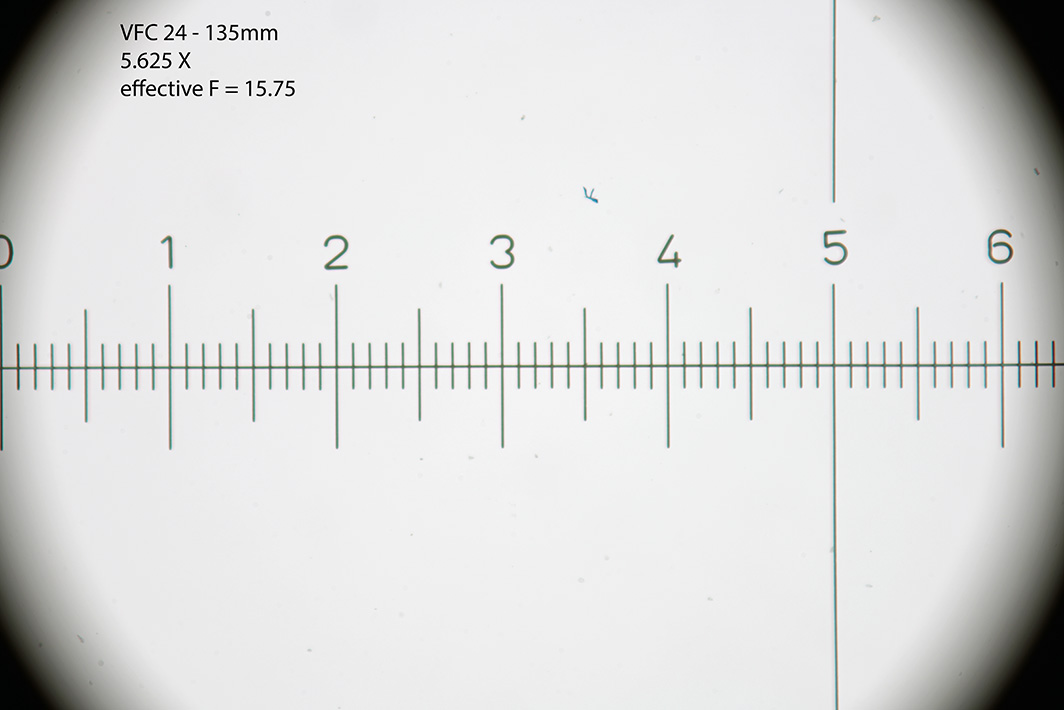
Reversed Lens: Minolta Rokkor-W MD 24mm F 2.8 VFC( variable field curvature). This is a rare lens that was produced for Product(close up) photography it has a unique feature where by the Curvature of the Field of focus can be adjusted from Concave through flat to convex. Its expensive and works best on FF system cameras( not so good on MFT)
This lens paired well with the same tube lenses listed under the SK 40mm with almost the same results ( some slight Vignetting with the 135mm and 200 mm tube lenses and no Vignetting with the SK 210mm.
I have already stated the first con of lens coupling( finding with lenses will work together), and the second is inferred strongly in the last paragraphs the best combinations seem to be with expensive lenses. I had hoped I would find cheap combinations, The SK 50mm2.8 enlarger lens, which can be got for less than US$60.00) worked with the same tube lenses as the 40mm but those tube lenses are not( apart from the SK 210/5.6) easily found and require specialist equipment ( speed boosters) to adapt them to DSLrs.
I did a run of test photos with the SK 40 mm and the above tube lenses I added in using a Minolta 300-S 2X teleconvertor. That teleconvertor is designed to pair with the 135mm and 200mm lenses mentioned here. In normal photography it works well.
Here are the test photos( please note I repeated the shots several times and have posted the best results here. All photos have been reduced ( Bi cubic sharper) for posting.
Also please note I used a €10.00 as the test target. The micro printing figures seen in the pictures are in real life 0.3mm high( should give you some perspective). Also as the note is 2 dimensional I didn't have to use stacking.
In some shots it may not look as if the fields is flat in those pictures it is not the flatness of field that was a problem... its was the bank note that was the problem ( it was hard to get it to sit flat. In the first two photos I made the mistake of getting the labels around the wrong way. I didn't notice until after I had deleted the original photos so I cut and pasted to make the corrections:
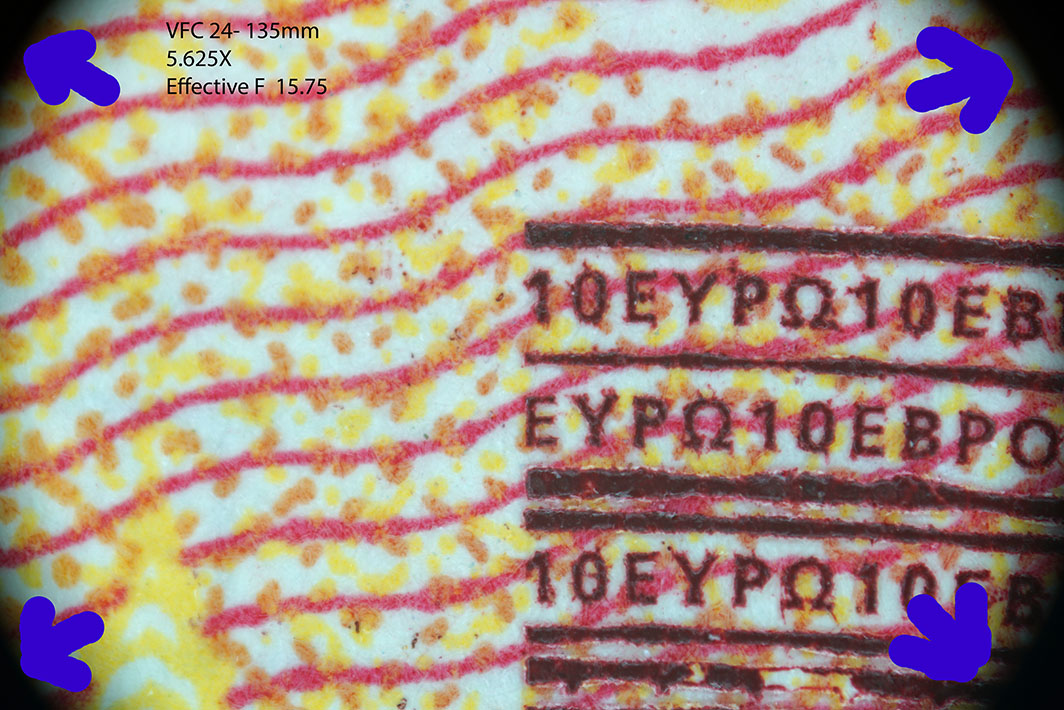
40mm plus 135mm effective F stop 9.45

40mm plus 135mm plus 2 X teleconvertor effective F stop 18.9
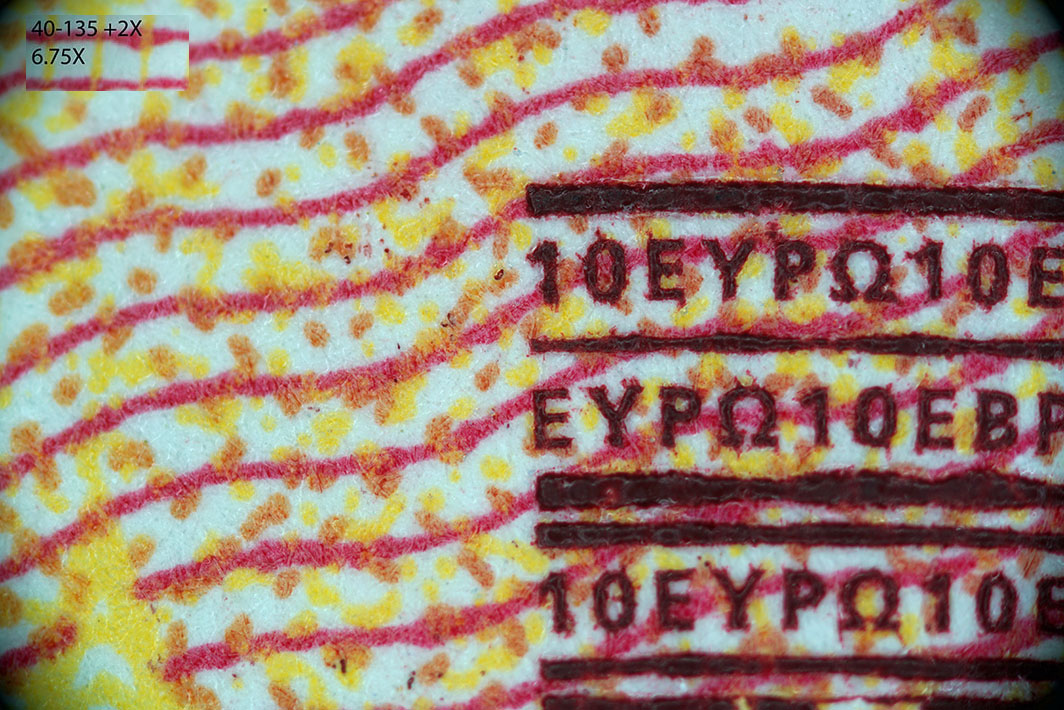
40mm plus 200mm effective F stop 14

40mm plus 200mm plus 2X convertor effective F stop 28
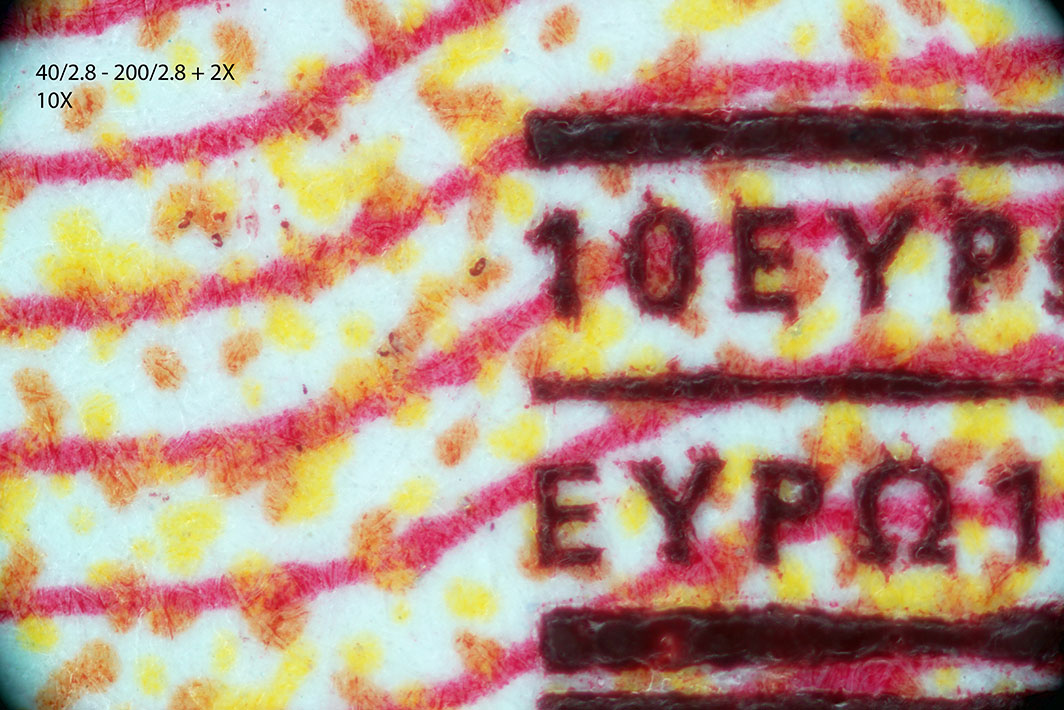
40mm plus 210mm effective F stop 14.7
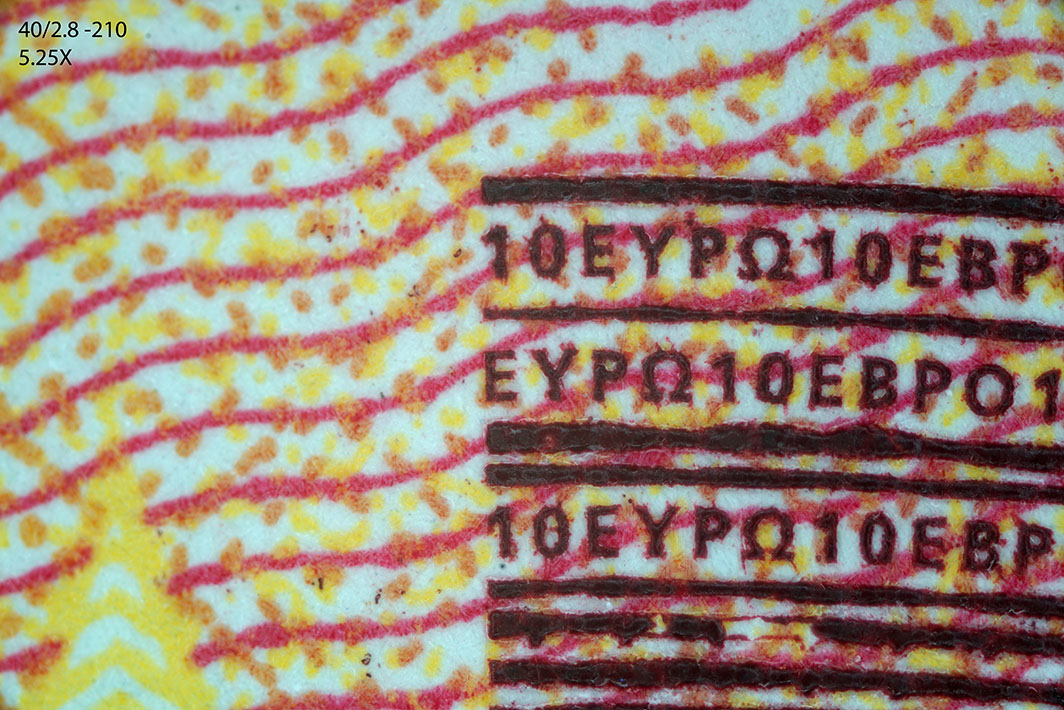
40mm plus 210mm effective F stop 29.4
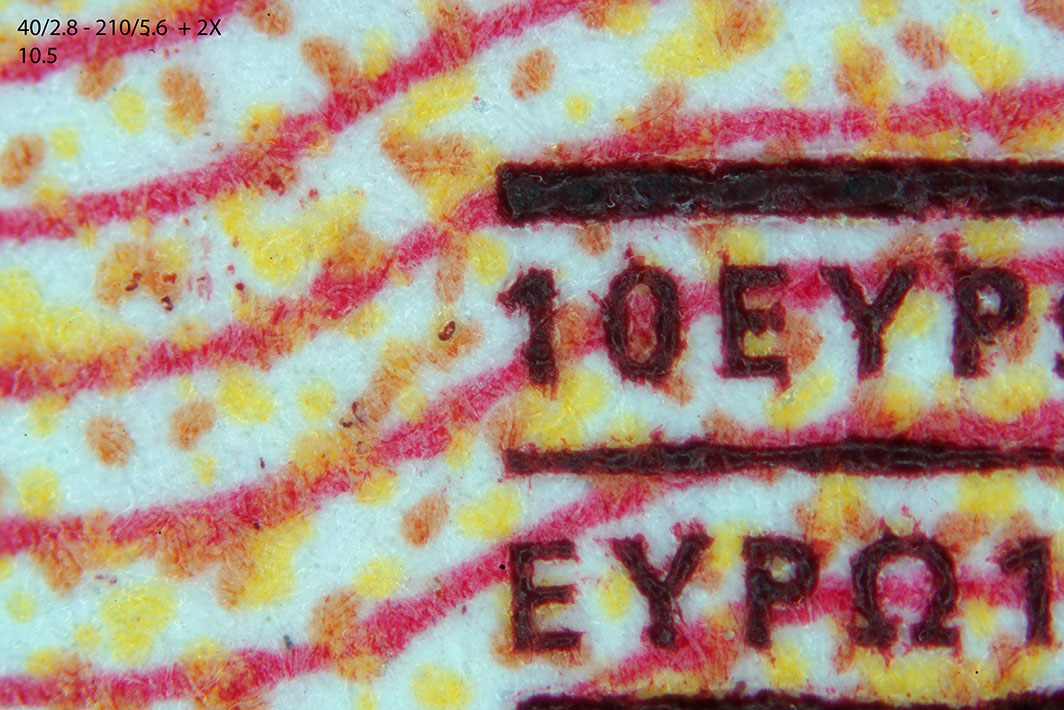
I don't know how these series of shots look to someone who hasn't seen this technique before. I suspect to some they look impressive, certainly I was really impressed and quite excited about the effectiveness of the technique. It may have been the influence of the fun I was having that made me enthusiastic about the technique but, then I got around to making comparisons with just extension:
The SK 40mm lens is a good performer, it is designed( when reversed) to produce high resolution images. My version is the enlarger lens body but it is still being produced now ( same design) as a Machine vision lens ( slightly different body). To get it to 10X ( some times higher) I have had to combine two bellows. In the past this has not been overly satisfactory as I used a 250 mm Swiss Arca standard rail to connect the two bellows .. the 250mm was only enough too use a single mounting screw for each bellows. Recently I obtained a 300mm rail. This has resulted in a much more secure reliable means of connecting the two bellows, as I can now secure each bellows with two mounting screws. As can be seen below( both pictures show the double bellows combination with the camera adapter and reversed 40mm attached:
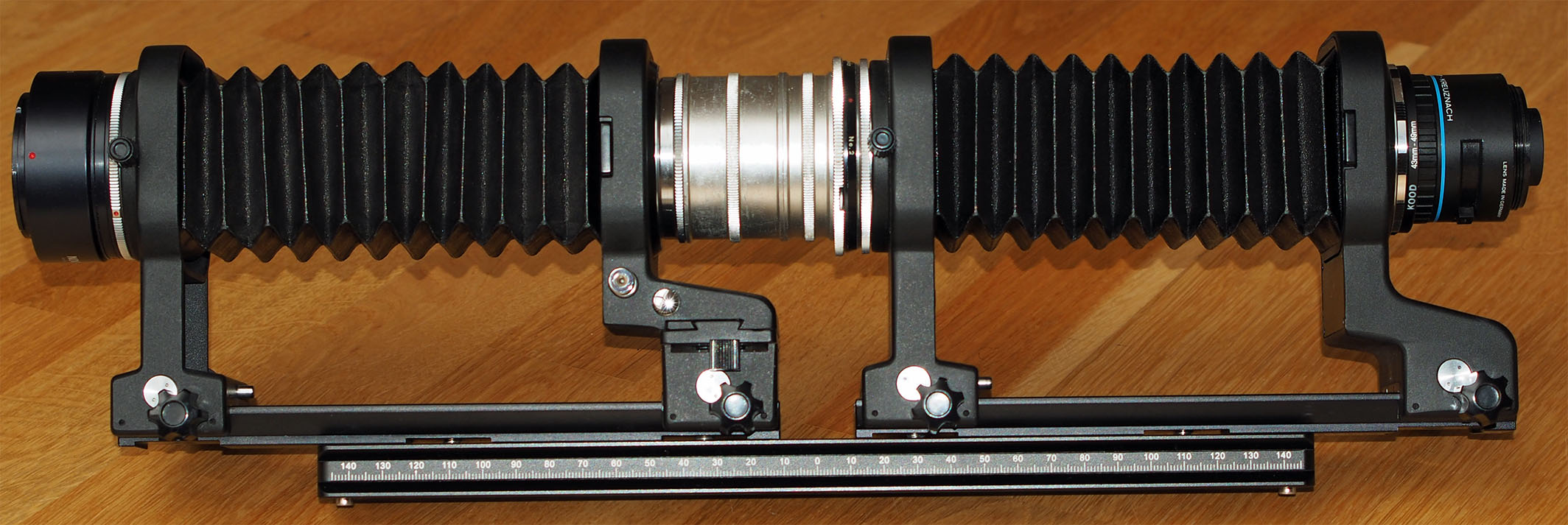
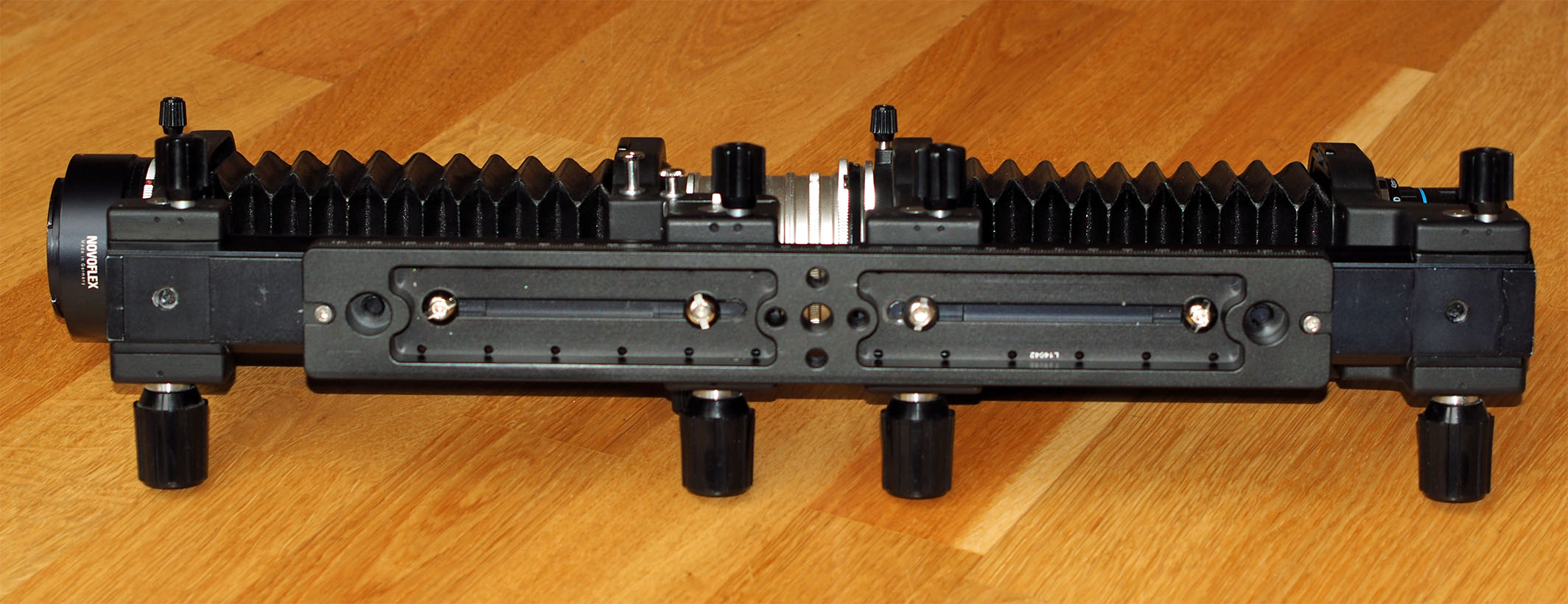
This is the result I achieved with this extension as I have experienced previously it looks much better than using lens coupling combined with a convertor:
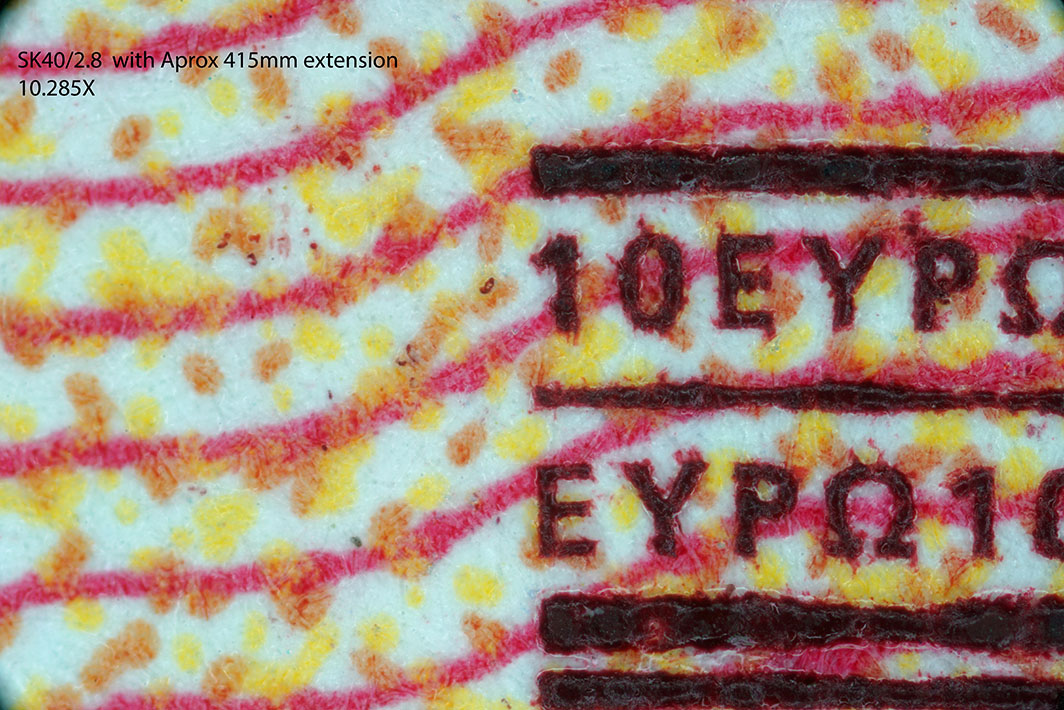
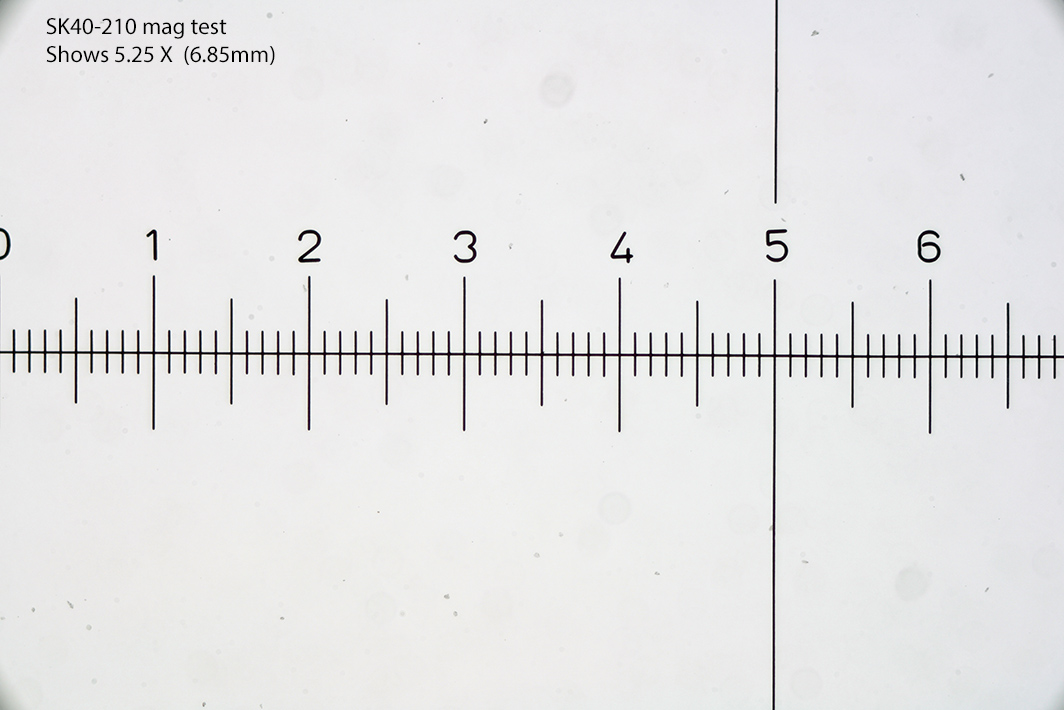
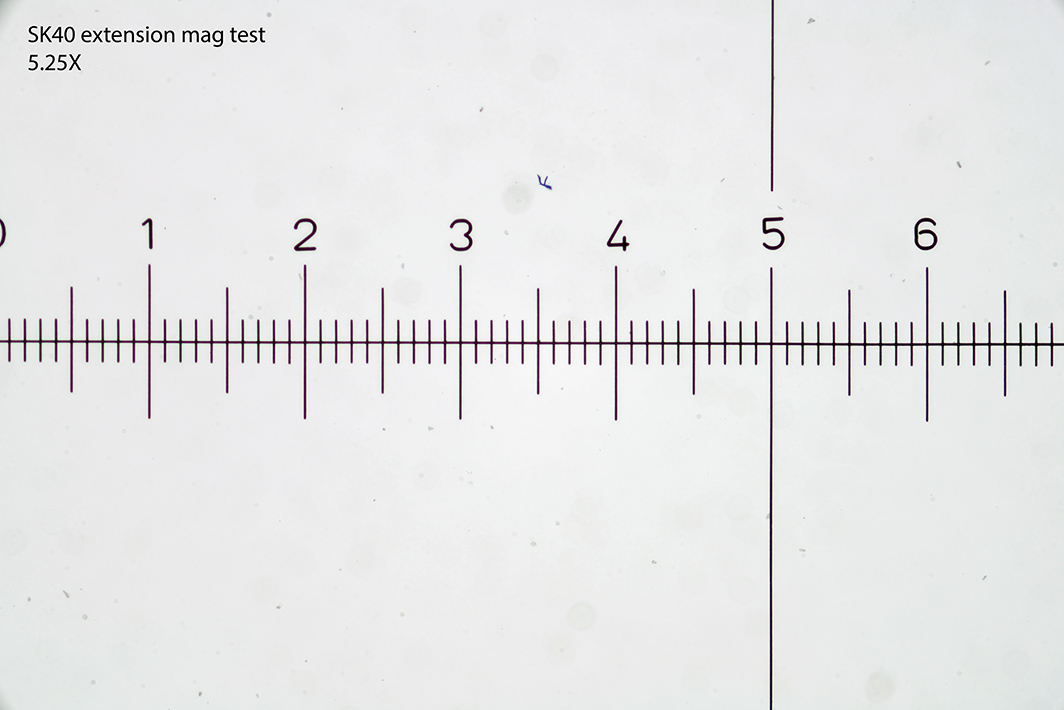
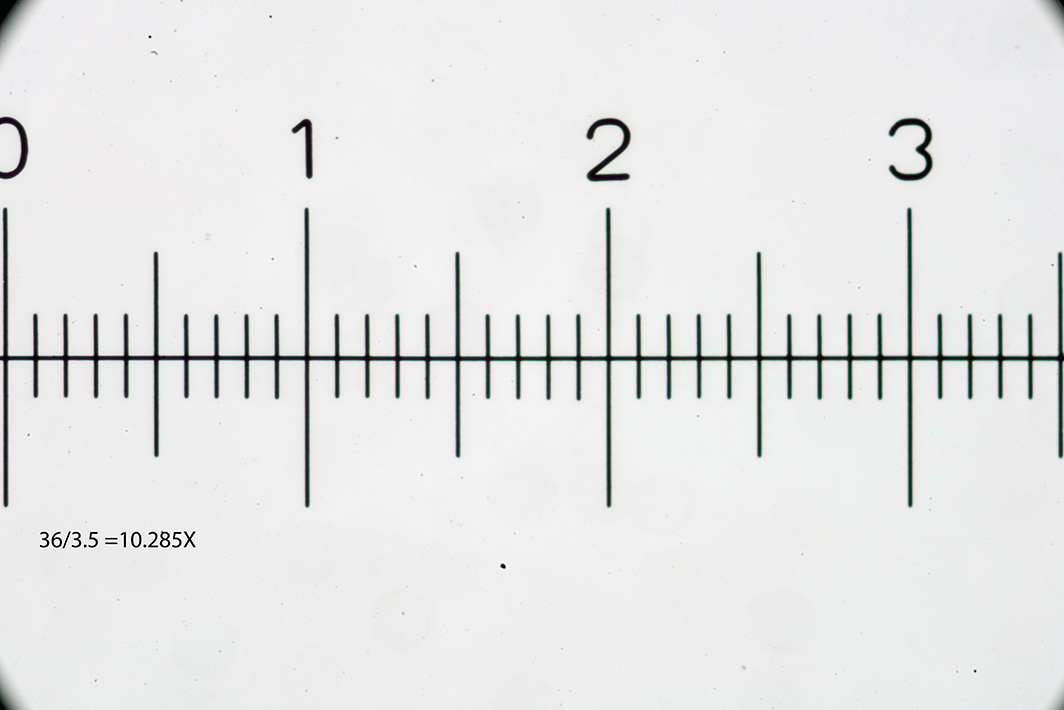
I calculated the magnification by simply photographing a Microscope calibration slide:
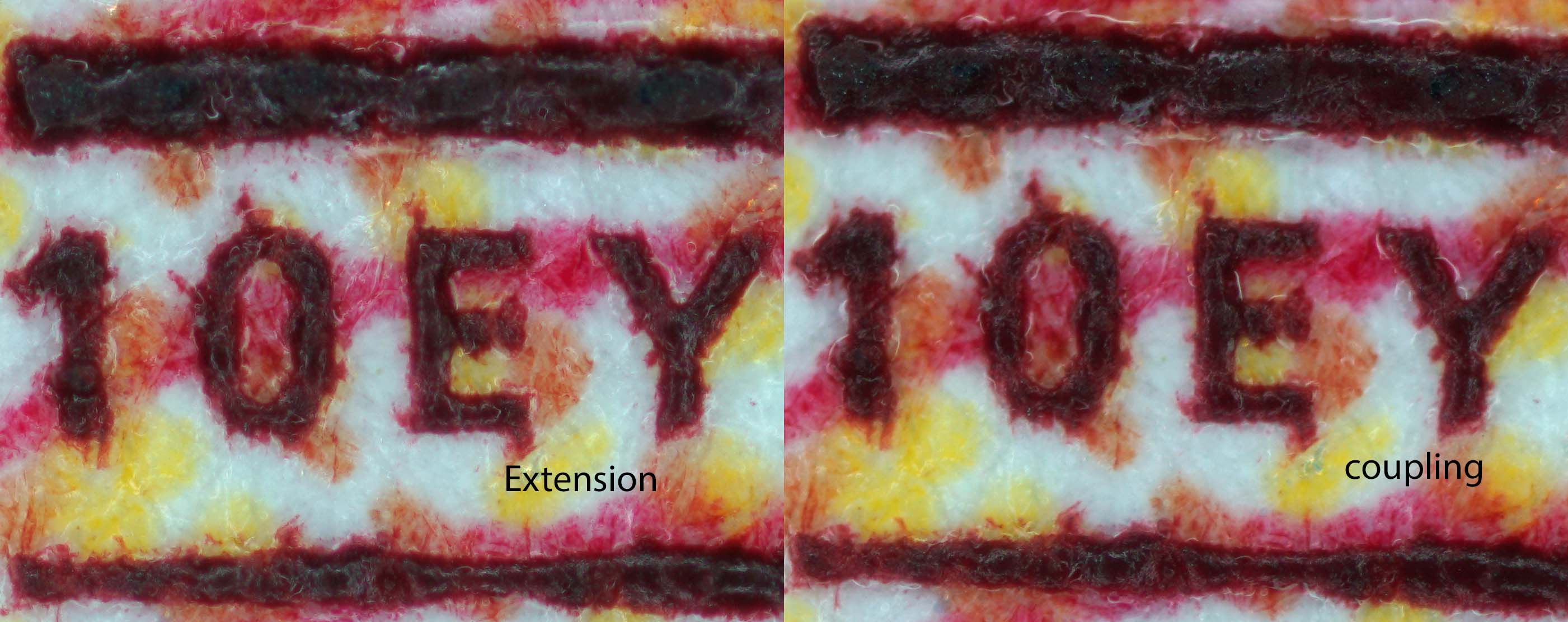
It may be hard to see the difference in IQ between extension and coupling. So here is a simple comparison shot. I cropped a section out of the image created using the 40mm coupled with the Minolta 200 mm and convertor( this was not a 100 % crop) I then cropped the same area from the extension photo. I then pasted them together.... and then I applied the reduction for posting here:
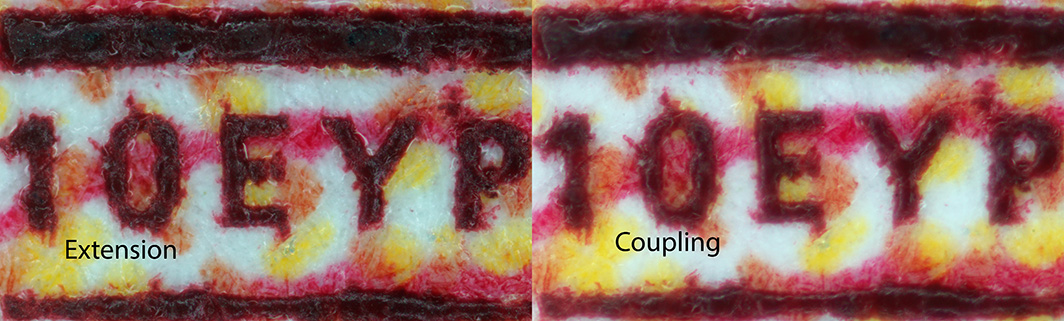
( note I found the same result at all magnification levels Extension was producing better IQ) For the above comparison I used the 40-200 coupling picture. This was because the teleconvertor was designed to fit that particular lens and in theory the IQ should be as good as it possibly could be. I had found that the SK 210 covered the FF sensor better but it suffered from flaring in the center of the lens
The theory states the lens coupling should produce the better results( I base this statement on the reduced diffraction). My experience has been that extension is better than coupling. I believe the fact the lens coupling hasn't matched the theory is due to optical design issues. I am assuming the combinations I used introduced image degradation. Given my experience I suspect that it is hard to find lenses that are perfectly matched.
I had a lot of fun trying the different lenses out. All I have confirmed is that Extension ( using bellows in this case) is the better option for me to produce high magnification shots, probably because there is a lot less to go wrong.










 Posted 12/01/2016 4:18 pm