| Author |
 Replies: 12 / Views: 1,657 Replies: 12 / Views: 1,657 |
|
|
Pillar of the Community
Canada
1632 Posts |
My guess is: 1. Delamination. But I cant explain the perfect arc that looks like it was struck with another planchet or part of a die cap on top of it. 2. Strike through. But I cant explain why the area of the reverse where 'Canada' appears to be untouched. I have seen another coin on CCF, which is/was Smallcentguy's http://goccf.com/t/76634&whichpage=15Weight of my coin is 3.2 g; normal weight is 3.24 g. Thoughts? 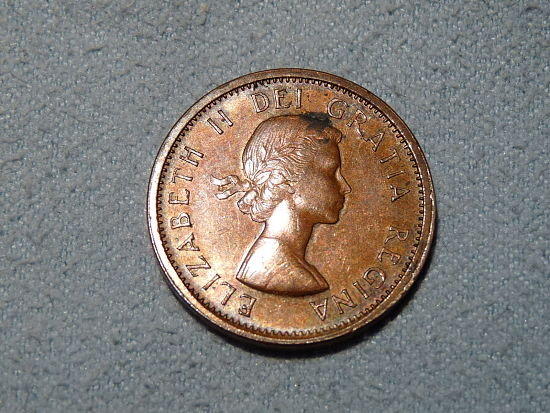 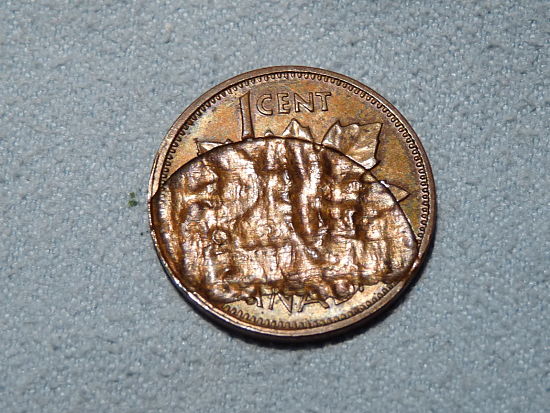 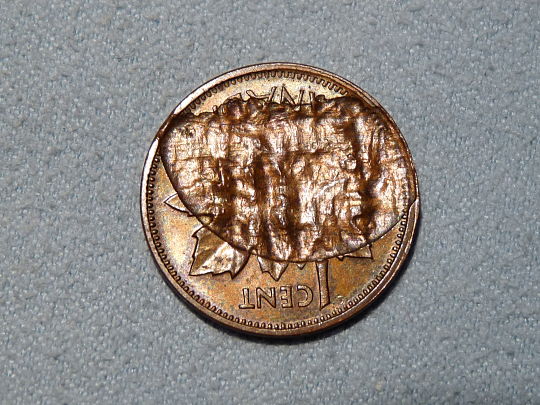 |
|
|
|
Valued Member
Canada
458 Posts |
not sure what to say but looks like a error from the mint
|
|
Pillar of the Community
 Canada
2361 Posts |
Partial clip with lamination.
|
|
Pillar of the Community
Canada
1463 Posts |
|
|
Pillar of the Community
Canada
9902 Posts |
Struck through a fragment?
"Dipping" is not considered cleaning...
-from PCGS website
|
|
Pillar of the Community
Canada
5644 Posts |
I agree with DBM .. struck through a lamination flake from another coin. Is the area raised or incuse?
|
|
Pillar of the Community
Canada
1463 Posts |
That maybe correct, struck throug a peeled fragment.
I suppose a partial clip would have the same groove on both sides.
so it's struck through a peeled fragment giving it the effect of a lamination peel on the coin?
|
|
Pillar of the Community
Canada
2361 Posts |
Quote:
I suppose a partial clip would have the same groove on both sides. Never thought of that, good reasoning. |
|
Pillar of the Community
 Canada
1632 Posts |
Okiecoiner - if you are referring to the area that has been struck-through, it is raised.
|
|
Pillar of the Community
Canada
872 Posts |
Ha ha! I bid on that one! Fairly aggressively too. good score!
I am leaning towards it being struck through a coin fragment.
|
|
Moderator
 Canada
10473 Posts |
If the weight is right on - then it is struck through a split partial planchet fragment. I have a couple examples like it - the texture inside the struck region is exactly like those seen in split planchets, but the split planchet is thin enough to allow the flow of metal to partially show through with the hammer die strike. Lamination peels have different textures under the peel, you would be able to read the date, and the edge is very ragged, see here: http://www.PCGS.com/cert/12282172http://www.PCGS.com/cert/12282173If you could ever find the other fragment, now that would be cool (and you would know the date)!! "Discovery follows discovery, each both raising and answering questions, each ending a long search, and each providing the new instruments for a new search." -- J. Robert OppenheimerContent of this post is licensed under a Creative Commons Attribution-NonCommercial 3.0 Unported License. See: http://creativecommons.org/licenses...0/deed.en_USMy eBay store
|
|
Pillar of the Community
Canada
695 Posts |
I'd like to think is it's struck through a disintegrated die cap fragment - just because that's cooler than struck through a laminated fragment from a previously struck coin.
|
|
Moderator
Canada
10473 Posts |
Except, we would see an orange-peel texture inside the strike through, and not the striated pattern... imagine this sitting face down on the planchet, before the strike.  "Discovery follows discovery, each both raising and answering questions, each ending a long search, and each providing the new instruments for a new search." -- J. Robert OppenheimerContent of this post is licensed under a Creative Commons Attribution-NonCommercial 3.0 Unported License. See: http://creativecommons.org/licenses...0/deed.en_USMy eBay store
|
| |
Replies: 12 / Views: 1,657 |
|







 Posted 12/05/2016 10:28 pm





