| Author |
 Replies: 11 / Views: 4,510 Replies: 11 / Views: 4,510 |
|
|
New Member
Denmark
40 Posts |
Sometimes interesting discoveries can be found in one's own collection. I've had this poor corroded example of a contemporary circulating counterfeit of a 1812 Bank of England 3 shilling for a while without realizing how important it was. 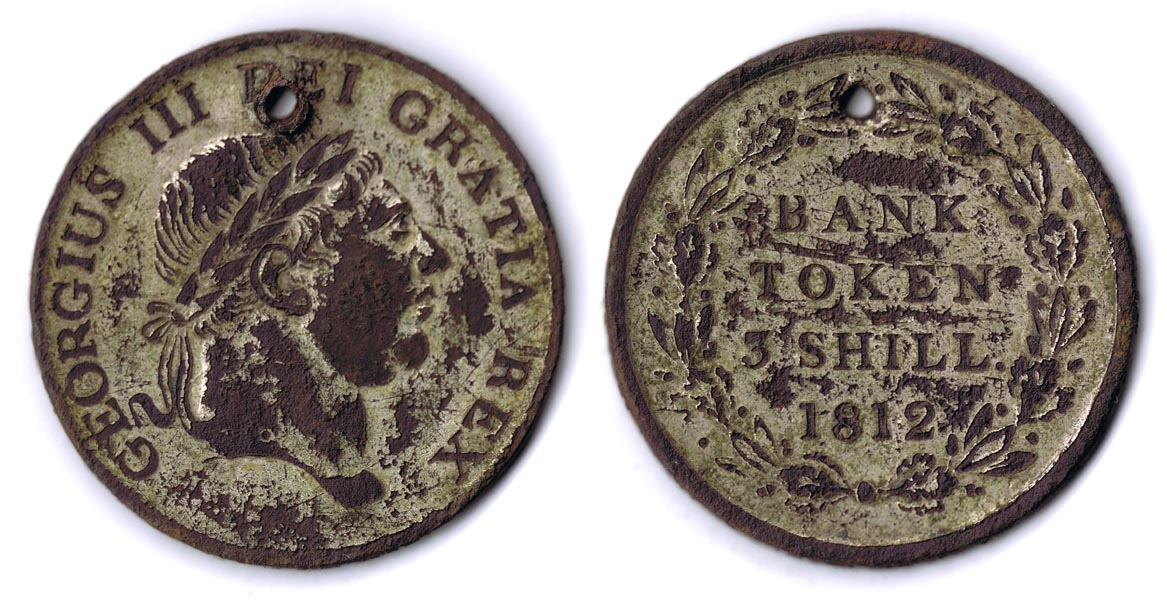 At first it's just a scarce variation of a very common counterfeit of which I've seen 23 examples. This one however has a different reverse and is the only one of its kind that I've noticed so far. Lately I've been going through my milled counterfeit 3 shillings (1811-1816) in order to make a better classification of the various types; and it was here I discovered that the reverse used for this particular counterfeit is not an engraved imitation, but of the exact same design as on a genuine coin! That leaves two possible explanations for the production of the counterfeit. Either the coin is a cast accidently using a counterfeit coin as host for the obverse - Or, the coin is struck using some sort of transfer die for the reverse. Unfortunately the condition of the coin makes it difficult to look for the usual signs of casting. The weight is 13.3 gr while the related counterfeits weights from 12.8 to 15.5 gr with an average weight of 14.2 (a genuine coin is 15.2 gr). - The diameter is 34.9 mm which is clearly smaller than the related counterfeit which measures between 35.1 and 35.4 mm. However both the relatively low weight and smaller diameter can be explained as a result of the corrosion. The reverse design is slightly smaller than for a genuine coin which at first would point to the counterfeit being cast. However if a transfer die is produced involving a casting process the result may likely have be the same - even if the die was made by a direct contact transfer fx.to a heated iron cylinder I suspect some reduction of size when the die is cooled? The obverse however is of exact same size as the counterfeit design. Had the coin been a cast one would expect that both obverse and reverse would have reduced designs. All in all I'm inclined to believe that the reverse was produced using a transfer method, but hope that a better example of this counterfeit will show up and perhaps clear all doubt.  (Top coin is the common counterfeit which shares obverse with the counterfeit in discussion. Bottom coin is a genuine bank token). Edited by seuk
01/05/2017 3:40 pm
|
|
|
|
Pillar of the Community
United States
1764 Posts |
This counterfeit type is in my new book coming out. Most are of a mercuric silver amalgamation type and probably over a high copper host coin.
HOWEVER - let me ask since the dies MATCH regal dies EXACTLY - do these types come in gold Proofs. Could it be an impaired Proof issue as this coloration mimics one in my collection of another type which is confirmed as being issued as gold proofs?
Too lazy to check KM.
John Lorenzo
Numismatist
United States
Edited by colonialjohn
01/05/2017 7:11 pm
|
|
New Member
 Denmark
40 Posts |
Gold proofs exist (BT46 in R.J. Marles: Collectors George III coins). However the die only match the regal design - not the size as it's slightly smaller. 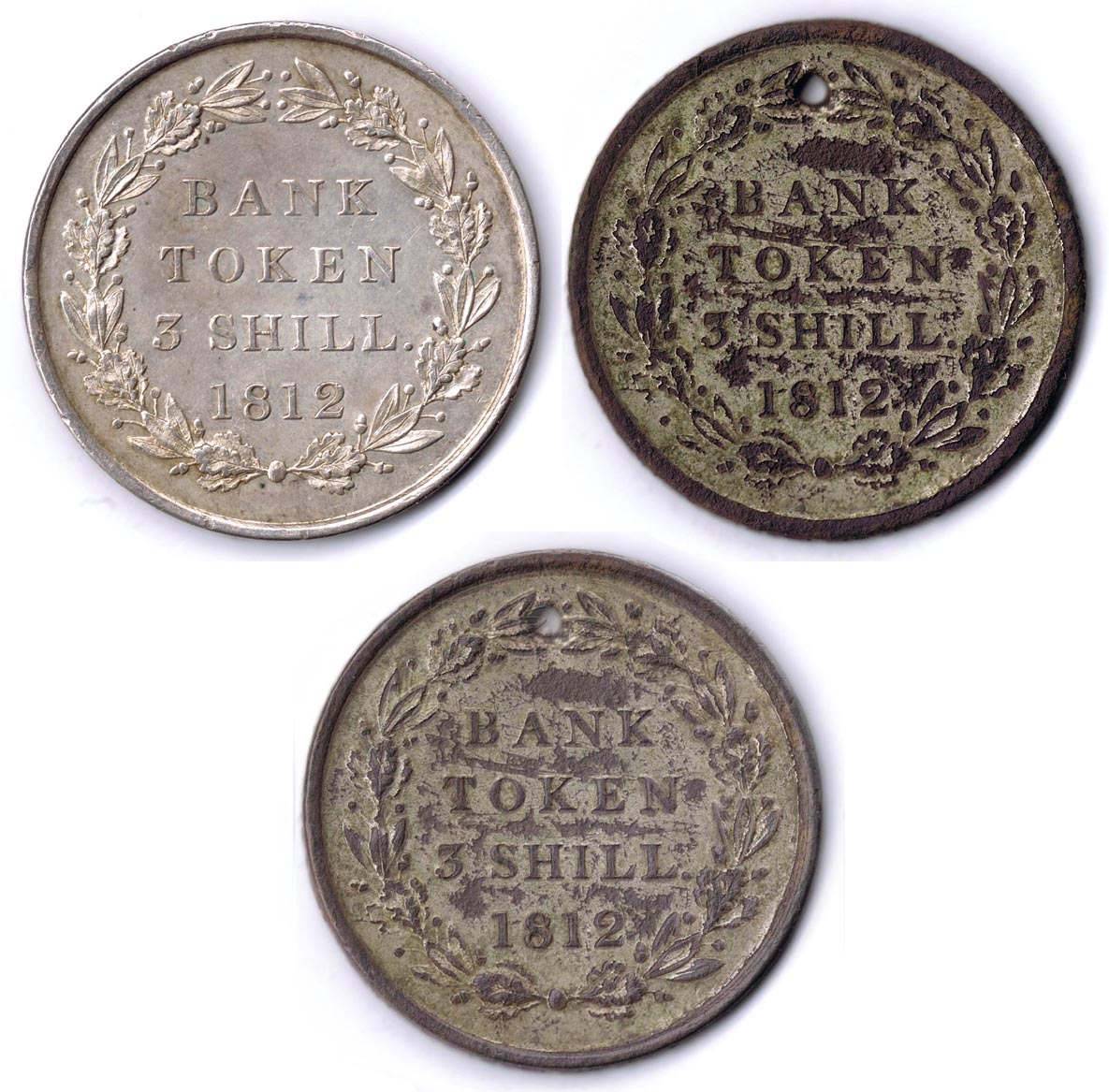 Here's reverses of a genuine and the counterfeit side by side and as an overlay below - I've 'ankered' the overlay at a SW-position so the diffrence in size shows more clearly as one moves up and to the right of the overlay. |
|
Pillar of the Community
United States
1764 Posts |
Its probably then a silver mercuric amalgamated wash (i.e., or brush on) (not plated) over a high copper substrate. Why the dies match exactly to a regal - perhaps they were discarded or stolen out of the mint. It happens ... but this is the first I have read - but due - as you say to the commonness of this particular counterfeit type I have never done a study if other regal dies have been used to create this form of contemporary circulating counterfeit of the period. No way - 100% certain that this fabric or this scenario even suggest a modern forgery type. IMO.
JPL
|
|
New Member
Denmark
40 Posts |
The bank tokens didn't circulate after 1818 and probably no counterfeits for circulation were made later than 1817 since the recoinage entered circulation this year. So I guess this particular counterfeit were made at some point during 1812-1817.
There's quite a few mysteries regarding the English counterfeits of the period. Fx. Why the silver plating seems to give way for the silver wash round 1811/12? Perhaps it was too expensive or time consuming to apply for the lower denominations? But even William Booths bank dollar is known both plated and silver washed, and he was arrested in 1812(!) - Also I've yet to see an example of a plated counterfeit of the later recoinage crowns.
Regarding the die transfer technique - one should think it would be an easier and even safer way for the coiner to produce the dies. However there may be a possibility that a die created by transfer method were less durable than an engraved die which caused engraved dies to be preferred?
|
|
Pillar of the Community
United States
5362 Posts |
The fact that there was believed to be a "European" die duplication process in existence before 1845 is documented in Riddel's Monograph. So it is apparent that the US mint was unaware of exactly what the process was or who developed it.
It is equally obvious that Riddell believed that the process was used to duplicate the "French" dies of Durango - specifically the dates 1832 and 1834 (Riddell # 365 and 371). That points to a mid 1830s date. By 1839-1844 the city of New Orleans was flooded with these coins.
Few of the counterfeits are cast, so I do not believe they did it using a casting process. Many cast counterfeits were made but they are easily distinguished by looking at very fine details.
What that process was exactly is more difficult to pin down. I found several references involving M. Boulton and his Soho operation. Boulton was, as early as the 1790s, looking for a way to duplicate objects like etchings without involving an engraver. I believe that Boulton's process was employed before 1820 to make many of the UK token counterfeits. It is also apparent that the milled issues of the UK mint were copied in similar ways before 1820. The process was developed BEFORE electro-typing or spark erosion came into existence. This is based on patent applications I have read which fix most electro-galvanic processes well into the 1840-43 time frame.
I have also noted that the French colony of Haiti was also deluged with high quality counterfeit issues (copper with a silver plate) as early as the 1820s. These counterfeits are still common and seem to be very close copies of the originals.
Boulton was in communication with the French mint and his contacts with their engineers may have resulted in the spread of information in both directions. The French and Boulton both worked on collars and planchet insertion by mechanical apparatus as well. I have not located definitive proof of which country developed the technology first or who learned from who but England (specifically Boulton) and the French are the prime suspects for development of all these techniques.
Just simply reviewing the coinage of France and England from the 1790s to the 1820s demonstrates the progress of minting technology. The other nations tended to lag behind.
|
|
New Member
Denmark
40 Posts |
Most of the British counterfeits of George IIIs time are milled using engraved dies. There are however a few exceptions from that. The recoinage crowns (1818-20) I've not seen milled. Counterfeits are common but all appears to be tin casts and I would suspect them to be to be of a later date as similar cast coins seems to be much more common in the Victorian period. Also the Irish 1808 30d appears to be more common as cast counterfeit than milled, but I've not done much research on these. Then there's the 1804 Bank of England dollar - I've seen two types of engraved dies: One pair of an unknown engraver and two obverse dies combined with 4 reverse dies, all most likely engrave by Benjamin Patrick (One of these die pairs were used by the known coiner William Booth). At first there seems to be a number of fairly common cast coins also, but I beginning to wonder if some of these could have been produced by a die transfer method? 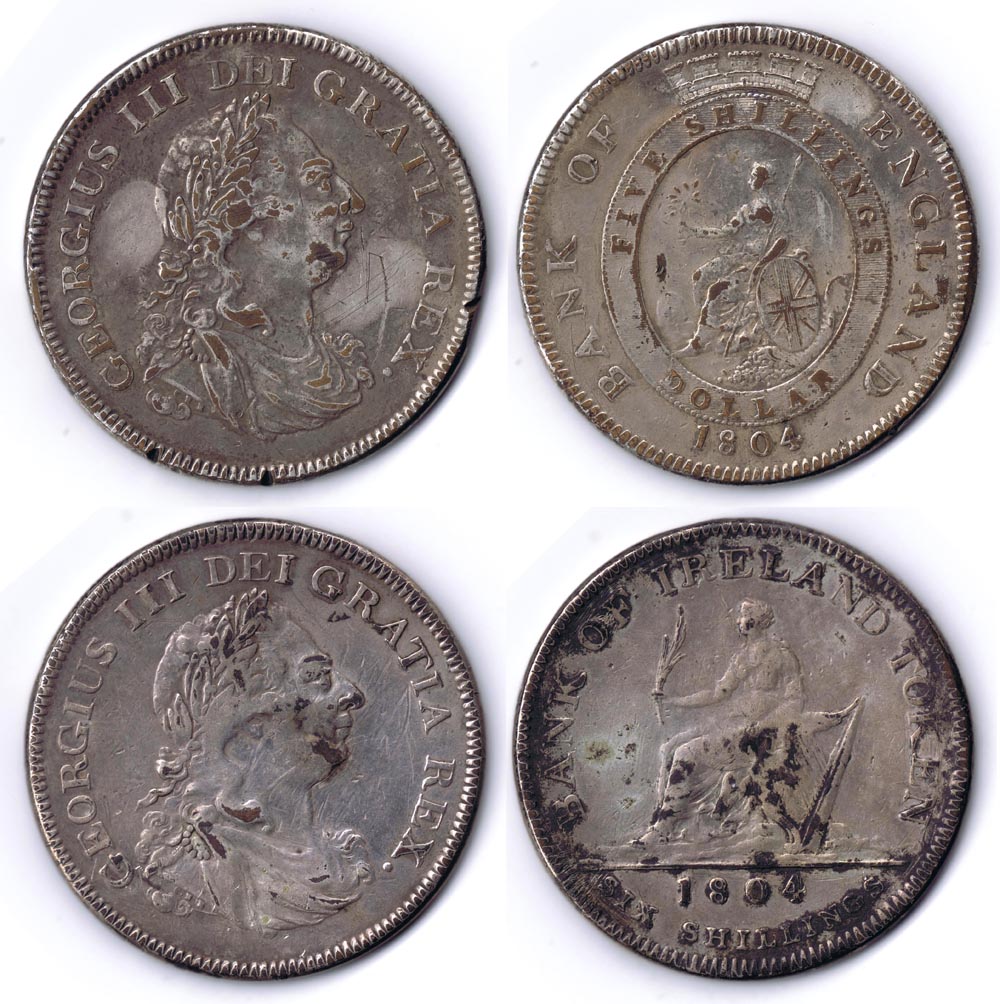 This BoE dollar and Irish 6 shilling are produced from the same obverse 'die' and are quite interesting, I think, since the dies used are obverse D and reverse 2a (inverted K) for the bank dollar. The genuine coin dies are believed to have been used for proofs only and not for circulating coins. The genuine dies were 42 mm and these counterfeits are only 41 mm. The smaller dies and the typical lack of finer details shows a casting process was involved in the process, though I not sure whether that was for the making the counterfeits, or for creating a hub for counterfeit dies? Edited by seuk
01/12/2017 2:59 pm
|
|
Pillar of the Community
United States
5362 Posts |
Loss of fine details in the transfer process is also seen in the creation of molds or dies by electro-typing.
I also wonder if a simple 1-1 Janvier type lathe could not have been used to replicate dies? Many of Boulton's inventions were mechanical by nature and were based on the earliest usage of modern measurement standards. A lathe system seems to be a technology that would be natural to Boulton while casting simply does not.
|
|
New Member
Denmark
40 Posts |
Think I got it... On the BoE dollar there's visible metal overflow on the obverse between OR and S I of GEORGIUS III indicating its struck using a collar. 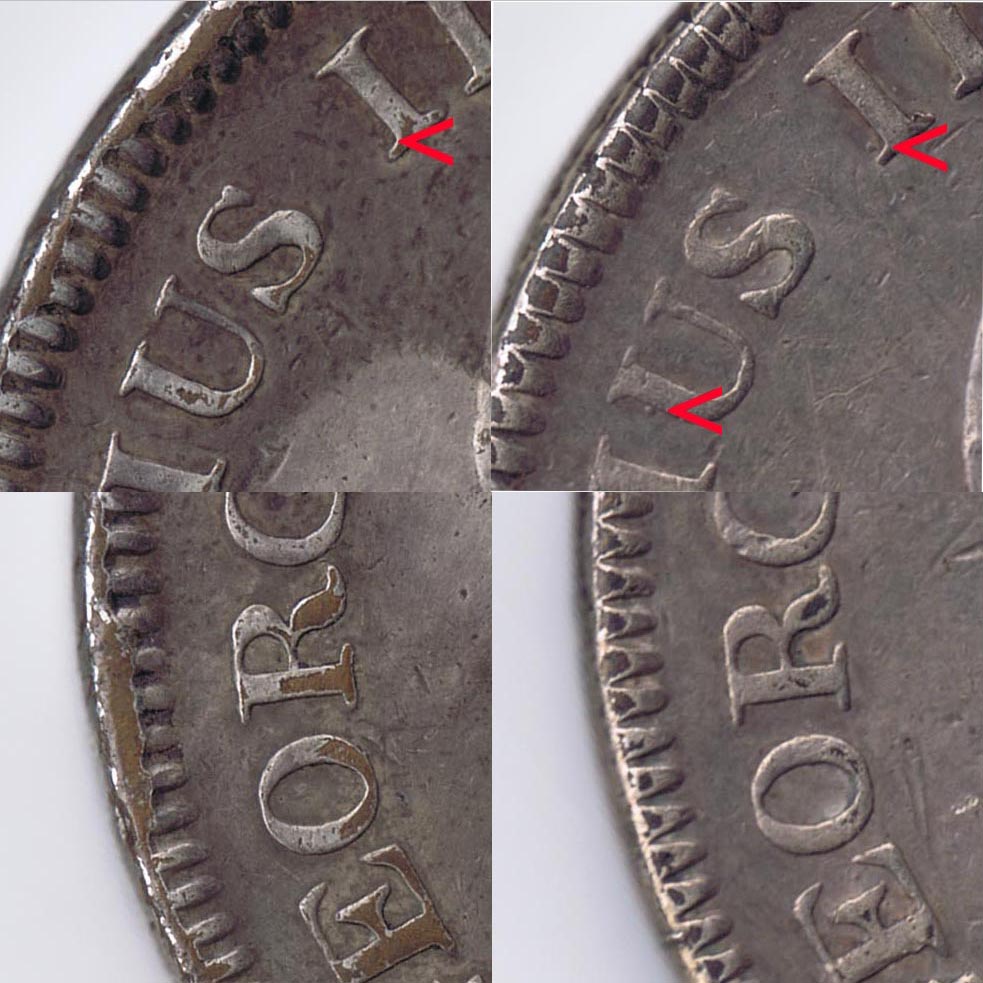 Die flaws - two small dots to the left of "U" and 1st "I" of GEORGIUS III. The dot at "U" is not visible on the BoE dollar in question but is found on other examples of this counterfeit. 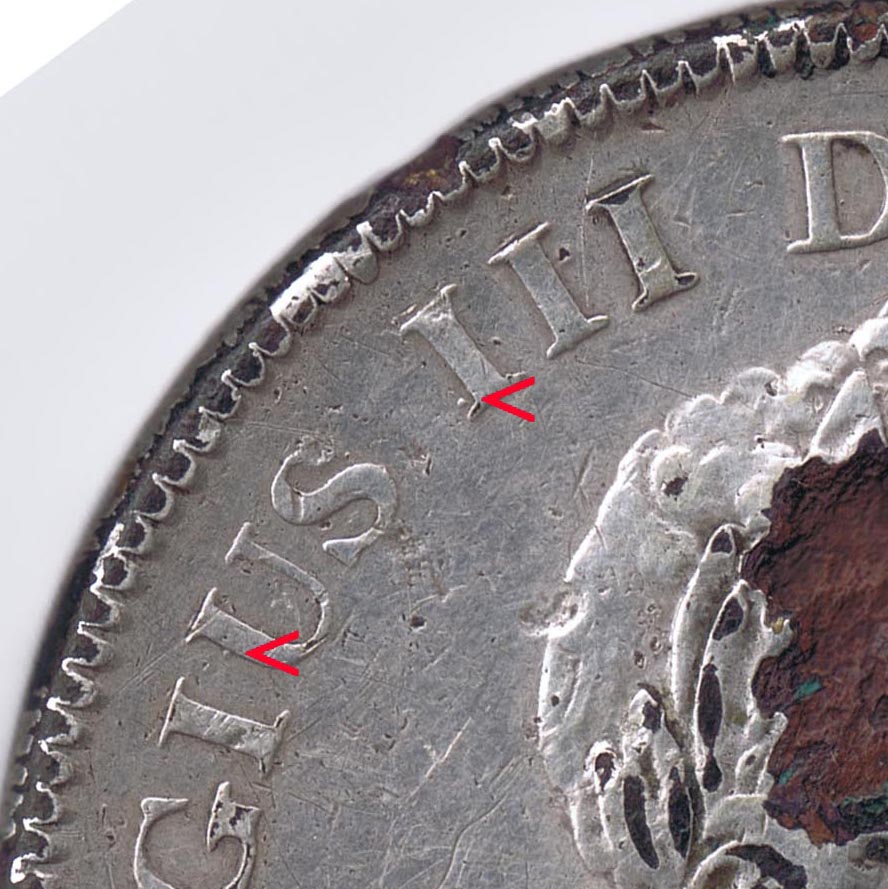 Edited by seuk
01/12/2017 5:39 pm
|
|
Pillar of the Community
United States
1764 Posts |
OK - you twisted my arm - here is coin #70 from my new book due out soon in about 4-5 months from the chapter on Foreign Counterfeits of 1500-1800. I do go a little later with some pieces but this is the title of the chapter. These were probably struck in copper and then as you say either silver washed or silver plated. In terms of what type of silver plating. In my book I try to show examples of silver foil - to crude Sheffield types - to Sheffield Birmingham types to eventually silver electrodeposition after 1840. Coin #70 is a Three Shilling Bank Token of these types which IMO is more rare than the two types you picture which are seen quite often in ebay UK. To me these are copper struck then silver plated as in specimen #70 the surface appears treated with mercury or used in the manufacturing process. With silver wash its mixed in with silver - spread on the copper substrate (i.e., coin's surface) then fired off (annealed) always leaving some detectable Hg level on the surface picked up with XRF analysis. Sorry no picture here but there is great photos in my new book. Be patient. Specimen # 70 1815 Great Britain 3 Shilling Bank Token Trace Mercury Silver Plate over a Low Zinc Brass Alloy Host Country: Great Britain. 1815. KM# Tn 5; S.3770; ESC-423 Type. 35.15 mm. 10.5 grams. Medal Turn Die Axis. Regal issues struck in silver at 92.5%. Obverse: George III Laureate Head facing right. Reverse: Legend within wreath. Issued by the Bank of England. XRF Analysis of Surface: Copper (74.83%), Zinc (5.82%), Silver (2.51%), Mercury (0.61%), Arsenic (0.58%), Tungsten (0.14%), Antimony (0.12%), Nickel (0.08%) and Bismuth (0.06%). Mercuric silver plate similar to Sheffield plate over a high copper/low zinc brass alloy type. Sometimes mercury is used to prepare the planchet for better silver plate adhesion and not just as a mixture aid for better silver spread. Provenance: Great Britain Coin Show in 2012. Notes: As any collector of these issues can tell you these tokens were counterfeited seriously in great quantities. The principal reason behind these issues for the Bank of England Dollar Tokens and other tokens was the inability of The Royal Mint to pay the market price for silver to create regal silver coins. Not a desirable William Booth product who has been considered by some to be the principal forger of the Bank of England Dollars of 1804 (KM#Tn 1) as he died in August 1812. He was suspected of counterfeiting all denominations of Bank of England tokens and was without a doubt the most prolific forger of the Regency Era. Some of these coins were found on his premises in Victorian times and are now in a local museum. In July 1811, the Government announced that counterfeits of the Three Shilling Bank Token were in circulation. The appearance is whiter and they sound very dull when rung. They are of copper, thinly plated and worth about a penny. On the whole they are executed nearly as well as those issued by the Bank, and it is much to be lamented that the execution of the Bank Token has admit¬ted of so early and easy a counterfeit. Persons to whom they are offered will do a public service by endeavoring to trace the quarter from whence they first came into circulation. Public exasperation at the continuing shortage of silver coins had by that time pushed many provincial banks and not a few factory owners into issuing their own private silver tokens. Specimens of this caliber are worthy of any counterfeit collection. The student should realize the more silvering obviously the more desirable a counterfeit is of this bi-layer type (i.e., silver plate over a low zinc brass alloy). Edited by colonialjohn
01/12/2017 9:19 pm
|
|
New Member
Denmark
40 Posts |
I'm looking forward to your book!  My main focus lies with the die study - trying to order the counterfeits into groups by separating the different engravers; perhaps even identifying these. The die transfer process leaves little room for that, though it may at some point be possible to associate some of the known coiners with that process, while not with any specific product. Fx. I'm wondering if William Henshall used a die transfer process for his BoE counterfeits? Lane & Fleig mentions that he made his own dies so it seems a likely possibility. http://www.numismatics.org.au/pdfjo...icle%201.pdf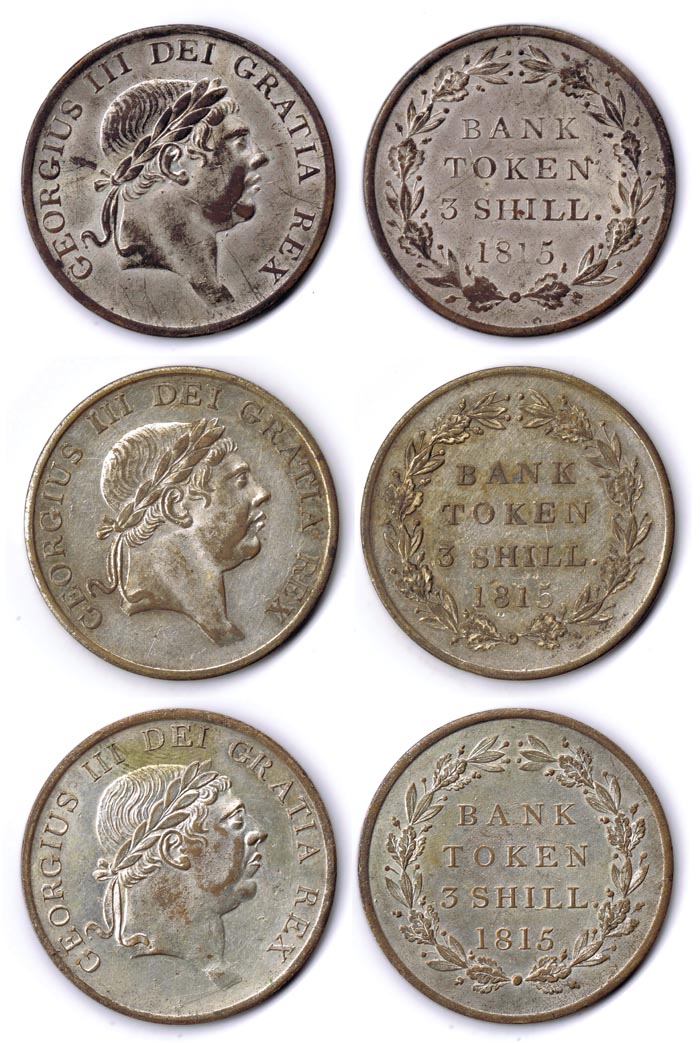 For the 1815 3 shilling I've seen a total of 57 counterfeits spread over 12 variations using 11 different obverses and 11 reverses. Not sure of any silver plating though. - These 3 are my best examples and appears to be silver washed. |
|
Pillar of the Community
United States
1764 Posts |
Seuk - will take another look but mine shows? surface peeling (from memory?) unlike your three OBVIOUS silver wash examples above - but my example is such high grade and has no wear points it may have fooled me due to its near Mint State perfection? BTW - great article. If I had this article I would have included a BOE but based on your research sounds like a BNJ article is in order or something similar based on your die counts! <BG>.
JPL
Edited by colonialjohn
01/16/2017 1:01 pm
|
| |
Replies: 11 / Views: 4,510 |
|










 Posted 01/06/2017 04:05 am


