| Author |
 Replies: 26 / Views: 4,536 Replies: 26 / Views: 4,536 |
|
|
|
Pillar of the Community
United States
4870 Posts |
Nice! It really shows the bag marks quite well!
|
|
Valued Member
United States
328 Posts |
|
|
Pillar of the Community
United States
6326 Posts |
Very commendable at your dedication to the exacting science of coin photography Prethen........
Since you're light years ahead of a lot of people here in that department probably already....well....just anxious to see future photo's !!
Nds76.....
Too funny !......yeah they do show up well ! .....looks like there's even a good "thunk" mark on the rim too!
|
|
Pillar of the Community
United States
4870 Posts |
Ohhh I just couldn't help myself!   |
|
Pillar of the Community
 United States
3234 Posts |
I'm a big proponent for a good scanner myself as I just got a new Canon scanner that can even do slabs pretty well. However, those are best for circulated coins and showing detail on uncirculated/Proof material.
|
|
Moderator
 United States
23522 Posts |
quote:
I only like the cheap 50mm lenses cause at 1.8 they are so much wider than the average 150mm which tends to be in the f4.0 range. I like the idea of relying more on available light than man-made light because of a coin's tendancy to reflect.
Light control is critical for proper coin shots; since they're static and you're triggering the shutter remotely anyways, longer exposures aren't as much a problem as you might think. Depth of field is problematic, though. Even if you're perfectly square to the coin, DoF with the 100mm Macro dictates apertures tighter than f/5.6 anyways, and I find myself starting at f/8 and tightening from there. I've posted some slightly tilted stuff here which was shot in the f/22 range. Even at that aperture, with the 100w of halogen light I'm using, exposures are still at or faster than 1/100. My "average" coin shot is ISO 400, 1/200 @ f/12. 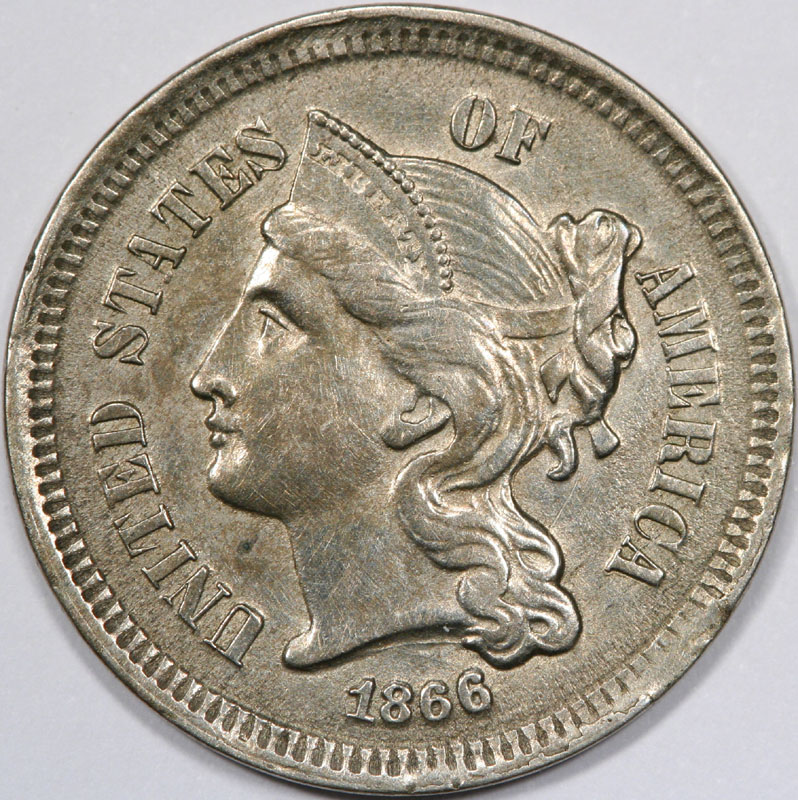 |
|
Pillar of the Community
United States
3234 Posts |
Yes, I definitely have a focus, DOF, problem that I have to learn how to overcome. Thanks for noting what you do, Dave.
|
|
Pillar of the Community
United States
1173 Posts |
Your Tokina is a fine lens...very well reviewed as being tack-sharp and contrasty. Here's a couple of pics with a Nikon 105 f/2.8 macro lens. I'll have to check, but I would guess f/11 for good depth of field. Of course this is a bigger coin than your favorite 3CN's, LOL.   Edited by hunter20ga
03/30/2008 08:30 am
|
|
Pillar of the Community
United States
3234 Posts |
I'll have to experiment with some F/11 shots and get back to you guys.
|
|
Pillar of the Community
United States
1173 Posts |
Hi, Prethen. Below is a handy web site for calculating depth of focus. With a 100 mm lens, at 10 inches and f/11, DOF is calcuated at 0.07 inch, or very close to the thickness of a new quarter. I've included a photo of a micrometer set to 0.07" along with a Lincoln Cent, so everyone can have a good idea of the DOF that we're working with. (If you check, at 105 mm, DOF shrinks to 0.06"...the lesson being that the longer the lens, the smaller the DOF. Also, if you focus at closer distances, DOF shrinks again. Change f/stops and DOF changes again...larger numbers will increase DOF, but increase exposure time; smaller numbers...say f/5.6 will decrease DOF and exposure time.) One caveat...different cameras have different sized sensors, so a 100 mm lens on a dSLR yields the same "magnification" as a 150 mm lens on a 35 mm SLR film camera. Use the drop down menu to select your camera. A second caveat...most lens manufacturers determine and advertise closest point of focus for a lens as the distance from the object to the senser, not from the object to the front of the lens. I'm assuming the website below has the same basis. (I added the Nikon lens cap just because SuperDave, who takes super pics, uses a Canon. LOL) http://www.dofmaster.com/dofjs.html Edited by hunter20ga
03/30/2008 1:43 pm
|
|
Pillar of the Community
United States
3234 Posts |
Most excellent information, Hunter!
|
| |
Replies: 26 / Views: 4,536 |







 First Page


 Posted 03/28/2008 1:26 pm


 Nice job nds76.



