| Author |
 Replies: 12 / Views: 3,443 Replies: 12 / Views: 3,443 |
|
|
Valued Member
United States
54 Posts |
I know very little about collecting currency, particularly older international notes. I have a small stack that came from a variety of yard sales and such from 30+ years ago. I won't flood the forum with them, but I wanted to toss a couple out to see if they have value or are just kind of neat. 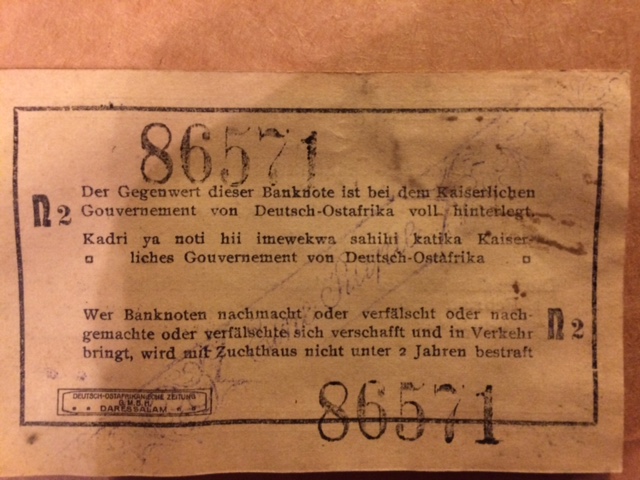 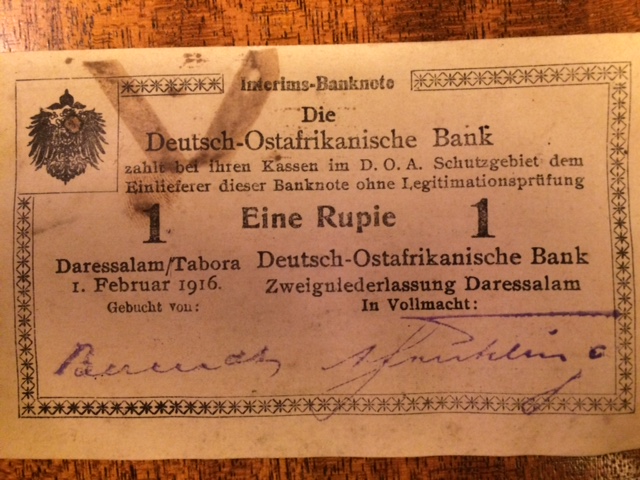 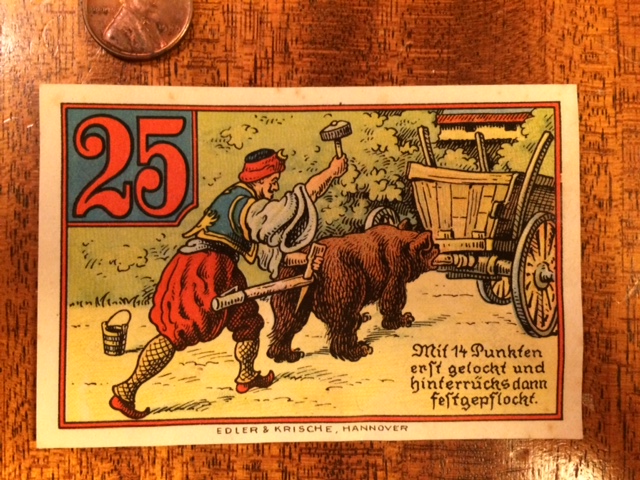 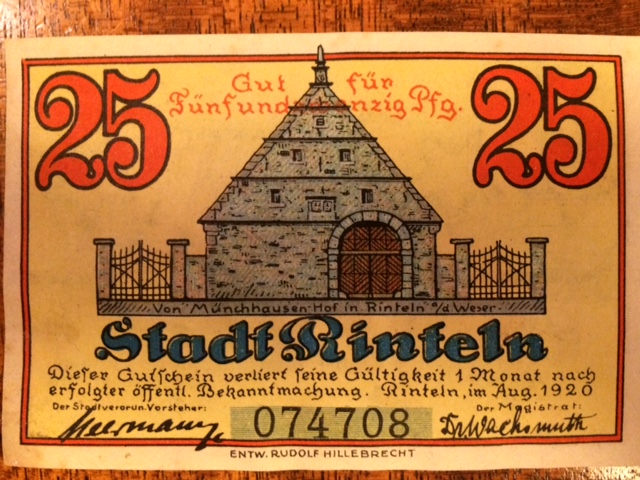 |
|
|
|
Rest in Peace
10197 Posts |
They're German East African notes, as colony of Germany back in 1916. That I can read off the notes, other than that...? "Deutsch" =German , Osterarfika= east Africa (Bank) Never seen before, cool find in garage sale, wonder what value?  |
|
Valued Member
 United States
54 Posts |
I gathered about as much from the first one. And, I'm also curious as to a value and/or what aspects of it might make it valuable.
The second one is odd. I really think that wooden rod runs into the bear's mouth and possibly out his nether region. Vlad the Bear Impaler?
To me, it seems so strange. But it is old, looks official, and the colors are great!
|
|
Valued Member
United States
54 Posts |
I'm gathering confidence that the colorful one is 25 Pfennig. It is certainly related to the bills in the picture/info section of this http://www.banknotes.com/derng.htm. Some of the art on these is absolutely brutal, though. I cannot believe it was used on currency. I've never put a link in a post here before, so we'll see how I did. |
|
Rest in Peace
10197 Posts |
I too am not sure it's legit German currency but direct notes from banks, remember that was WW 1, just prior to lack of currency/coin in the motherland, the precursor to the Notgeld, where individual business or states issued the "money of necessity". The depictions are indeed brutal, the Russian " Bear" maybe? And yes, Vlad did exactly that style of a "hanging" execution for his enemas, I mean enemies! The style of dress is more southern Germany, Bavaria possibly, or further south to Austria/Hungary I believe. Interesting history behind these, wonder what, I'm one who likes the "what's behind it" stories. And yes, "funf und tswanzig = 5+ 20 pfg = Pfennig and IS Notgeld, for something of services for an Inn, most likely beer or lodging in the German state of Rinteln The first is for the East Africa area worth 1 Rupee, an Indian value, Arabian peninsula/African coast. A lot there! Edited by Crazyb0
02/13/2017 12:00 am
|
|
Valued Member
United States
484 Posts |
Yes, the first note is from German East Africa. I do not collect these, but I know some are worth a nice sum ... a good find in a yard sale! The second note is a type of German Notgeld called Serienscheine, or Series notes. These were issued by municipalities and sometimes utility companies, bus and railroads, etc. I have the note above and one of the other in the set. You can find the set for sale here, from a great Notgeld dealer http://www.apcpapercollect.com/l1095rintelna.htm- you really should check there first before you make a purchase as he is usually much cheaper. Notgeld is typically quite inexpensive, but there are some which are exceptions. |
|
Valued Member
Germany
303 Posts |
Catalog reference for the 1 Rupie from German East Africa (Deutsch Ostafrika / abrv. DOA) is one of the rather common issues. Catalog reference is Rosenberg 928h, valued 15 € in unc condition.
However, you could check for any watermark of your banknote as this is the only thing that I couldnt see in the photos. Besides, I checked for any possible varieties (signature, overprint, etc.) but couldn't find anything.
Still it is a nice piece of history from Daressalam.
Edited by Potsdam
02/13/2017 08:55 am
|
|
Valued Member
United States
54 Posts |
Well, the Notgeld dealer sure did have a copy of the same odd note.
The only marking I can see on the older, plain paper one is the stamp that runs from the lower left to the upper right of the front.
I'm guessing that, of these two, I probably have bills that are neat enough to keep, but not valuable enough to sell. No true surprise there!
I do appreciate the help with these. I'm going to do some searching and post others that I either cannot find or suspect could have some value.
|
|
Valued Member
Germany
303 Posts |
You are talking about the blue stamp that says "EINE RUPIE" (One Rupee).
If you watch that banknote with backlight, you should be able to see some sort of watermark. It might be a bit hard to identify the watermarks on these issues because they are not always centered (centered watermarks with 2 recognizable text lines do sell with quite a premium). I've also got one of these notes from Daressalam and I can only make out 5 letters but it's luckily enough to identify the watermark (which is the name of the respective printing house). You can also try to turn around the banknote or try to identify the watermark with the banknote upside down. As I said, they can look very weird on these banknotes.
Here is the list of possible watermarks with respective premium that has to be added to the cat. value according to Rosenberg catalogue:
a) common watermarks: "Drewsen", "Zanders" (+10 €)
b) less common watermarks: "Eichberger", "Hohenofen", "Ebbinghaus", "Alfeld-Gronau" (+20 €)
c) scarce watermarks: "Marggraff", "Poensgen & Heyer", "Schnabelsmühle", "Weissenborn" (+50 €)
d) very scarce watermarks: "Brückner", "Coeslin", "Wintersche Papierfabrik", "Reichsadlerpapier" (+100 €)
e) if your watermark is in central position and more than 1 line is visible add another 50 % of the value
If I was you I'd keep the Rupie anyway because it is a great piece of history from the short period of German colonization but as you can see, having a certain watermark can multiply the value of your banknote easily by factor 10.
Catalogues list a ton of different varieties for these banknotes which only exist because these were printed in wartime in a not very well organized environment.
|
|
Valued Member
United States
54 Posts |
I never did spot a watermark, but I have learned a lot about both these bills. The comments in the thread were helpful, and they gave me some other ideas where to look.
I'm going to post a couple more pics in a different topic. What I expect is that I have a lot of different bills with no large collector value. As I identify these, I think I will come up with a way to put a lot of them in a frame and hang them in my library.
I think they're attractive and neat slice of history. They don't - to me - belong shut in a bill book.
Thanks!
|
|
Pillar of the Community
United Kingdom
983 Posts |
Here are the reverse sides of the other serienscheine pieces in this set from Rinteln: (All very colourful and with great graphics)! 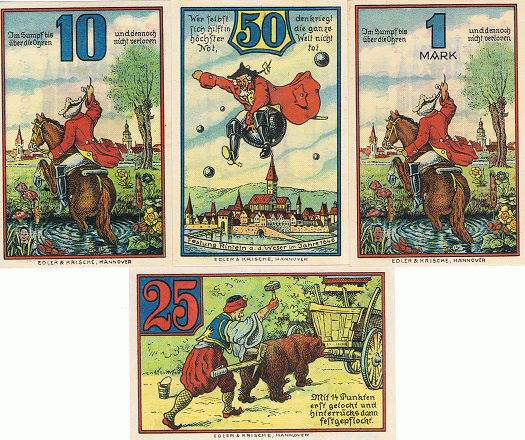 |
|
Pillar of the Community
United Kingdom
983 Posts |
Mit 14 punkten erst gelockt und hinterrücksdann festgepplockt.
The 25pf translation is:
'First lured with 14 points and then pegged behind.'
Baron Munchhausen (who you see jumping or riding, on the other graphics) recounts a story where he once caught a bear by putting lots of honey onto the drawbar. The bear ate and ate, thus being impaled step by step and finally Münchausen simply had to fix the bear in place with a peg. Ouch!
(I think the text refers to the 14 point plan that Woodrow Wilson suggested to end World War I).
I hope that helps and others find interesting.....
|
|
Moderator
 United States
198363 Posts |
Excellent information!  |
| |
Replies: 12 / Views: 3,443 |
|







 Posted 02/12/2017 8:21 pm


