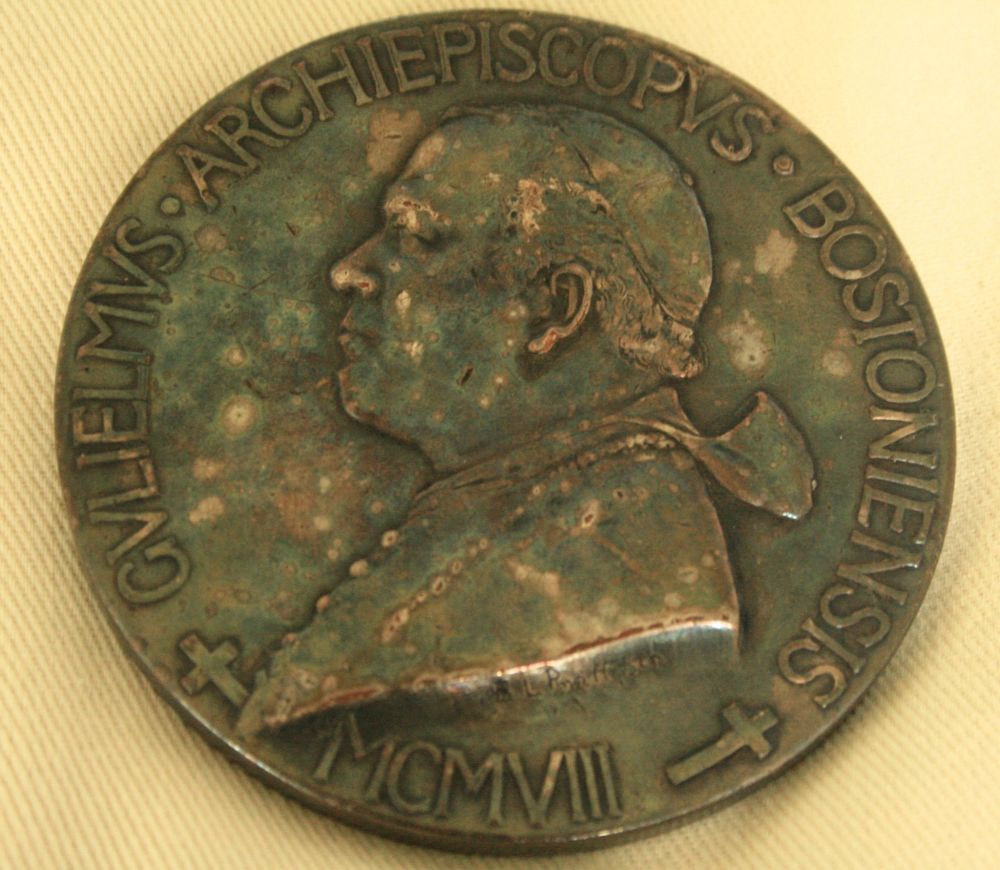
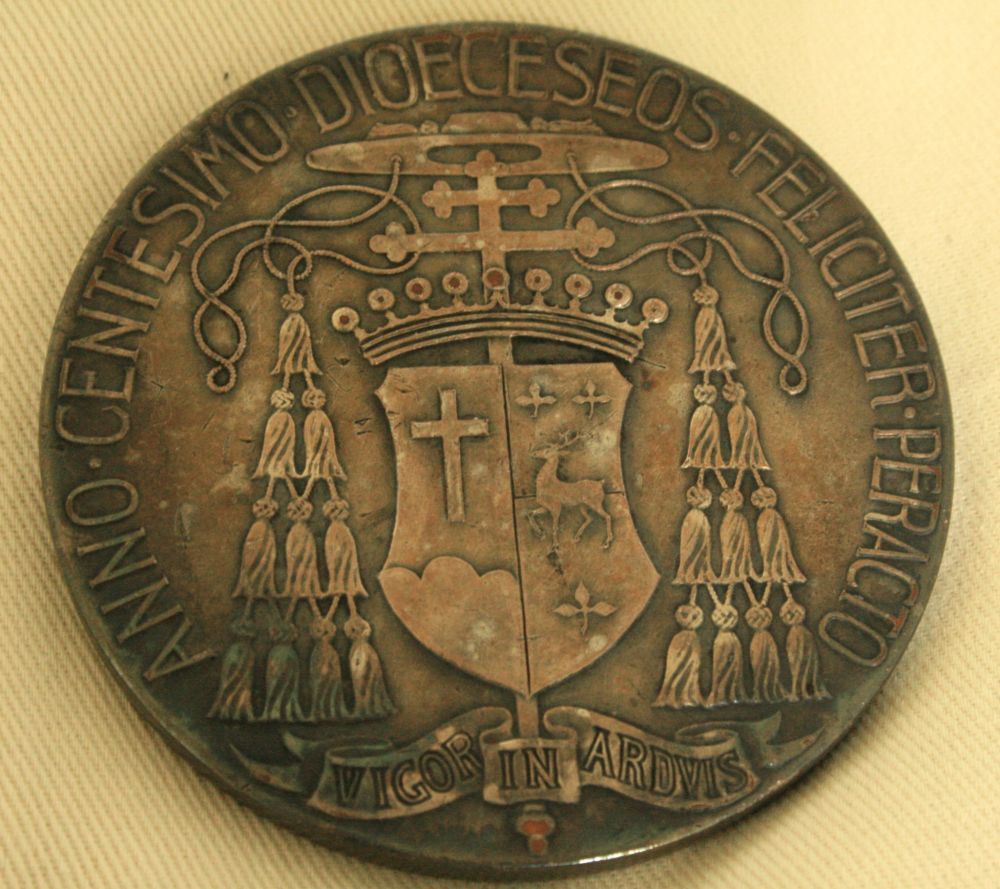
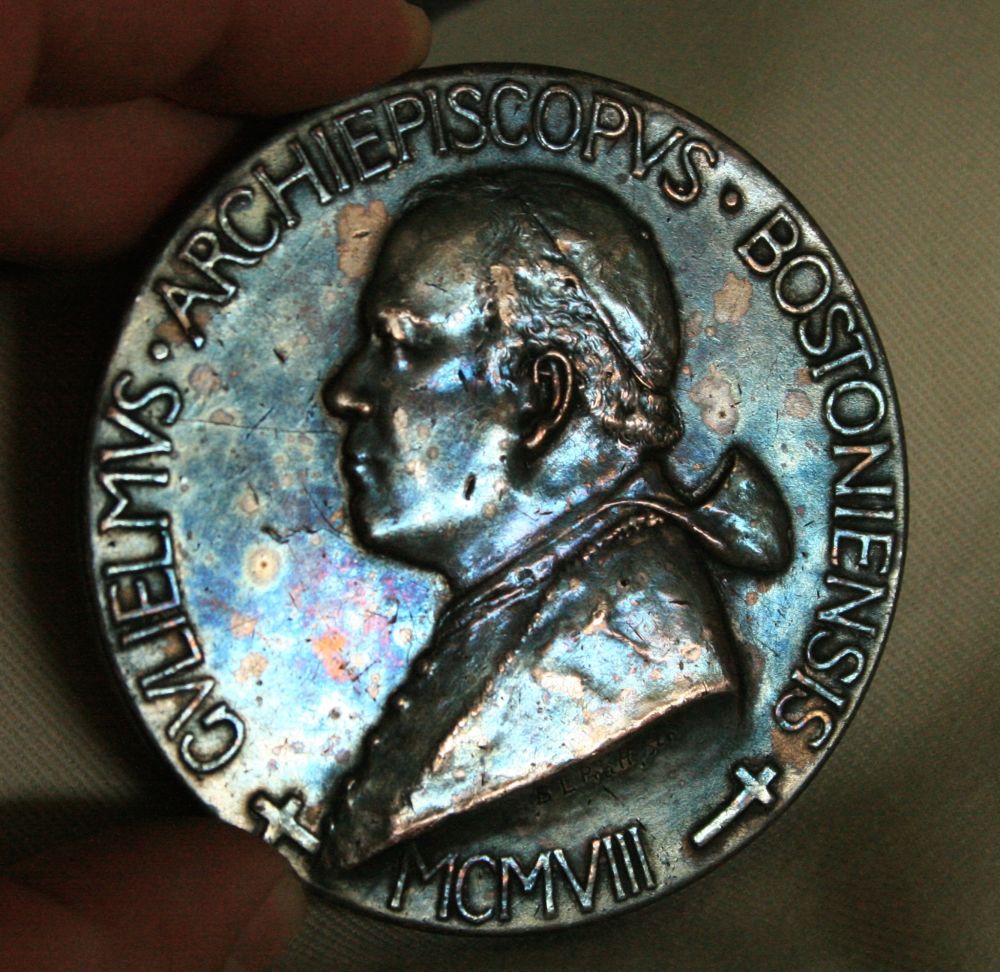
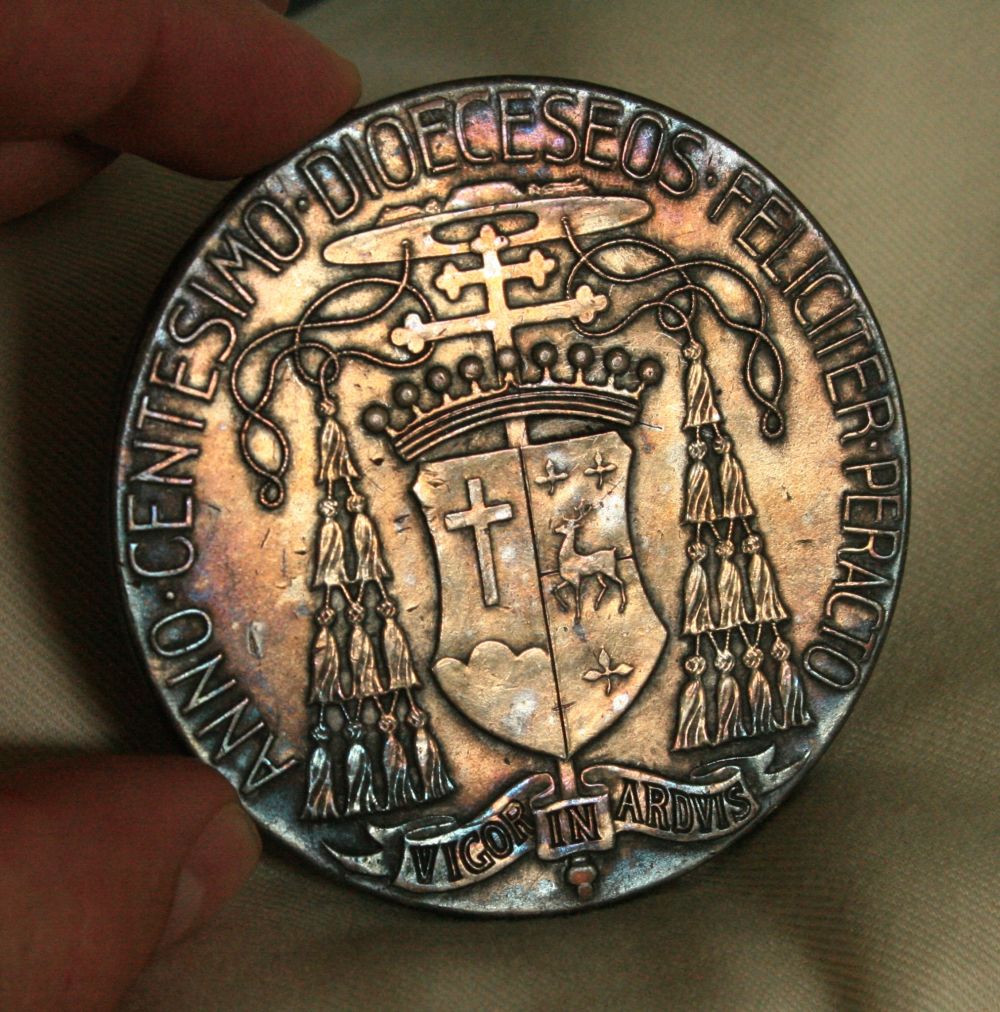
Just thought I would share one of my medals. Enjoy!

I believe there were only 500 of these medals made.
William Henry O'Connell (December 8, 1859 - April 22, 1944) was an American cardinal of the Roman Catholic Church. He served as Archbishop of Boston from 1907 until his death, and was elevated to the cardinalate in 1911.
Early life
William O'Connell was born in Lowell, Massachusetts, to John and Bridget (nee Farrelly) O'Connell, who were Irish immigrants. The youngest of eleven children, he had six brothers and four sisters. His father worked at a textile mill and died when William was four years old. During his high school career, he excelled at music, particularly the piano and organ.
O'Connell entered St. Charles College in Ellicott City, Maryland, in 1876. At St. Charles, he was a pupil of the noted poet John Banister Tabb. He returned to Massachusetts two years later and entered Boston College, from which he graduated in 1881 with gold medals in philosophy, physics, and chemistry. He then furthered his studies at the Pontifical North American College in Rome.
Priesthood
O'Connell was ordained to the priesthood by Lucido Cardinal Parocchi on June 8, 1884. A pneumonia and bronchial congestion cut short his pursuit of a doctorate in divinity at the Pontifical Urban Athenaeum, forcing him to return to the United States in 1885 without his degree.
He then served as curate of St. Joseph Church in Medford until 1886, when he became curate of St. Joseph Church in the West End of Boston.[1] Returning to Rome, O'Connell was named rector of the North American College in 1895. He was raised to the rank of Domestic Prelate of His Holiness in 1897.
Episcopal career
Bishop of Portland in Maine
On February 8, 1901, O'Connell was appointed the third Bishop of Portland, Maine, by Pope Leo XIII. He received his episcopal consecration on the following May 19 from Francesco Cardinal Satolli, with Archbishops Edmund Stonor and Rafael Merry del Val, at the Lateran Basilica. Upon his arrival in Maine, he was given an official reception by Governor John F. Hill. He was presented with a reliquary of the True Cross by Pope Pius X after the latter's election in 1903.
In 1905, in addition to his duties as a diocesan bishop, O'Connell was named papal envoy to Emperor Meiji of Japan; he was also decorated with the Grand Cordon of the Order of the Sacred Treasure. He was made an Assistant at the Pontifical Throne in 1905 as well. He was also viewed as having actively campaigned to become Archbishop of Boston, donating to numerous Vatican causes and publicly expressing his loyalty to the pope.
Archbishop of Boston, and Cardinal
O'Connell was named Coadjutor Archbishop, with right of succession, of Boston, and Titular Archbishop of Constantina on February 21, 1906. As coadjutor, he served as the designated successor of Archbishop John Williams, who was then in declining health. He later succeeded Williams as the second Archbishop of Boston upon the latter's death on August 30, 1907.
On November 27, 1911, O'Connell became Boston's first Archbishop to become Cardinal, and was given the title of Cardinal-Priest of S. Clemente. O'Connell was late to two papal conclaves in a row, in 1914 and 1922, due to having to cross the Atlantic Ocean in the slower transportation of the day. He made a protest to Pope Pius XI, who in response lengthened the time between the death of the Pope and the start of the conclave. O'Connell was able to participate in the subsequent 1939 conclave, although by that time air travel was available.
O'Connell favored a highly centralized diocesan organization, encompassing schools, hospitals, and asylums in addition to parishes. O'Connell wielded immense political and social power in Massachusetts, earning him the nickname, "Number One." For instance, he was responsible for defeating a bill to establish a state lottery in 1935, and for defeating a referendum liberalizing state birth control laws in 1942. The only politician who had anywhere near O'Connell's political clout was Governor (and future U.S. President) Calvin Coolidge, but even Coolidge picked his battles carefully, preferring to ignore the Archbishop whenever possible. In the years leading up to the Second World War O'Connell became a powerful force for the neutralists in trying to keep the United States out of World War II, in the pre-Pearl Harbor era.










 Posted 02/25/2017 11:23 am


