



Coin Community Family of Web Sites Join Thousands of Coin, Bullion, & Money Collectors
Royal Estate Auctions - $1 Coin Auctions300,000 items to help build your collection! Join Thousands of Coin, Bullion, & Money Collectors Specializing in Modern Numismatics Royal Canadian Mint products, Canadian, Polish, American, and world coins and banknotes. Vancouvers #1 Coin and Paper Money Dealer Coin, Banknote and Medal Collectors's Online Mall


Username:
Password:
Save Password
Forgot your Password?


This page may contain links that result in small commissions to keep this free site up and running.

Welcome Guest! Registering and/or logging in will remove the anchor (bottom) ads. It's Free!

1862 Rupee Authenticity?

To participate in the forum you must log in or register.
Author Previous TopicReplies: 4 / Views: 1,373Next Topic  
Pillar of the Community
0xDA71D's Avatar
United States
1215 Posts
 Posted 03/02/2017  3:59 pm Show Profile   Bookmark this topic Add 0xDA71D to your friends list Get a Link to this Message Number of Subscribers
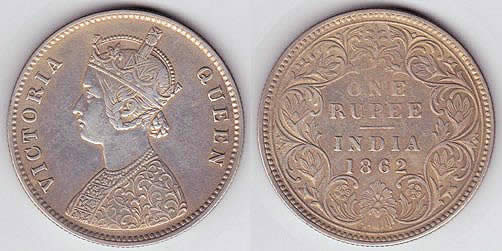
I was thinking what you all thought about the authenticity of this rupee, which I bought for spot along with other coins. It weighs 11.5 grams but looks "off." It has been slightly damaged (warped)


1862-Rupee-Authenticity?
Rest in Peace
Crazyb0's Avatar
10197 Posts
 Posted 03/02/2017  4:10 pm  Show Profile   Bookmark this reply Add Crazyb0 to your friends list Get a Link to this Reply
What seems off about it?


1862-Rupee-Authenticity?
Pillar of the Community
Archraz's Avatar
United States
3499 Posts
 Posted 03/02/2017  4:23 pm  Show Profile   Bookmark this reply Add Archraz to your friends list Get a Link to this Reply
0xDA71D - Interesting example. I think that it is an authentic 1862 Zero Dots Madras mint example. However, I think that it was buried and excavated. It probably had extensive corrosion, which was then harsly cleaned (unfortunately, many dealers in India damage coins through abrasive cleaning). The flatness of the reeds may indicate that it was in a bezel and worn as jewelry at some point.

I've been collecting Indian Rupees for about 15 years now. And there was very little interest in the US until pretty recently. One used to be able to buy AU Victorian rupees for spot as recently as 2000-2005 or so. And they were subject to being made into coin jewelry or just generally abused because they were aesthetically-pleasing, not collected by many in the US, and the Krause books did not list them as having much value (Krause essentially kept its Indian coin prices static from the 1990s until about 2012). While one can still get good deals (especially on princely state & pre-colonial coinage which do not feature English text) from dealers who are ignorant of Indian coins, increased collecting in Indian and Britain has resulted in Rupees suddenly bringing higher prices.
Edited by Archraz
03/02/2017 4:25 pm
Pillar of the Community
0xDA71D's Avatar
United States
1215 Posts
 Posted 03/02/2017  5:16 pm  Show Profile   Bookmark this reply Add 0xDA71D to your friends list Get a Link to this Reply
Thank you so much Archraz! This coin definitely looks beat up, so much so that I thought it was a cast counterfeit. Do you know what entry this is under in the Krause catalog? There seems to be so many different varieties of this coin
Pillar of the Community
Archraz's Avatar
United States
3499 Posts
 Posted 03/02/2017  6:32 pm  Show Profile   Bookmark this reply Add Archraz to your friends list Get a Link to this Reply
0xDA71D - Sure thing!
Your coin is KM#473.1. It can be a bit tough to give the exact ID of some 1862 Rupees. But this example is Madras mint given that it is reverse type one. (Reverse types are based upon the style of the flower at the 12 o'clock position right above the word "one."). Reverse type one only appeared with the type A Bust (Bust types are based upon the details of the panels and particular pattern of vegital interlace design in Victoria's dress). This coin also has zero dots. Dots appear either right above the word "One" on the reverse or between the date an the flower at 6 o'clock on the reverse. Numismatists have long debated the exact meaning of the dots since mint records were spotty in India during this period. However, 1862 Rupees were minted from 1862 until about 1874. The general consensus is that each year beyond 1862, rupees received a dot. So an 1862 with 4 dots above the flower and below the date would be an 1866. (Krause tends to list dot varieties as 0/0, 1/2, 0/4, etc. These mean Zero dots above/zero lower, one dot above/two lower, zero dots above/four dots lower, respectively). This way of hiding the true date of the coin was due to the fact that these new rupees were introduced into parts of India which had previously used more traditional or Mughal-style coinages. Thus, many persons may have not trusted coins which they could not read and seemed to have variation in the date/text each year.
In sum, your coin is one of the more common types of 1862 Rupees. It was actually minted in 1862 at Madras.

  Previous TopicReplies: 4 / Views: 1,373Next Topic  

To participate in the forum you must log in or register.


Disclaimer: While a tremendous amount of effort goes into ensuring the accuracy of the information contained in this site, Coin Community assumes no liability for errors. Copyright 2005 - 2026 Coin Community Family- all rights reserved worldwide. Use of any images or content on this website without prior written permission of Coin Community or the original lender is strictly prohibited.
Contact Us  |  Advertise Here  |  Privacy Policy / Terms of Use

Coin Community Forum © 2005 - 2026 Coin Community Forums
It took 0.21 seconds to rattle this change. Forums