 American Numismatic Society
 - Last month, on November 7, 2016, the internationally acclaimed Canadian artist Leonard Cohen died of cancer. He was regarded as a man of many talents, who painted, wrote novels, poetry, and the songs for which he was best known. He was a man of art, culture, and ideas, who appreciated the value of both Manhattan and Berlin.
Within the large oeuvre left behind by Cohen, the song Hallelujah stands out for its great popularity and the life of its own that it has taken on in the hands of the many other musicians (now more than 300 in multiple languages according to Wikipedia) who have played and modified its lyrics since it was first released in 1984. However, all versions begin with Cohen's original lament "Now I've heard there was a secret chord / That David played, and it pleased the Lord / But you don't really care for music, do you?" and this has prompted the topic for this edition of the ANS blog. Regardless of whether a numismatist does care for music (Cohen's or anyone else's) or not, David's secret chord and those of other lyric poets have made an impact on coins from antiquity up to modern times.
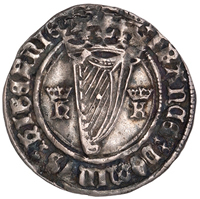
David is depicted playing his chord on the enigmatic Irish St. Patrick coinage of the seventeenth century, some of which was carried off to New Jersey to serve as halfpence in the cash-starved colony. Its production in two denominations (or one that was later reduced in weight?), date of issue, meaning of its iconography, and the circumstances of its arrival in New Jersey have captured the imagination of Colonial American numismatists for decades and even became the topic for an ANS Coinage of the Americas Conference in 2006. The famous king also plays on contemporary coins of Nuremberg and the Papal States, as well as on psalmenpfennige (medallic awards for the completion of Protestant religious education, which included the memorization of Psalms—the Biblical songs attributed to David).
Read the Entire Article 






 Posted 04/13/2017 11:21 am


