| Author |
 Replies: 8 / Views: 1,794 Replies: 8 / Views: 1,794 |
|
|
Pillar of the Community

United States
4051 Posts |
It was raining a bit today, but a few intrepid sellers braved the weather to sell their wares at the DeAnza Electronic Swap. I found a nice 2x objective, plus a decent stepped acrylic display rack, and as I was leaving a seller arrived and started unloading. He was descended-upon by 30 hungry buyers (including myself) and we all "helped" with unloading his boxes as we checked out his very eclectic offerings. I left his space with some interesting things: - A 1.8deg/step stepper motor with exposed shaft on both ends - A PanaVise head - A book on Color Theory - A couple packs of laser sticker sheets It is these sticker sheets which were the find of the day. They were in the same box as the Color Theory book, and other art and photography items. The interesting thing is they are labeled as "True Gray", which was very intriguing indeed! When I got home, I stuck one to the back surface of one of my Velvet Transfer Disks and snapped a reference pic after doing a quick manual WB. The surface is not uniform one color, but sort of a mottled gray of varying shades. The good thing is the shades maintain the same RGB across the full range of brightness, so they are very easy to WB and are a superb Gray reference and Background. Here is a 1954-S RPM#4 Lincoln Cent that I've been using as a reference coin for a while, shot on the background. Below the reference photo is the same image with saturation turned to 0, followed by same image with saturation maxed out. I see almost zero color shift in the background as I change saturation! This is a hard quality to come by in a background. Image was shot with a 75mm Nikon EL-Nikkor at f5.6 and two diffused Jansjos: Here are the images:    |
|
|
|
Pillar of the Community
Canada
2784 Posts |
wow ray excellent information. that is an excellent photo of that penny.
|
|
Pillar of the Community
Canada
9871 Posts |
So the first one is the true colour, right.
|
|
Pillar of the Community
 United States
4051 Posts |
Yes, first one is color correct. The background is color correct in all three.
|
|
Valued Member
United States
110 Posts |
Ray; I used your first image here and extracted the RED matrix for its pixel data. The Image of the(partial) RED matrix below shows values that has a large range (80-120+/-). What would the ideal value be if these numbers were all the same in the Red, Green, and Blue matrices, to accomplish this task with best results? 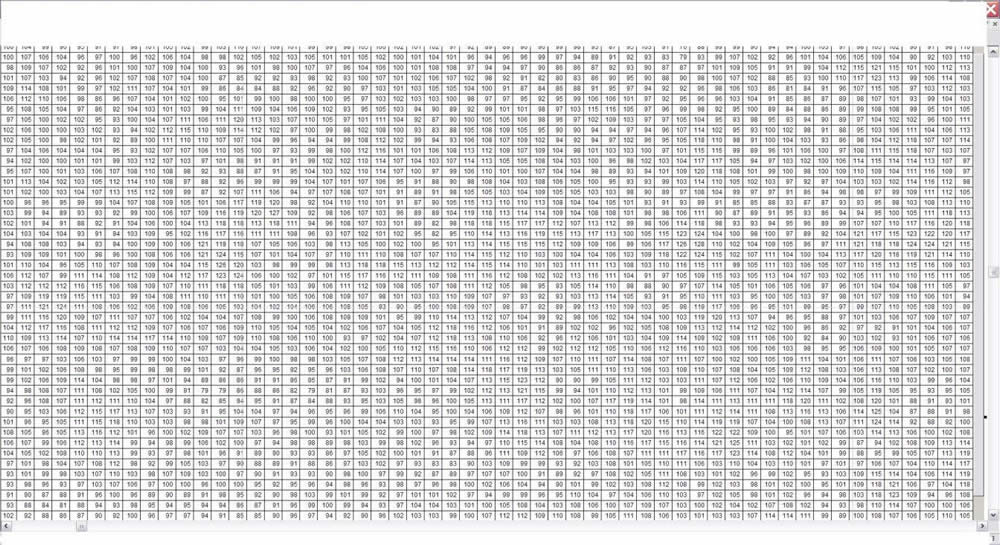   |
|
Pillar of the Community
United States
4051 Posts |
There is a big range because the background has a "texture" causing variation in brightness. It is not the photographic standard "Middle Gray" or "18% Gray", which comes in at 128,128,128. However, even 18% cards have a fair amount of variation since they are not flat. There are shadows and highlights, and these show up as variations in brightness similar to the above, though maybe not as pronounced.
|
|
Valued Member
United States
441 Posts |
Have you guys heard of the "12% vs 18%" gray controversy as to which is "true " photographic std calibration gray? Folks in each camp are willing to fall on their sword over it. Please explain the difference and if it even matters.
|
|
Pillar of the Community
United States
4051 Posts |
|
|
Valued Member
United States
110 Posts |
OK ....Thanks!
That is a real good and interesting reference link you posted.
The first card above was all RGB 128 and the second card was all 110 values.
My guess was close!
Thanks!
|
| |
Replies: 8 / Views: 1,794 |
|







 Posted 04/09/2017 4:38 pm





