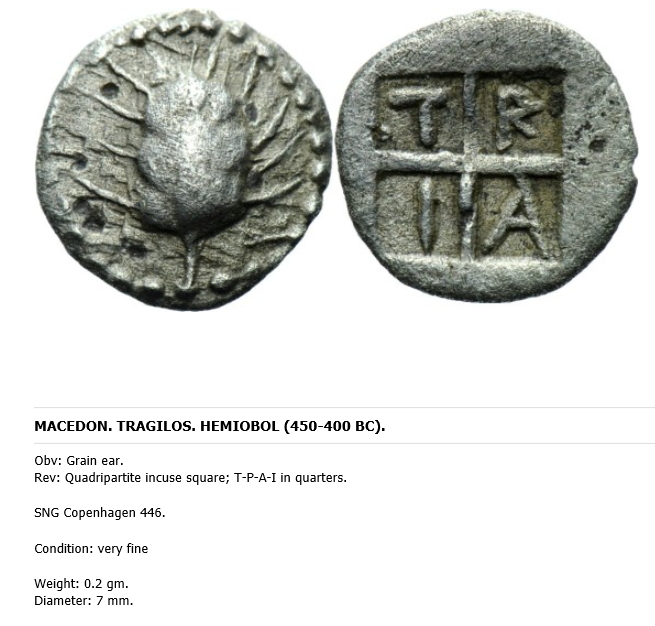
I have been wondering, going through a lot of Greek silver fractions often 0.12 grams and 5 mm... I notice there seems to be a lot not documented very well, or online anyway. So many with only one other example. And because of the size there are countless of these in mixed lots available that people don't go through simply because we all can't see that low the detail. But once properly photographed I am simply floored.
My theory is this would make such a great thing to collect with so much left not documented and reasonable, but how would you ever display the items? Does anyone collect these and if so are you using magnified display holders or do you just show the photograph to the person you are talking about the coin with and they trust you that is what actually is in the case? Seems you could have a priceless series of hemiobols that all fit in a little black book almost.
Yeah, small Greek silver is great. I just keep mine in 2x2 flips like any other coin. The only drawback is that despite how tiny they are even so they aren't cheap!
I have a few small ones but this one takes he biscuit for me, such fine detail showing the skill of the die maker.
Wow! I know these were struck but individually that seems so hard to imagine. Either way the blow up might be the only way to do this as the science of holders that can take these to decent viewing range is just not there. Something for much smaller coins then the ones you see below I imagine. And quite a few more magnifying levels also if you could even hold the tiny coins in some place well.
Quote: The only drawback is that despite how tiny they are even so they aren't cheap!
This all the way - which is why I still don't have any. I'd love to get one, however - with my terrible shortsightedness I'd only need to take the glasses off to appreciate it!
(That said, I do have some relatively nice 17th and 18th century Russian silver wire kopeks that aren't much larger.)
Quote: Too small for my eyes and too expensive for my budget. I'll take a nice large silver tetradrachm over these little guys.
I didn't realize they were that expensive, sorry. I thought it was somewhere in the range of maybe 50-100 dollars, or perhaps even cheaper.
If they're really as expensive as you seem to say, I'd rather ignore the entire idea and buy something cheaper and more common, like, I dunno, a Byzantine tremissis or something. Maybe even a full solidus.
(And no, I'm not buying tetradrachms - far too afraid of getting a fake, nowhere near experienced enough to recognize one. I thought that fractions might not have been faked as much because they're nowhere near as popular. And if I ever end up buying any kind of ancient electrum, it probably won't be a hekte - far too large; hemihekte or smaller. At least in that case they really appear to be cheaper.)
Really Greek Silver Hemiobols are not very expensive if you look at just a quick search of ebay "silver hemiobol" in past sales. And large lots are very available from Roma in UK, NN in Austria, and all very real so buying and selling them on ebay is pretty common.
First look at the Roma link for their next auction to see the countless available then look at the ebay past sales of silver hemiobols past sales right below that. It is a fairly big trades these days and no worry at all about someone faking these tiny items when so many of the real ones are available in the market. And that is just Roma numismatics, there are like 5 other auction houses in UK and Europe moving these in bulk. Now that Brexit happened UK is the way for large lots, you get coins in a week or two. EU can take months and so much paperwork. You register with homeland security for large lots from EU so you do get the coins but you have to register as an importer of record etc. Nothing like that from UK.
They are great really. Simon and Alex at Roma are very responsive to e-mails when you buy from them and extremely friendly. Also, I was not advocating people buy big lots I was pointing out how many of these fractions are available these days, but the only way to do this collector thing and not go under if you really love coins is to buy big lots and sell off some in my humble opinion. The fractions are starting to trade correctly based on supply and demand which is what I always wanted to see. Kyzikos Boar/Lion is so static like silver bullion and you can instantly see this is a $10, this is $25, this is $50 in an open auction that starts at $1. Same with Miletos Lion/Star diobol. You learn so much going through the large lots but you have to collect knowledge more then coins and be wiling to part with items. Such a wonderful time to be into ancients with such a connected world!
Yes, I understand. My response was more tongue in cheek...i haven't done much selling of coins as my focus has been on the buying side of the equation.
"If you climb a good tree, you get a push." -----Ghanaian proverb
"The danger we all now face is distinguishing between what is authentic and what is performed." -----King Adz
Selling ancient coins would not only be extremely expensive to me (if a coin sells for $20-25 or less, I end up with a net loss regardless of however much I paid, because of shipping), but, as long as it's not within my country, also technically illegal (as in I'm liable to end up in jail if I sell them, unless I obtain a document saying that they are not cultural property - and I'm not even guaranteed to get that).
In other words, until I get really rich or win the lottery or something (or maybe move to a country with less crazy laws, which I suppose might happen earlier), I should probably stay away from large lots unless I'm willing to keep every single coin, and preferably should stay away from Greek silver entirely (aside from that one 5th century BC coin, and maybe that one 6th century BC coin, to round off my "at least one from each century" list).
I suspect that the reason why the tiny fractions are so pricey, is that they are comparatively rare due to their small size and low survival rate into modern times.
Seltman illustrates a range of fractions down to 1/4 obol, which is the equivalent of 1/196 of a tetradrachm. Such a coin should weigh about 0.09 of a gram.
Disclaimer: While a tremendous amount of effort goes into ensuring the accuracy of the information contained in this site, Coin Community assumes no liability for errors. Copyright 2005 - 2026 Coin Community Family- all rights reserved worldwide. Use of any images or content on this website without prior written permission of Coin Community or the original lender is strictly prohibited. Contact Us | Advertise Here | Privacy Policy / Terms of Use












 Posted 04/17/2017 11:14 am


