| Author |
 Replies: 11 / Views: 3,343 Replies: 11 / Views: 3,343 |
|
|
Pillar of the Community
United States
7067 Posts |
The Arsacid era began when Arsakes (Arsakes I) was elected leader of a Central Asian Dahae tribe called the Parni, and then proceeded to wrest control of the Seleukid satrapy of Parthia to become the first Parthian king. He came to power around 247 BC and would rule until around 211 BC, perhaps the year of his death. For the duration of the empire, which lasted almost 500 years, coins honored the Parthian founder by depicting a seated archer - Arsakes - on the reverse. What is not so well know is that the archetype for the seated archer reverses of Parthian coins (as well as, ultimately, the Indo-Parthian and other Eastern coins that imitated the motif) may well have been the reverses of coins from almost a century and a half before Parthia started minting its own. Fred Shore, in Parthian Coins and History: Ten Dragons Against Rome, states that the Parthian "reverse design was derived from the Seleukid drachms which showed Apollo seated on the omphalos..." For years I've taken that as gospel since, well...you know, it's from Fred Shore.* However, I came across what I think is a more plausible theory that was put forth by Vesta Sarkhosh Curtis of the British Museum and Sarah Stewart of the London Middle East Institute at SOAS, in an article entitled The Iranian Revival in the Parthian Period. Curtis and Stewart make their cursory case in just two sentences (within the context of an article more focused on its titular theme), without doing any detailed comparisons. But those two sentences, and my own poking around the Web after reading them, were enough to convince me: Datames (sometimes referred to as Tarkumuwa) was a satrap of Cappadocia from 385 - 362 BC, under the Achaemenid/Persian Empire. Around 375 BC he struck silver staters at the Tarsos, Cilicia mint that, on their reverses, depict him seated, wearing Persian dress (including the bashlyk and baggy trousers that the Parthians would later adopt), with empty sleeve (another motif borrowed by the Parthians), inspecting (or offering?) an arrow, with a bow to lower right and winged solar disk to upper right. As Curtis and Stewart state in their article: "This could indicate that the coins of the western satraps of the Achaemenid Empire (were) known to the early Arsacids once they took over power in Parthia." Datames is shown in a 3/4 view whereas the Parthian archer is always in profile, and he (Datames) holds an arrow rather than the bow. But the similarities are clear enough. Compare, for example, the legs of the throne of Datames in the rightmost image of the top pic, with the throne legs in the leftmost image of second pic, which is the very first coin issued by the Parthians. Pics below courtesy of CNG and Parthia.com. Reverses of coins of Datames: 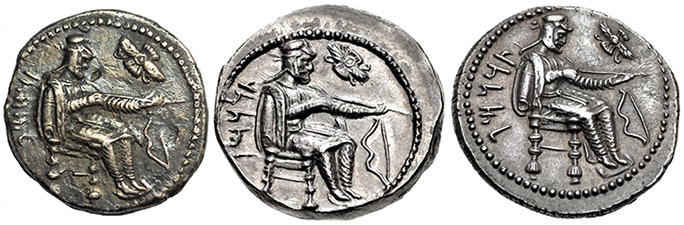 Reverses of two drachms of Arsakes I from the beginning of the Parthian Empire, and an Artabanos IV (216 - 224 AD) reverse from the final years of the Empire, showing the degenerated image of the archer: 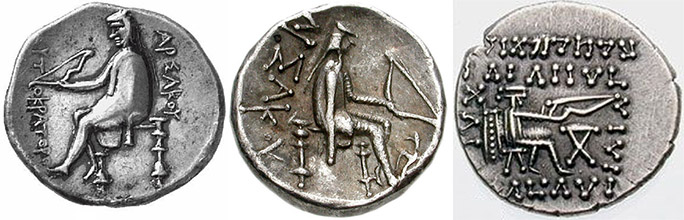 *I should add that the transition from throne to omphalos as the seat of choice for the Parthian archer in the coinage of Mithradates I (171 - 138 BC) and some rulers afterwards, may well have been inspired by the omphalos of Apollo in the Seleukid issues. Edited by Kamnaskires
05/14/2017 10:02 pm
|
|
|
|
Moderator
 United States
34563 Posts |
Fascinating insight Bob. Thanks for writing up this analysis. I wonder if you could also post a pic or two of the Apollo on that stone omphalos? I see examples in wildwinds, and see why you immediately gravitated away from that image as the origin of the seated archer on the rev of Parthian coins.
"If you climb a good tree, you get a push."
-----Ghanaian proverb
"The danger we all now face is distinguishing between what is authentic and what is performed."
-----King Adz
|
|
Pillar of the Community
 United States
7067 Posts |
Quote:
I wonder if you could also post a pic or two of the Apollo on that stone omphalos? Sure, Dave. Here he is in all his glory, sans bashlyk, sans baggy trousers, sans empty sleeve...sans clothes at all. 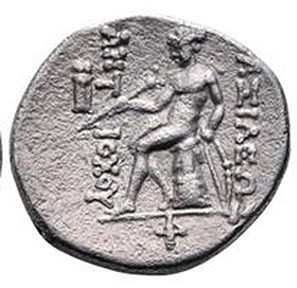 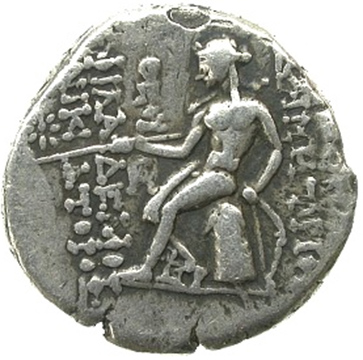 Edited by Kamnaskires
05/14/2017 9:41 pm
|
|
Moderator
United States
23731 Posts |
he Parthians put their spin on the reverse but they are pretty much the same from the earlier coins. Very interesting thread.
|
|
Pillar of the Community
United States
949 Posts |
Having collected "Great Archer" Achaemenid sigloi, I am always fascinated to find vestiges of its imagery in it cultural successors (which I have not collected). This is great stuff.
May I ask, what is the script on the third coin in the first group you show? I think it is too early for Pahlavi but don't know what it could be.
|
|
Pillar of the Community
Russian Federation
5186 Posts |
Quote:
Datames (sometimes referred to as Tarkumuwa) Only Tarkumuwa I've ever heard of before was Tarkumuwa of Mera from that one Hittite seal (formerly known as Tarkudimme of Erme before the writing was read properly). Sorry if this is a stupid question - do those two have anything else in common, and is the name of Anatolian origin? |
|
Pillar of the Community
United States
6130 Posts |
Super thread, although I wonder if the image of Datames is itself borrowed from Greek imagery? Not coins necessarily, but I am sure that Apollo on the Omphalos predates the Seleucid empire, and I can see the appeal of wanting to be a warrior-poet for your people. I suppose we may never know.
The script is Phoenician, or a Punic dialect. I have always wanted a Phoenecian-script coin, but they are not generally easy to find, at least in decent condition that won't break the banks!
|
|
Pillar of the Community
United States
7067 Posts |
Thanks for the replies. Pretty esoteric subject, I realize, but a fun line of inquiry/study that I stumbled into while reading yesterday. Quote:
...what is the script on the third coin in the first group you show? I've seen it described in multiple listings, Irbguy, as Aramaic, spelling out Datames. The descriptions vary on how they interpret the letters...meaning I've seen these variations: TRKMW, TDRMW, and TRDMW. Here's the link to CNG with the whole description of the one you asked about: https://cNGCoins.com/Coin.aspx?CoinID=272086Quote:
Tarkumuwa of Mera...do those two have anything else in common I don't know. However, we're talking about the same part of the world. In the article I mention in my post, the authors refer to Datames as "Tarkamuwa, formerly known as Datames, of the fourth century BCE." The "formerly" there is interesting. Perhaps then, just perhaps, Tarkamuwa/Tarkumuwa (I've seen it spelled both ways) was an honorific title bestowed on Datames at some point - a title that references the earlier Hittite king(?).  |
|
Pillar of the Community
United States
7067 Posts |
Quote:
I wonder if the image of Datames is itself borrowed from Greek imagery? I'm sure you're correct about this, Steve. But the specific way the enthroned king motif crystallized in the coins of Datames circa 375 BC - with the striking similarities (to the Arsakes I coins more than a century later) in clothing, throne, and with the bow/arrow connection - suggest that these were the direct antecedent to the initial Parthian issues. |
|
Pillar of the Community
United States
949 Posts |
Thanks Bob. I looked at a table of thirteen forms of late Phoenician/Semitic script, and the letters on the coin bear closest similarity to the inscriptions on the Elephantine papyri, c 5th century BC. This is the basis for claiming the underlying language is Aramaic, and that works very well for the obverse inscription, reading right to left (beth-yod-yod-lamedh-resh-zayin) so I presume it applies just as well for the reverse inscription (thav-resh-kaph-mem-waw). I have unexpectedly run into these letter forms elsewhere, and wanted to nail it down. This is helpful. Thanks again.
Edited by lrbguy
05/15/2017 10:10 am
|
|
Pillar of the Community
United Kingdom
946 Posts |
Really interesting post Bob. Certainly the Hellenic celators in the main cities of the Iranian world would determine what the Parthians got in terms of the artistry of their coinage. The gesture of Datames looks to be in the standard depiction of Iranian rulers making vows, including the garb, of that period and earlier, such as the depiction of king Cyaxares of Media at his tomb in qyzqapan in Iraqi Kurdistan. I made a depiction of him as there are few (for understandable security reasons. Luckily on a visit to Erbil in 2008 the airlines magazine had a "better" photo of this site which I used to draw from) photos of this tomb available that clearly show it. Cyaxares reigned over 200 years prior to Datames regional rule in Cappadocia. Note the clothing (Bashlyk) and the holding a bow with his left hand, whilst he gestures/salutes to an altar with is right. (I did not draw the other king that is shown standing on the other side of the altar. He is in a similar pose, gesturing/saluting the altar with right hand and holding top of bow with left, but slightly different clothing. He is thought to be king Alyattes of Lydia.)  The artistry of the sculptural work on his tomb looks to be Mesopotamian or even Lydian rather than Hellenic. |
|
Pillar of the Community
United States
7067 Posts |
Thanks for the very interesting contribution to the thread, Masis. It provides more context, for sure. I wish you posted here more often! Yes, the iconography and attire in the Cyaxares image seem to represent long-standing traditions in that part of the ancient world. Aspects of your image relate, as you say, to the eventual Datames and Parthian motifs, but also to the later Sasanian fire altar reverses - especially given the fact that there was another attendant figure symmetrically positioned to the right. Thanks for posting!
|
| |
Replies: 11 / Views: 3,343 |
|









 Posted 05/14/2017 9:30 pm


