Coin Community Family of Web Sites Join Thousands of Coin, Bullion, & Money Collectors
Join Thousands of Coin, Bullion, & Money Collectors 300,000 items to help build your collection! Vancouvers #1 Coin and Paper Money Dealer Shop for APMEX Bullion on eBay!Royal Canadian Mint products, Canadian, Polish, American, and world coins and banknotes. Specializing in Modern Numismatics Coin, Banknote and Medal Collectors's Online Mall


Username:
Password:
Save Password
Forgot your Password?


This page may contain links that result in small commissions to keep this free site up and running.

Welcome Guest! Registering and/or logging in will remove the anchor (bottom) ads. It's Free!

This Coin Most Likely First Found In Northern Greece

To participate in the forum you must log in or register.
Author Previous TopicReplies: 11 / Views: 1,424Next Topic  
New Member

United States
3 Posts
 Posted 06/06/2017  12:51 pm Show Profile   Bookmark this topic Add Bearcatgeo to your friends list Get a Link to this Message Number of Subscribers
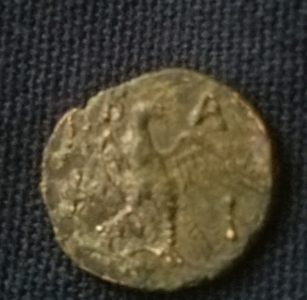
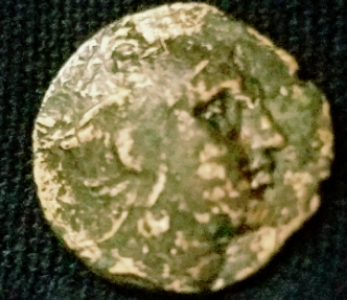
Trying to find out more about this coin passed to me by my father, a Greek immigrant. And help is appreciated.
This-Coin-Most-Likely-First-Found-In-Northern-Greece

This-Coin-Most-Likely-First-Found-In-Northern-Greece

*** Moved by Staff to a more appropriate forum. ***
Moderator
Learn More...
echizento's Avatar
United States
23731 Posts
 Posted 06/06/2017  6:08 pm  Show Profile   Bookmark this reply Add echizento to your friends list Get a Link to this Reply
to the community
Pillar of the Community
United States
3439 Posts
 Posted 06/06/2017  6:22 pm  Show Profile   Bookmark this reply Add FVRIVS RVFVS to your friends list Get a Link to this Reply
I am out of my comfort zone on Greek bronze but I will venture a guess on it
(no one else has !)
The reverse looks like it has a Ptolemaic style. Not Alexandria though so perhaps Levantine ?
The portrait also does not look like Ptolemy to me but might be the deified Alexander in elephant headdress.
Some experts here know more about these types than I so hopefully we can get a more learned opinion for you !
Pillar of the Community
Kamnaskires's Avatar
United States
7066 Posts
 Posted 06/06/2017  6:28 pm  Show Profile   Bookmark this reply Add Kamnaskires to your friends list Get a Link to this Reply
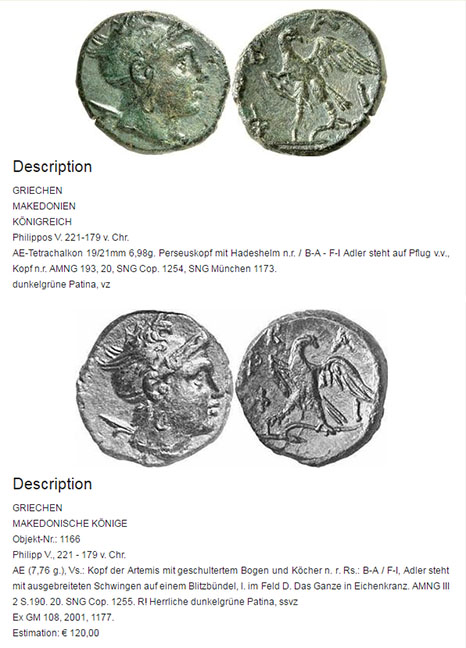
Philip V, Macedonia, c. 220 - 179 BC.
Pillar of the Community
Kamnaskires's Avatar
United States
7066 Posts
 Posted 06/06/2017  6:38 pm  Show Profile   Bookmark this reply Add Kamnaskires to your friends list Get a Link to this Reply

This-Coin-Most-Likely-First-Found-In-Northern-Greece
Valued Member
greekandromancoins's Avatar
Australia
205 Posts
 Posted 06/06/2017  8:32 pm  Show Profile   Bookmark this reply Add greekandromancoins to your friends list Get a Link to this Reply
Hi Bearcatgeo


Very nice coin.

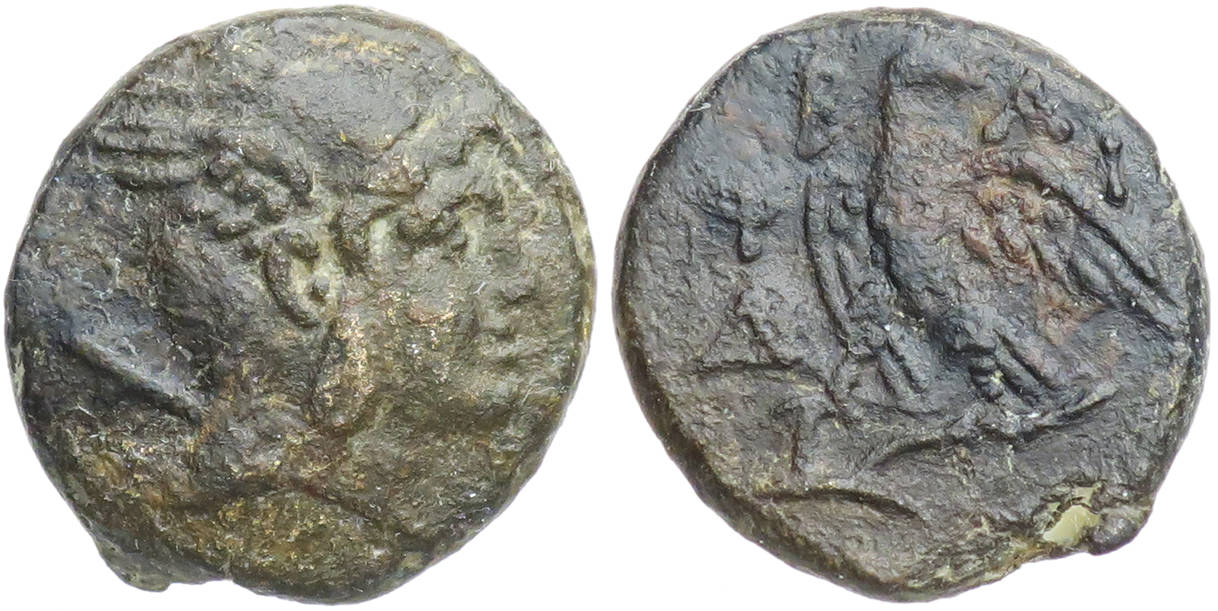
Here is my example.

The bronze coinage of Philip V and his son, Perseus are quite similar - it is easy to confuse the two at a glance! When I see Perseus on one side and eagle on the other, I know it is either Perseus or Philip V but then need to take a closer look.

This-Coin-Most-Likely-First-Found-In-Northern-Greece
Pillar of the Community
Kamnaskires's Avatar
United States
7066 Posts
 Posted 06/06/2017  8:39 pm  Show Profile   Bookmark this reply Add Kamnaskires to your friends list Get a Link to this Reply
The coins of father and son are indeed similar, but I believe the phi-I combo in the lower reverse fields is unique to Philip V.
Valued Member
greekandromancoins's Avatar
Australia
205 Posts
 Posted 06/06/2017  8:54 pm  Show Profile   Bookmark this reply Add greekandromancoins to your friends list Get a Link to this Reply
Yes. Presumably, the phi-I is short for Philip and the B-A for Basilews. Do you know what the Delta-I means? Is it a regnal year or something? SNGs don't really go into much detail about why things appear on coins.

Edited by greekandromancoins
06/06/2017 9:11 pm
New Member
United States
3 Posts
 Posted 06/07/2017  02:50 am  Show Profile   Bookmark this reply Add Bearcatgeo to your friends list Get a Link to this Reply
Thank you to all who have replied. So, is the image Philip or Perseus?
Valued Member
greekandromancoins's Avatar
Australia
205 Posts
 Posted 06/07/2017  04:03 am  Show Profile   Bookmark this reply Add greekandromancoins to your friends list Get a Link to this Reply
Hi Bearcatgeo,

The image is of Perseus, the demigod from greek mythology that slayed Medusa. The coin is issued in the name of Philip V. His son was called Perseus but not the same as the Perseus aforementioned which features on their coinage.

Peter
New Member
United States
3 Posts
 Posted 06/07/2017  04:48 am  Show Profile   Bookmark this reply Add Bearcatgeo to your friends list Get a Link to this Reply
Ah...now I understand. Thank you very much.
Pillar of the Community
United States
3439 Posts
 Posted 06/07/2017  08:58 am  Show Profile   Bookmark this reply Add FVRIVS RVFVS to your friends list Get a Link to this Reply
I knew we would get to the bottom of it !
Now I will go back to my Roman imperials and leave the Greeks to my learned brothers (and sisters !)
  Previous TopicReplies: 11 / Views: 1,424Next Topic  

To participate in the forum you must log in or register.


Disclaimer: While a tremendous amount of effort goes into ensuring the accuracy of the information contained in this site, Coin Community assumes no liability for errors. Copyright 2005 - 2026 Coin Community Family- all rights reserved worldwide. Use of any images or content on this website without prior written permission of Coin Community or the original lender is strictly prohibited.
Contact Us  |  Advertise Here  |  Privacy Policy / Terms of Use

Coin Community Forum © 2005 - 2026 Coin Community Forums
It took 0.29 seconds to rattle this change. Forums