| Author |
 Replies: 10 / Views: 7,195 Replies: 10 / Views: 7,195 |
|
|
Valued Member
Australia
222 Posts |
I was wondering how long a small spot of verdigris takes to spread on a CuNi coin?
Rgds,
Eric
|
|
|
|
Moderator
 Australia
17035 Posts |
I can't say I've heard of it "spreading" on a cupronickel coin, but I won't say it's impossible. I would've assumed it would need to remain in a favourable environment for it to grow (high temperature, humidity, salty air, etc).
Bronze disease on copper and bronze coins spreads much faster, and can do so under normal atmospheric conditions.
Don't say "infinitely" when you mean "very"; otherwise, you'll have no word left when you want to talk about something really infinite. - C. S. Lewis
|
|
Pillar of the Community
United States
2600 Posts |
Eric, I have wondered the same thing so have been trying an experiment. I took a couple of of coins with lots of verdigris and put them in a zip lock bag with a handful of copper cents and threw them in a desk drawer. they have been in there for a few months now and the last time I checked the unaffected coins were still unchanged. I will keep an eye on them and post if there are any changes.
Jim
|
|
Valued Member
 Australia
222 Posts |
I have a few old pennies at the bottom of an archive box which have verd on them, but they haven't deteriorated at all, either. Perhaps it takes years to spread even by the square millimeter?
|
|
Moderator
Australia
17035 Posts |
It's also known as "bronze cancer", and like cancer, it can be unpredictable. It might sit there, mostly harmless, for years - then suddenly break out and start spreading. If the conditions of the coin change - say, the coins are poured out of one jar and into another, or the jar is moved to a different environment - can be enough to trigger the spreading.
It's also important to note that not all "green stuff" on coins is prone to spreading. Bronze patina is very dark green, and on ancient coins is stable, and even preferred to bare copper metal. A modern coin shouldn't have developed this yet, but under certain conditions a similar encrustation can form.
General rule of thumb: if it's dark green and glossy-looking, it's safe and stable. If it's pale green and/or powdery-looking, it's the bad stuff.
Don't say "infinitely" when you mean "very"; otherwise, you'll have no word left when you want to talk about something really infinite. - C. S. Lewis
|
|
Valued Member
Ireland
498 Posts |
Thats good info.
I mostly found some cuni coins in boxes with verdegris.
if most of the coins in the box have verd maybe a month or two but when it will go a year it is already spread to other coins on most coins in the box.
|
|
Valued Member
United States
226 Posts |
Very descriptive analogy Sap  . Coin analysis is all about "eye" awareness and it is often hard to put in words, yet you have done an excellent job. Copper is a very reactive metal under the correct circumstances, such as when in contact with moisture and mild acids or bases (Ph). Minor long term exposure to chemicals tends to develop patina on the coins surface, where as specific moisture/chemical concentrations corrode the surface. Rarely would you see a copper coin with original patina that is less then 100 years old. Under the correct lighting conditions the 1832 Half Cent toning is luminescent green with virtually no pitting, where as the 1881 3CN's surface has been breeched. 1832 Half Cent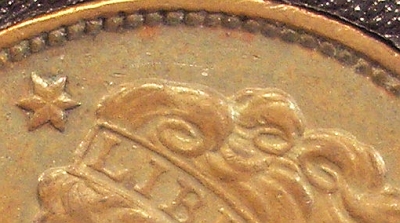 1881 Three Cent Nickel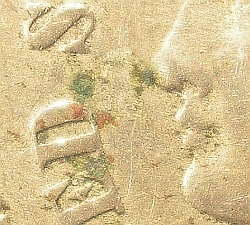 |
|
Pillar of the Community
United States
543 Posts |
|
|
Pillar of the Community
Australia
655 Posts |
quote:
Minor long term exposure to chemicals tends to develop patina on the coins surface, where as specific moisture/chemical concentrations corrode the surface.
Interesting. As an analogy it sounds like taking a little poison over a long period, one tends to develop a resistance to it, but a big dose at once kills. |
|
Pillar of the Community
United States
810 Posts |
Im getting a little concerned with coins with vedigres. Ive been finding alot of nickels lately with it on it. What are you suppose to do when finding coins with it on it too? Another thing does it harm people? I'm just curious on that.
|
|
Bedrock of the Community
United States
20753 Posts |
Not that it is important but it is spelled Verdigris. And it is not actually Verdigris on your coins unless they were exposed to an Acetate such as what is in Vinegar. Many silly people clean coins with Vinegar and that could start Verdigris. Any coin containing Copper will start to turn to a brownish or greenish color as long as it is exposed to Oxygen, Carbon Dioxide and Moisture. Actually all Copper anything is effected similarly. Copper piping is an example. Underground Copper Grounding systems show that same reaction. No it's not PVC either. Another typical old wives tale, so to speak. Meaning a story repeated over and over and over and just becomes a habit instead of fact. Bronze, Brass, many coins contain Copper and they all react with O, then CO2 and then with H OH. The greenish coating you find on anything Copper is called Copper Carbonate noted as [CuCO3-Cu(OH)2].
|
| |
Replies: 10 / Views: 7,195 |
|







 Posted 04/26/2008 10:05 am


