| Author |
 Replies: 10 / Views: 9,654 Replies: 10 / Views: 9,654 |
|
|
New Member
Australia
4 Posts |
Hi. I just noticed that one of my post-1945 florins that I recently bought has developed a moss-like green patina. I remember reading somewhere that this is VERY bad as my silver coin will eventually be "eaten", and will spread to any other silver coins stored alongside it. Unfortunatelly I can't remember which guide I perused that mentioned this. But is this true, and should I clean the coin?
|
|
|
|
Moderator
 Australia
16982 Posts |
A base-silver coin suddenly turning green? Doesn't happen too often. I'd suspect "PVC damage" if it's stored in a cheap-and-nastty album, but if you're saying only one of your florins is turning, then it probably isn't the album.
I don't think "silver disease" is quite as contagious as "bronze disease", but then, 50% silver isn't supposed to go green in the first place. Presumably it's been exposed at some stage to a nasty environment.
If it's suddenly appeared over a relatively short period of time, then it's quite possible that it already had it before you bought it, and is now just returning after a poor cleaning job.
Either way, it's probably not going to be in "collectable" condition, whether you clean it or not. I'd recommend cleaning it.
Don't say "infinitely" when you mean "very"; otherwise, you'll have no word left when you want to talk about something really infinite. - C. S. Lewis
|
|
Pillar of the Community
Australia
655 Posts |
I sometimes buy bullion florins and some of those are pretty nasty. The first thing I'd try is hot soapy water. Let them soak for a while and it may come off pretty easy. If not, with the more stubborn ones I use ammonia. They tell me this may wreck the coin but hey it's already bullion. I haven't tried acetone yet. Maybe that would be better? The results. 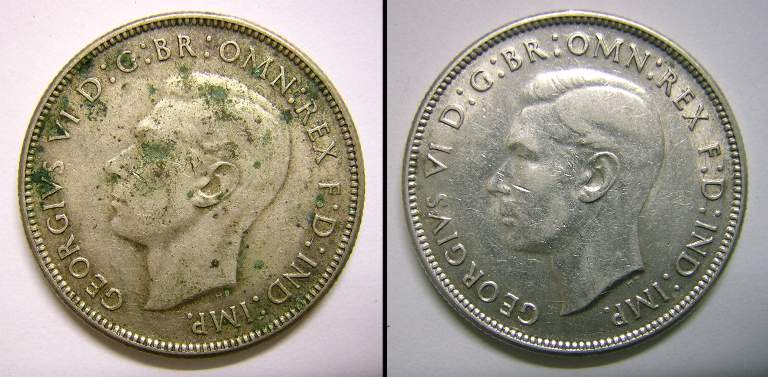 |
|
Pillar of the Community
Australia
1360 Posts |
quote:
Originally posted by Learjet
If not, with the more stubborn ones I use ammonia.
They tell me this may wreck the coin but hey it's already bullion.
.  I've done that with old silver bullion coins too. |
|
New Member
United States
1 Posts |
Strange. I thought greenish patina, generally, does not develop on silver pieces.
|
|
Moderator
United States
195203 Posts |
 to the Community, jpz79! As Sap said above, it is likely PVC damage which I believe reacts with the copper alloyed into the silver. |
|
Pillar of the Community
Australia
908 Posts |
It's a PVC coating which will damage coins over time.Having bought many coins that have this
PVC coating I have developed a method of removing it even on ultra high grade coins which
doesn't damage the coin any further.In short if your coins are collectible you need to remove
the green coating asap to preserve them.If they are only bullion it doesn't really matter
|
|
Pillar of the Community
Australia
1366 Posts |
Quote:
Having bought many coins that have this
PVC coating I have developed a method of removing it even on ultra high grade coins which
doesn't damage the coin any further. ... and the secret is? |
|
Pillar of the Community
Australia
908 Posts |
Quote:
.. and the secret is? The secret is that I can get rid of the PVC allowing PCGS to grade them |
|
Pillar of the Community
Australia
1366 Posts |
Quote:
The secret is that I can get rid of the PVC allowing PCGS to grade them Not sure where you're going with this? I just thought that if you had found something that works then you wouldn't mind sharing it with others but each to his own. |
|
Bedrock of the Community
Australia
21789 Posts |
There can be only two dates of Australian .500 fine silver Florins, with the "IND. IMP" obverse legend: 1946 and 1947.
Both are common.
In this condition, they are certainly NOT worth it to be TPGraded, simply because their value does not justify the shipping and grading fees.
I have seen these with a greenish patina, in this sort of condition and less, but NEVER with the aggressive bronze disease that can affect copper and bronze coins. Have also seen this greenish patina with .500 fine silver coins that have never been in PVC albums. Most probably due to the influence of the high copper proportion in the alloy.
The alloy is 'Quaternary Metal':
50% silver, 40% copper, 5% nickel, 5% zinc,
used throughout the British Empire and Great Britain for nominally.500 fine silver coins.
Sap is right:
If you choose, clean then any way you wish, because they won't loose any value, irrespective of the cleaning method.
|
| |
Replies: 10 / Views: 9,654 |
|










 Posted 05/07/2008 10:34 am


