As above. I will add a bit of history and conjecture for those who might be interested in the historical connotations. "Ouvrier" means not only worker but also agent (of a company or organization.)
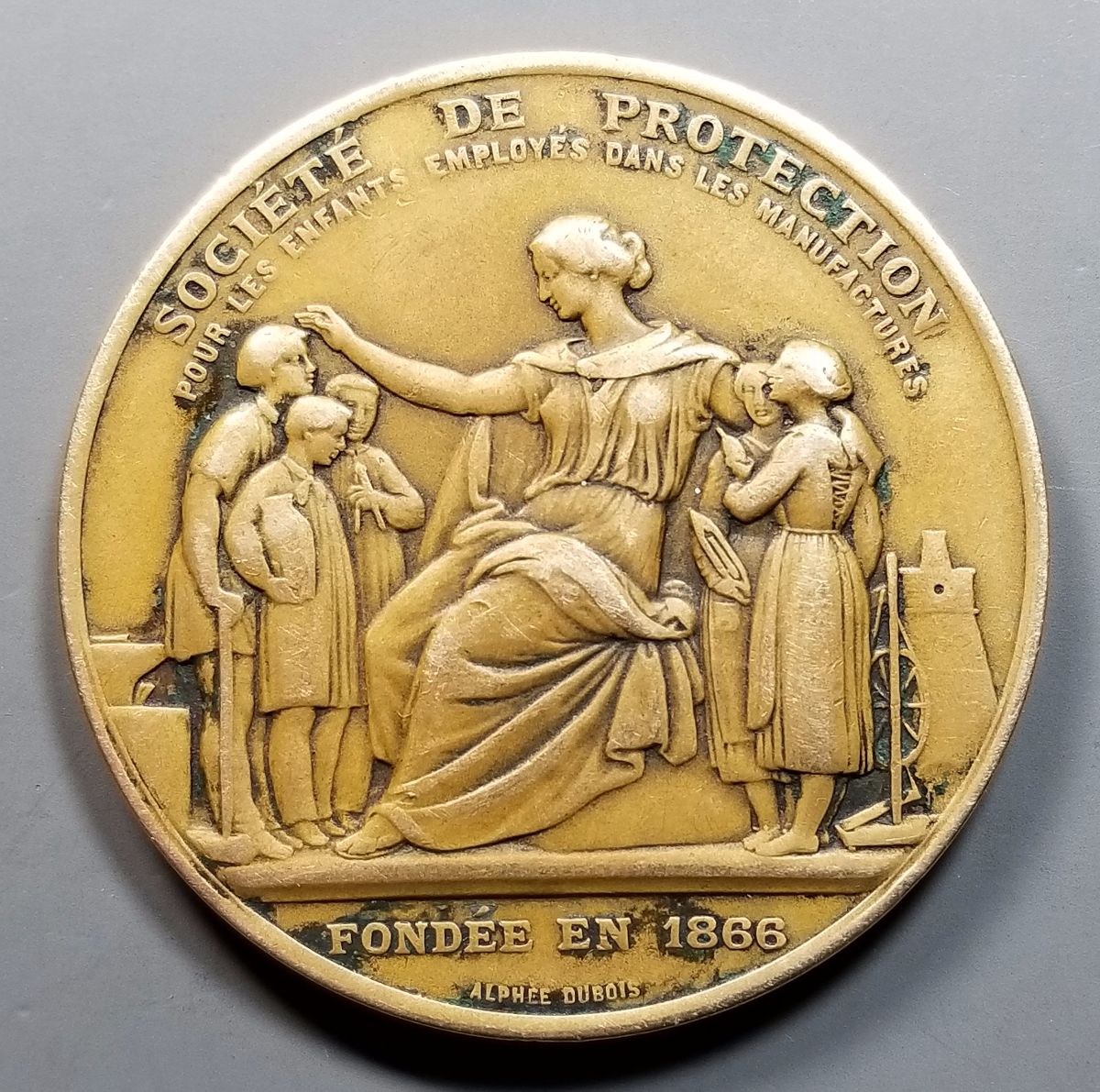
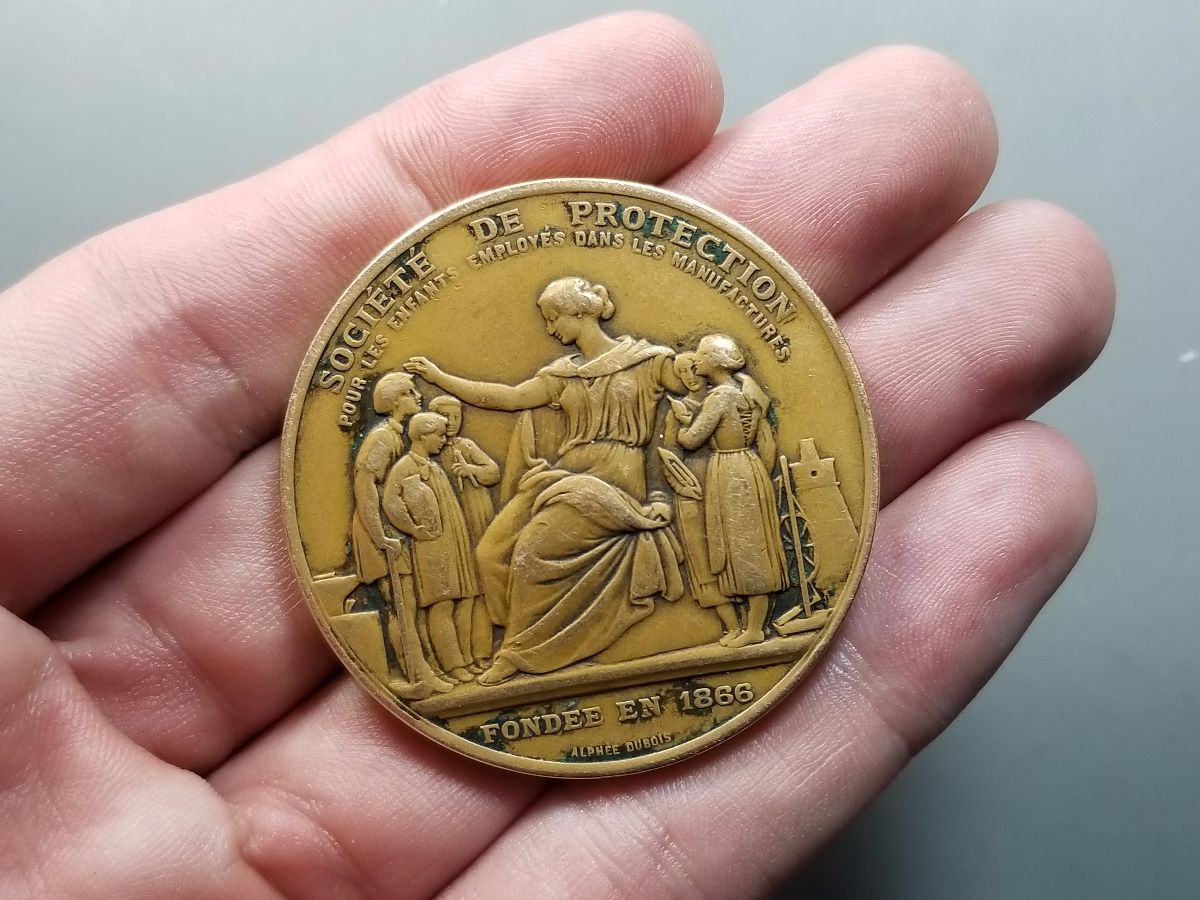
An allegorical figure (perhaps Marianne in the role once held by Sts. Joseph and Nicholas, a nod towards the ongoing de-Catholicization of Republican France at the time?) is on the obverse; to her right, we see an anvil, with the three boys carrying a hammer or axe, a compass, and a pottery jar; to her left are a treadle spinning wheel, a dressmakers' form (?), and the girls hold a flatiron and a spool of thread or a bottle.
In the decade from 1850-1859, the averaged annual mortality rate for orphaned and homeless children under the age of twelve in France was almost 58/100 or 58%. In other words, for every 100 children born, 58 would not survive past the age of twelve (28 of those 100 would have died before age two.)
This is relevant, because many of these particular orphaned or homeless children were put to work in the emerging factories and industries of France in addition to traditional apprentice positions. These children worked in terrible, deadly conditions, and were deprived of even the barest protections that were granted to full apprentices and adult employees. Masters were not bound to honor their apprentice contracts, or even draft them; there were no restrictions on hours; safety was nonexistent; and there was no provision for any sort of education other than the task at hand.
As an example, in the 1870s in the United States, the average working day for a child (of 12-15 years) was 12 to 14 hours for six days. While at work, the doors of the factory were locked: this prevented theft, discouraged absenteeism, and also kept out social workers, government officials and others who might have been interested in the working conditions. Accidents were common, usually the loss of digits or limbs. No thought was given to air quality, chemical exposures, or other safety hazards. Those who left without permission or failed to show up for any reason lost their employment. Fires were particularly feared and deadly; the combination of padlocked doors, no fire protection systems, and no access to fire escapes made factory fires a deadly and devastating event. If you became too sick, weak, or injured to work, you were fired on the spot with no means of financial assistance or insurance. If you protested the conditions, spoke poorly of the company or the supervisors, or otherwise made any attempt to improve your working environment, you were also often immediately fired, and often given a sound thrashing in the process to "teach you a lesson." These brutal conditions applied equally to the older workers, sometimes much more so.
The SPAEM (founded in 1866 as on the medal) was established originally to advocate for these children laborers and all others employed as children; to try to enforce apprentice contracts, to encourage their education, to promote health and welfare, etc. In May 1874, the French government passed a law requiring compulsory education for all children under the age of twelve, and prohibiting them from working in industrial or factory apprentice positions. The law was largely ignored by everyone, from factory owners to farmers. SPAEM advocated for the law, and also worked to provide educational materials, funds, and such for the children of industry. Later on, the Society also provided benefits for children who were injured on the job; financial assistance, medical care, and even family counseling were made available. Pressure began mounting on the government to regulate and investigate industrial activities and provide basic protections for both child and adult workers, or to allow workers to form organizations to carry out those goals.
Trade unions were not legalized until 1884. After that time, Bourses du Travail came into existence (labor councils) and they provided some of the benefits that had previously been dependent entirely on charities. In addition, the Bourses supported the formation of trade unions, and those trade unions targeted illegal child labor among many other concerns. Eventually they were united under the auspices of the Confederation Generale du Travail (CGT), who took a forceful, militaristic approach towards achieving workers' rights including those of underage laborers. By remaining staunchly apolitical they were able to make progress towards child labor laws, wages/hours/standards acts, workers' safety committees, etc. It wasn't easy progress -- in 1908 the French minister Clemenceau allowed (or encouraged, depending on whom you ask) troops to open fire on CGT strikers during a labor stoppage, resulting in the indiscriminate massacre of much of the CGT leadership and over a hundred striking workers. Eventually, despite the CGT's devolution into partisan politics, schisms and warring factions, French labor laws (such as the Accords de Matignon in 1936) would largely obviate the need for charitable societies to protect the most vulnerable of workers - child laborers.
Member
ANA - EAC - TNA - SSDC - CCT #890
"Most of the things worth doing in the world had been declared impossible before they were done." -- Louis D. Brandeis













 Posted 10/12/2017 8:05 pm