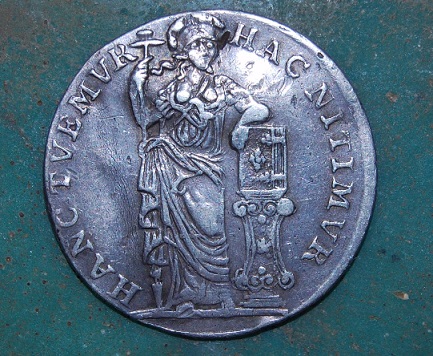
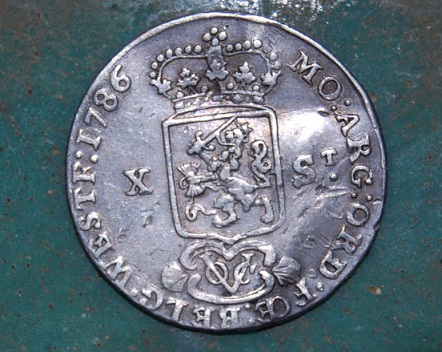
A nice 6 stuiver or ship shilling issued by the Dutch VOC company in it's later days in 1786.
The VOC, founded in 1602, had possibly in fact the first globally-recognized corporate logo. Around the world and especially in English-speaking countries, the VOC is widely known as the "Dutch East India Company". The name 'Dutch East India Company' is used to make a distinction with the [British] East India Company (EIC) and other East Indian companies. As the first historical model of the quasi-fictional concept of the megacorporation, the VOC possessed quasi-governmental powers, including the ability to wage war, imprison and execute convicts, negotiate treaties, strike its own coins, and establish colonies. The VOC played a crucial role in business, financial, socio-politico-economic, military-political, diplomatic, ethnic, and exploratory maritime history of the world.
In terms of military-political history, the VOC, along with the Dutch West India Company (WIC/GWIC), was seen as the international arm of the Dutch Republic and the symbolic power of the Dutch Empire. The VOC was historically a military-political-economic complex rather than a pure trading company (or shipping company). In terms of exploratory maritime history of the world, as a major force behind the Golden Age of Dutch exploration and discovery (ca. 1590s-1720s), the VOC-funded exploratory voyages such as those led by Willem Janszoon (Duyfken), Henry Hudson (Halve Maen) and Abel Tasman revealed largely unknown landmasses to the western world. In the Golden Age of Netherlandish cartography, the VOC navigators and cartographers helped shape geographical knowledge of the modern world as we know them today. The commercial networks of Dutch transnational companies, like the VOC and GWIC, provided an infrastructure which was accessible to people with a scholarly interest in the exotic world.
Due to structural changes, the Fourth Anglo-Dutch War, and French invasion of the Netherlands, the company was nationalised in 1800, and its possessions and debt were taken over by the government of the Batavian Republic (1795-1806). The VOC's territories became the Dutch East Indies and were expanded over the course of the 19th century to include the whole of the Indonesian archipelago, which would later become the modern Republic of Indonesia.
Obv: Standing Dutch Maiden
Legend: HAC NITIMVR - HANC TVEMVR
Rev: Coat-of-arms between X & ST., in a rococo cartouche with the VOC logo.
Legend: MO:ARG:ORD:FŒ:BELG:WESTF:1786
Mass: (gr) 5,56
Diameter: 28mm








 Posted 10/22/2017 1:33 pm


