Edward I (17/18 June 1239 - 7 July 1307), also known as Edward Longshanks and the Hammer of the Scots (Latin: Malleus Scotorum), was King of England from 1272 to 1307. He spent much of his reign reforming royal administration and common law. Through an extensive legal inquiry, Edward investigated the tenure of various feudal liberties, while the law was reformed through a series of statutes regulating criminal and property law. Increasingly, however, Edward's attention was drawn towards military affairs.
As the first son of Henry III, Edward was involved early in the political intrigues of his father's reign, which included an outright rebellion by the English barons. In 1259, he briefly sided with a baronial reform movement, supporting the Provisions of Oxford. After reconciliation with his father, however, he remained loyal throughout the subsequent armed conflict, known as the Second Barons' War. After the Battle of Lewes, Edward was hostage to the rebellious barons, but escaped after a few months and joined the fight against Simon de Montfort. Montfort was defeated at the Battle of Evesham in 1265, and within two years the rebellion was extinguished. With England pacified, Edward joined the Ninth Crusade to the Holy Land. The crusade accomplished little, and Edward was on his way home in 1272 when he was informed that his father had died. Making a slow return, he reached England in 1274 and was crowned at Westminster on 19 August.
After suppressing a minor rebellion in Wales in 1276-77, Edward responded to a second rebellion in 1282-83 with a full-scale war of conquest. After a successful campaign, Edward subjected Wales to English rule, built a series of castles and towns in the countryside and settled them with English people. Next, his efforts were directed towards Scotland. Initially invited to arbitrate a succession dispute, Edward claimed feudal suzerainty over the kingdom. In the war that followed, the Scots persevered, even though the English seemed victorious at several points. At the same time there were problems at home. In the mid-1290s, extensive military campaigns required high levels of taxation, and Edward met with both lay and ecclesiastical opposition. These crises were initially averted, but issues remained unsettled. When the King died in 1307, he left to his son, Edward II, an ongoing war with Scotland and many financial and political problems.
Edward I was a tall man for his era, hence the nickname "Longshanks". He was temperamental, and this, along with his height, made him an intimidating man, and he often instilled fear in his contemporaries. Nevertheless, he held the respect of his subjects for the way he embodied the medieval ideal of kingship, as a soldier, an administrator and a man of faith. Modern historians are divided on their assessment of Edward I: while some have praised him for his contribution to the law and administration, others have criticised him for his uncompromising attitude towards his nobility. Currently, Edward I is credited with many accomplishments during his reign, including restoring royal authority after the reign of Henry III, establishing Parliament as a permanent institution and thereby also a functional system for raising taxes, and reforming the law through statutes. At the same time, he is also often criticised for other actions, such as his brutal conduct towards the Scots, and issuing the Edict of Expulsion in 1290, by which the Jews were expelled from England. The Edict remained in effect for the rest of the Middle Ages, and it was over 350 years until it was formally overturned under Oliver Cromwell in 1657
Edward II (25 April 1284 - 21 September 1327), also called Edward of Caernarfon, was King of England from 1307 until he was deposed in January 1327. The fourth son of Edward I, Edward became the heir to the throne following the death of his older brother Alphonso. Beginning in 1300, Edward accompanied his father on campaigns to pacify Scotland, and in 1306 he was knighted in a grand ceremony at Westminster Abbey. Edward succeeded to the throne in 1307, following his father's death. In 1308, he married Isabella of France, the daughter of the powerful King Philip IV, as part of a long-running effort to resolve the tensions between the English and French crowns.
Edward had a close and controversial relationship with Piers Gaveston, who had joined his household in 1300. The precise nature of Edward and Gaveston's relationship is uncertain; they may have been friends, lovers or sworn brothers. Gaveston's arrogance and power as Edward's favourite provoked discontent both among the barons and the French royal family, and Edward was forced to exile him. On Gaveston's return, the barons pressured the King into agreeing to wide-ranging reforms called the Ordinances of 1311. The newly empowered barons banished Gaveston, to which Edward responded by revoking the reforms and recalling his favourite. Led by Edward's cousin, the Earl of Lancaster, a group of the barons seized and executed Gaveston in 1312, beginning several years of armed confrontation. English forces were pushed back in Scotland, where Edward was decisively defeated by Robert the Bruce at the Battle of Bannockburn in 1314. Widespread famine followed, and criticism of the King's reign mounted.
The Despenser family, in particular Hugh Despenser the Younger, became close friends and advisers to Edward, but in 1321 Lancaster and many of the barons seized the Despensers' lands and forced the King to exile them. In response, Edward led a short military campaign, capturing and executing Lancaster. Edward and the Despensers strengthened their grip on power, formally revoking the 1311 reforms, executing their enemies and confiscating estates. Unable to make progress in Scotland, Edward finally signed a truce with Robert. Opposition to the regime grew, and when Isabella was sent to France to negotiate a peace treaty in 1325, she turned against Edward and refused to return. Isabella allied herself with the exiled Roger Mortimer, and invaded England with a small army in 1326. Edward's regime collapsed and he fled into Wales, where he was captured in November. Edward was forced to relinquish his crown in January 1327 in favour of his fourteen-year-old son, Edward III, and he died in Berkeley Castle on 21 September, probably murdered on the orders of the new regime.
Edward's relationship with Gaveston inspired Christopher Marlowe's 1592 play Edward II, along with other plays, films, novels and media. Many of these have focused on the possible sexual relationship between the two men. Edward's contemporaries criticised his performance as a king, noting his failures in Scotland and the oppressive regime of his later years, although 19th-century academics later argued that the growth of parliamentary institutions during his reign was a positive development for England over the longer term. Debate has continued into the 21st century as to whether Edward was a lazy and incompetent king, or simply a reluctant and ultimately unsuccessful ruler.
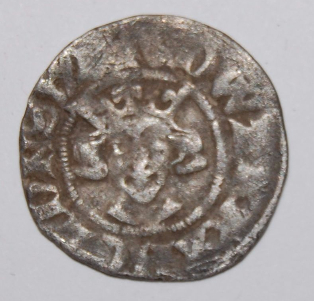
Obv: Crowned king, with curly hair facing
Legend: +EDW REX ANGL DNS HYB
Which translates to: EDWARD KING OF ENGLAND LORD OF IRELAND
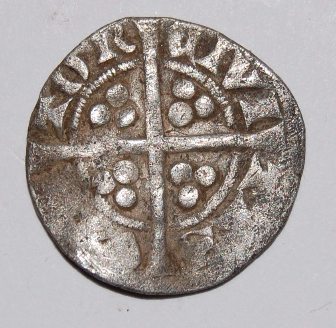
Rev: Cross with 3 pellets in every quadrant
Legend: CIVITAS CANTOR
Diameter: 18,5mm
Mass: 1,34 gramm









 Posted 10/27/2017 10:00 pm


