Archaeological findings indicate that the area surrounding Zwolle has been inhabited for a long time. A woodhenge that was found in the Zwolle-Zuid suburb in 1993 was dated to the Bronze Age period. During the Roman era, the area was inhabited by Salian Franks.
The modern city was founded around 800 CE by Frisian merchants and troops of Charlemagne. The name Zwolle is derived from the word Suolle, which means "hill" (cf. the English cognate verb "to swell"). This refers to an incline in the landscape between the four rivers surrounding the city, IJssel, Vecht, Aa and Zwarte Water. The hill was the only piece of land that would remain dry during the frequent floodings of the rivers. Zwolle was established on that incline.
A document mentions the existence of a parish church dedicated to St Michael. That church, the Grote or Sint Michaëlskerk (big or Saint Michael Church), was renovated in the first half of the 15th century and exists to this day. The church contains a richly carved pulpit, the work of Adam Straes van Weilborch (about 1620), some good carving and an exquisite organ (1721).
On August 31, 1230, the bishop of Utrecht granted Zwolle city rights. Zwolle became a member of the Hanseatic league in 1294, and in 1361 joined the war between the Hanseatic League and Valdemar IV of Denmark. In the 1370 Treaty of Stralsund that ended the war, Zwolle was awarded a vitte, a trade colony, in Scania, then part of Denmark. Zwolle's golden age came in the 15th century. Between 1402 and 1450, the city's Gross Regional Product multiplied by about six.
In July 1324 and October 1361, regional noblemen set fire to Zwolle. In the 1324 fire, only nine buildings escaped the flames.
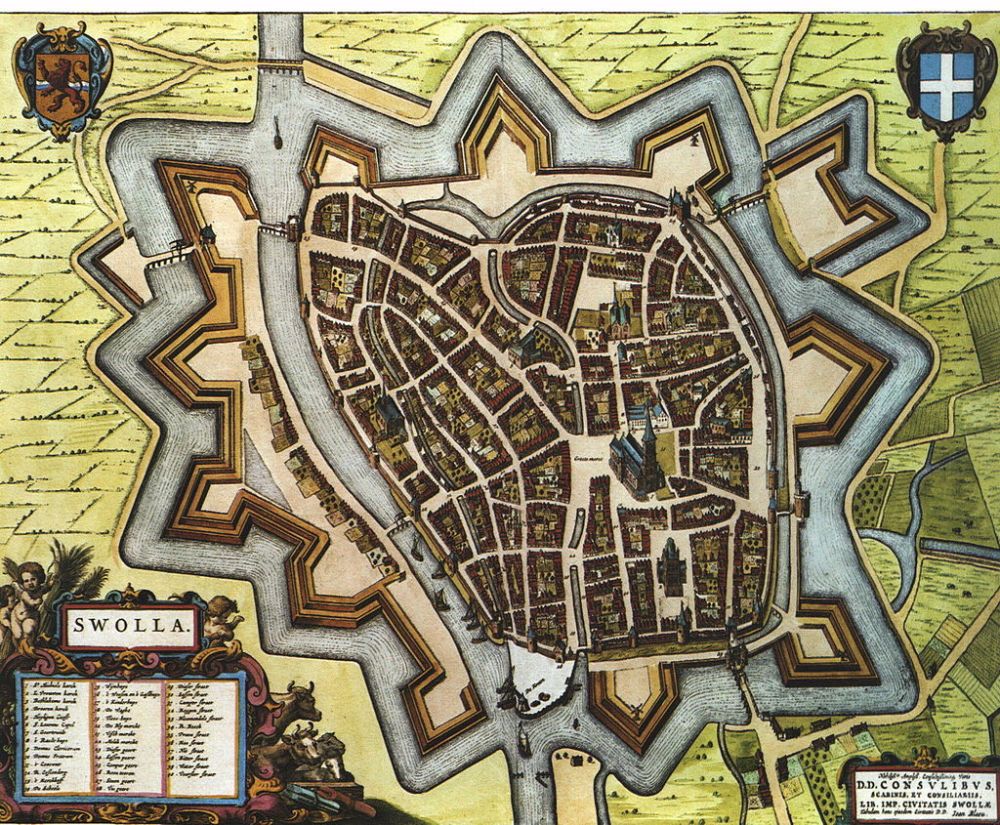
Map of Zwolle by Joan Blaeu in Blaeu's "Toonneel der Steden", 1652
Zwolle was also, with Deventer, one of the centers of the Brethren of the Common Life, a monastic movement. 5 km (3 mi) from Zwolle, on a slight eminence called the Agnietenberg, (hill of St Agnes), once stood the Augustinian convent in which Thomas à Kempis spent the greatest part of his life and died (in 1471).
At least as early as 1911, Zwolle had a considerable trade by river, a large fish market, and the most important cattle market in the Netherlands after Rotterdam. The more important industries comprised cotton manufactures, iron works, boat-building, dyeing and bleaching, tanning, rope-making, and salt-making.
Librije
In World War II, Zwolle was single-handedly liberated from the Germans by Canadian soldier Leo Major. He was made an honorary citizen of Zwolle in 2005 and a street is named for him.
Zwolle was in comparison to the other Dutch cities a bit late with the opening of a mint house. The city waited until she obtained the coin right from the German emperor. This happened to Zwolle in 1488 (by Frederick III). After Zwolle had won the right to mint, from 1488 to 1499 coins were struck for the account of the city, in the name of the German emperors.
Since 1534 Zwolle participated in the agreement with the cities of Kampen and Deventer to set up a joint currency. This mint was established in Deventer, however, the costs and revenues were divided among the three cities. The mint was in operation from 1534 to 1583 in Deventer and from 1583 to 1588 in Kampen. These coins were also issued by the titles of the German emperors because all three cities exercised the mint right through the privileges of the German emperor(s). After the conquest of Deventer in 1587 by the Spaniards under Parma, the town of Kampen had still issued coins in the name of the three cities untill 1588. However, after this year, cooperation between the three cities ceased as the city of Deventer could no longer satisfy the terms of the agreement. After the revival of Deventer (1591) by Prince Maurits, however, the three-city mint was no longer pursued, but the cities began to mint each other on behalf of the city. Already in 1588 Zwolle entered into negotiations with Caspar Wijntgens, but it was only coincided with his brother Balthasar Wijntgens Jr. from about 1591. Again in the name of the German emperors:
Rudolf II 1596-1612
Matthias In 1612-1619
Ferdinand II 1619-1637
Ferdinand III 1637-1657
Because the city of Zwolle had no control over its quality and amount of coins, friction with the states-general was often generated. Indeed, the city was in the republic but relied on the coin duty on the German emperor's minting privilege from 1488. Finally, in 1606, the States General and the city agreed that they would suspend the minting for a period of 3 years at a repayment sum of 6000 guilders.
However, already in 1612, the first urban coins of Zwolle again appeared. The reopened coin house returned coins in the name of the German emperors. After the death of German Emperor Ferdinand III, the last coins were (1657-1694) minted as an example and as much as possible according to the rules of the States General. However, it was often enough that the coins were too light and that prohibited coins were issued like shillings and florins. Finally, in 1694, the mint was finally closed against a yearly payment of 4000 guilders, which the city received until its abolition by King Louis Napoleon in 1809.
Obv: Crowned Spanish double coat of arms
Legend: MONE.ARGEN. IMPERI.CIVITA.ZWOL coat of arms
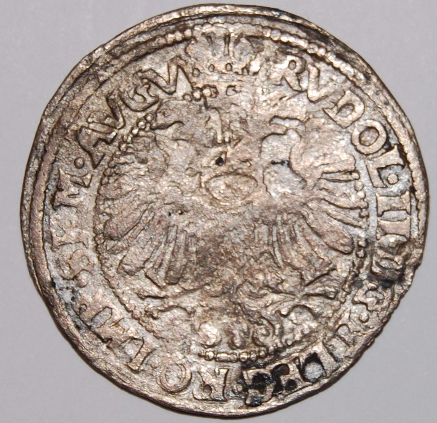
Rev: Crowned double eagle with scepter and globe
Legend: RVDOL.II.D.G.ELEC. RO.IMP.SEM.AVGV
Diameter: 32mm
Mass: 3,66 gramm

 *** Moved by Staff to a more appropriate forum. ***






 Posted 10/27/2017 11:23 pm