Coin Community Family of Web Sites Join Thousands of Coin, Bullion, & Money Collectors
Specializing in Modern Numismatics Shop for APMEX Bullion on eBay!Vancouvers #1 Coin and Paper Money Dealer Coin, Banknote and Medal Collectors's Online Mall Join Thousands of Coin, Bullion, & Money Collectors Royal Canadian Mint products, Canadian, Polish, American, and world coins and banknotes. 300,000 items to help build your collection!


Username:
Password:
Save Password
Forgot your Password?


This page may contain links that result in small commissions to keep this free site up and running.

Welcome Guest! Registering and/or logging in will remove the anchor (bottom) ads. It's Free!

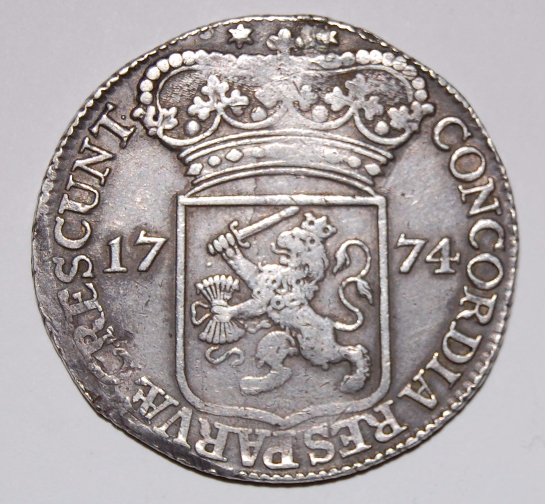
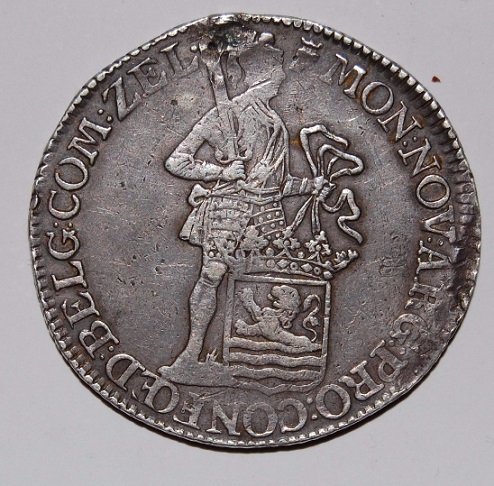
Dutch Ducat From The Province Of Zeeland 1774

To participate in the forum you must log in or register.
Author Previous TopicReplies: 10 / Views: 2,392Next Topic  
Pillar of the Community
Archeo1982's Avatar
Netherlands
521 Posts
 Posted 10/27/2017  11:20 pm Show Profile   Bookmark this topic Add Archeo1982 to your friends list Get a Link to this Message Number of Subscribers
The current province of Zeeland fell for the coinage for a long time under the great territory of Holland. The legend on the Dutch coins that were issued in Dordrecht ended therefore often with COMES HOL ZEL (Count of Holland and Zeeland). On December 18, 1579, the states of Zeeland decided to set up their own mint in Middelburg. The former coin master of Holland, Jeronimus Bruynseels, was approached for the function of the ministry of Zeeland. When he accepted, delegates from Zeeland were sent to Antwerp to gather at the meeting of the General Assembly. At this meeting the delegates had to guarantee that the Zealand coins would be included in the "coin tolerance". This was to prevent that the Zeeuws coins were being declared billions of dollars. The deputies also had to obtain permission from Archduke Matthias and Prince Willem van Oranje.

The states of Holland, however, responded fiercely to the intention of the States of Zeeland to open a minting house. Prince Willem van Oranje also said in a letter "not to be very pleased with it". The states of Holland even ordered to imprison Jeronimus Bruynseels because he had dared as a Dutch citizen to conclude a contract with the states of Zeeland for the purpose of setting up a new mint. Jeronimus Bruynseels released a 6000 guarantor on condition that he would not leave the city (Dordrecht). The States of Zeeland took no pleasure in this whole process and argued that if the creation of a new currency was previously the privilege of the crown, this privilege now rests with the states of each region because of the authority of the Spanish king ( Philips II) was no longer recognized. According to Zeeland, the states of each region had the sovereign power to open a ministry if they regard this as the interests of their residents.

During this argument, Middelburg was pushed forward (on the advice of Bruynseels, as long as Jan Noirot was appointed as temporary co-master from Antwerp) (16 June 1580) to continue preparing for the minting. A temporary mint was set in a house on the Dam / Molstraat corner.

On July 22, 1580, Zeeland decided to play the game harder, the Middelburg baljuw was ordered to pick up Jeronimus Bruynseels in Dordrecht. If Holland would like to do something about it, the States of Zeeland would respond to this by holding Dutch residents who stayed in Zeeland. Bruynseels arrived in Middelburg without any problems and was sworn on August 22, 1580. On November 24, he received his first instruction to issue Philips daalders, Burgundian daalders, golden crowns, stuivers and oorden.

Thus, in 1580, the minting for Zeeland in Middelburg finally began, which again indicates how confusing the situation was during the republic's starting time. Even Willem van Oranje could not stop the creation of a new coin house. It is also remarkable that Jeronimus Bruynseels in 1586 returns as General mint master of the mint of the United Dutch States. He was succeeded by Jacob Boreel on the Zeeland mint. Jeronimus Bruynseels was sent to Enkhuizen in 1586 by the states-general together with Jacob van Sloten (family of Dutch mintmaster Johan van Sloten?). They had to interrogate the captive hagemunter Anthonis van Eembrugge about his counterfeit practices and find out who accomplices were.

The Zeeuwse mint was moved under Jeronimus Bruynseels to the Middelburg Abbey. This abbey had to be abandoned by the Norbertijner canons in 1574 after surrender of the city to the armies of Orange. The minting tools was partly from the estate of a deceased coin master from Brugge and partly manufactured in Utrecht at the expense of Bruynseels.

The first copper oorden of Zeeland were minted with the portrait of Philips II and with his title as Count of Zeeland. On the backside, the coat of arms of Austria-Burgundy is placed. The legend on a first rare issue was still the credo of Philips II (DOMINUS MIHI ADIUTOR), but this changed in the new credo that the other regions started to use, namely: PACE ET IUSTITIA (peace and justice). On 7 June 1590, the States of Zeeland decided that in the Zeeland region only copper money could be circulated in the Zeeland region itself.

In the 17th century, the text LUCTOR ET EMERGO (I struggle and come above the waves) appeared on the Zeeland's duiten en oorden. In 1754, however, there were legends with the text: LUCTOR ET EMENTOR. This means something like: I struggle and go down. It would be a misguided joke of the die cutter Martinus Holtzhey Junior. Drs. However, G. van der Meer wrote an article on some of the facts that make his involvement in this case doubtful.

The provincial minting house of Zeeland produced until 1796, the coins that were issued after this date are no more provincial coins but fall under the Batavian Republic. In 1798 the mint was finally closed.

Obv: Standing armored Knight with crowned shield at feet
Legend: MON NOV ARG PRO CONFŒD BELG COM ZEL
Rev: Crowned arms of Zeeland between the year 1774
Legend: CONCORDIA RES PARVAE; CRESCVNT
Diameter: 43mm
Mass: 28 gramm


Dutch-Ducat-From-The-Province-Of-Zeeland-1774
Edited by Archeo1982
10/27/2017 11:27 pm
Valued Member
cara's Avatar
Uruguay
217 Posts
 Posted 10/28/2017  9:07 pm  Show Profile   Bookmark this reply Add cara to your friends list Get a Link to this Reply
@Archeo1982, nice coin and History !!

Was the Silver Dutch Ducat equivalent to other currencies at that time for trade purposes?
Pillar of the Community
Archeo1982's Avatar
Netherlands
521 Posts
 Posted 10/28/2017  9:13 pm  Show Profile   Bookmark this reply Add Archeo1982 to your friends list Get a Link to this Reply
I believe it was. Like the lion dollar & later on the Maria Theresia Thaler
New Member
naperville-pawn's Avatar
United States
2 Posts
 Posted 02/26/2024  11:53 am  Show Profile   Bookmark this reply Add naperville-pawn to your friends list Get a Link to this Reply
Archeo1982 - thank you for the detailed information and analysis

history, being a lifelong learning endeavor, we understand its a winding road of information - we wonder if you could cite ANY sources for us to read more on your 1579-1586 details on mintmaster Bruynseels ?

his was an active tenure at the beginning of the Dutch republic and we are trying to explore more - thanks for any time you can give on these thoughts
Moderator
Learn More...
jbuck's Avatar
United States
188342 Posts
New Member
naperville-pawn's Avatar
United States
2 Posts
 Posted 02/26/2024  3:00 pm  Show Profile   Bookmark this reply Add naperville-pawn to your friends list Get a Link to this Reply
thank you jbuck and community :) we thought we could sneak in unnoticed, but you caught us
Pillar of the Community
thq's Avatar
United States
3343 Posts
 Posted 02/27/2024  08:49 am  Show Profile   Bookmark this reply Add thq to your friends list Get a Link to this Reply
A brief history of the patagon would be interesting Archeo1982.
"Two minutes ago I would have sold my chances for a tired dime." Fred Astaire
Pillar of the Community
beem's Avatar
United States
570 Posts
 Posted 03/03/2024  1:34 pm  Show Profile   Check beem's eBay Listings Bookmark this reply Add beem to your friends list Get a Link to this Reply
Great post.

Silver Ducats are one of the last big bargains out there, as far as silver crown sized coins go. And the modern proof silver ducats are a solid bargain, too, especially those with lower mintages.
Pillar of the Community
Learn More...
tdziemia's Avatar
United States
7940 Posts
 Posted 03/05/2024  06:22 am  Show Profile   Bookmark this reply Add tdziemia to your friends list Get a Link to this Reply

Quote:
A brief history of the patagon would be interesting Archeo1982.
.

I'll start ...
The patagon was part of the 1612 monetary reform undertaken by Albert VII of Austria and Isabella, the governors of the Spanish Netherlands. By then, the United Provinces of the Netherlands (Dutch Republic) had broken away and become independent, so, the type was intended to be struck in the following principalities (mints in parentheses).
- Duchy of Brabant (Antwerp, Brussels, Maastricht, 's-Hertogenbosch)
- County of Flanders (Bruges)
- Duchy of Luxembourg
- Lordship of Tournai
Under their successor, Philip IV, it would also be struck at
- Country of Artois (Arras)
- County of Burgundy/Franche Comte (Dole)

Specified at 28.1 grams and 0.875 fine, it was initially valued at 48 stuivers/patards, and contained about 5% less silver than the imperial Reichsthaler, and the local Ecu de Bourgogne / Bourgondische Rijksdaalder which preceded it, and about 3% less silver than the Dutch Republic's rijksdaalder.

It was hammered until the reign of Charles II, when the presse au balancier (screwpess?) was introduced around 1691 at Antwerp, Brussels and Bruges.

de Witte (Vol. 3, 1899) also called it a "silver sovereign" (souverain d'argent) and says the origin of the name patagon was an "augmentative" (which I presume to be the opposite of a "diminutive") of the pataca, the small copper coin of Spain and Portugal , though other more imaginative hypotheses exist.


Edited by tdziemia
03/05/2024 07:15 am
Pillar of the Community
Learn More...
tdziemia's Avatar
United States
7940 Posts
 Posted 03/06/2024  06:39 am  Show Profile   Bookmark this reply Add tdziemia to your friends list Get a Link to this Reply
...almost forgot ...

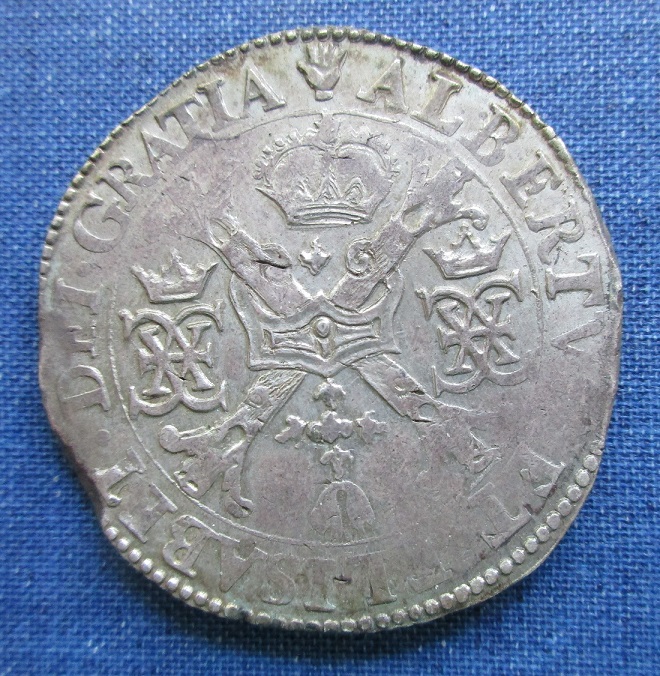
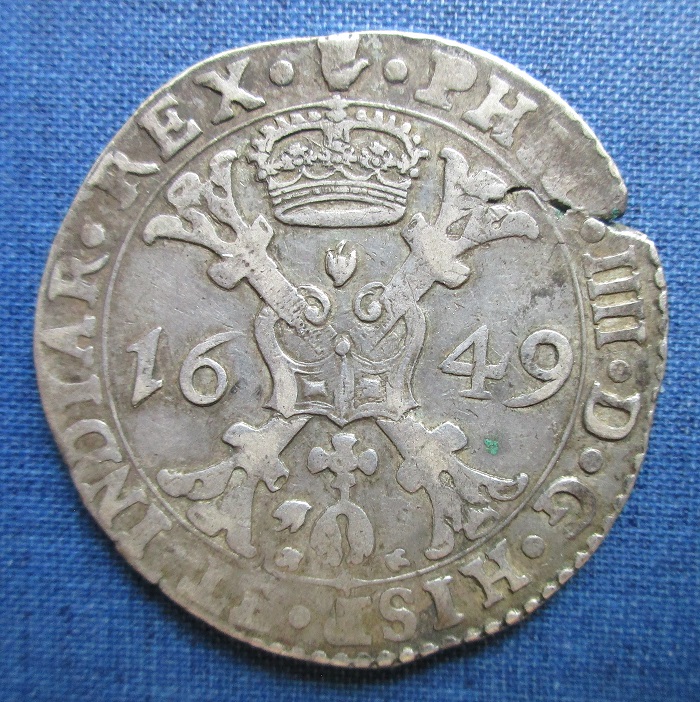
As with its predecessor, the obverse design features a crowned Burgundian cross (cross of Saint Andrew with a firesteel at center) and the beginning of the sovereign's titles. Initially, the cross was flanked by the soverigns' AE monograms:
Dutch-Ducat-From-The-Province-Of-Zeeland-1774

Later (from 1623) it was flanked by the date:
Dutch-Ducat-From-The-Province-Of-Zeeland-1774

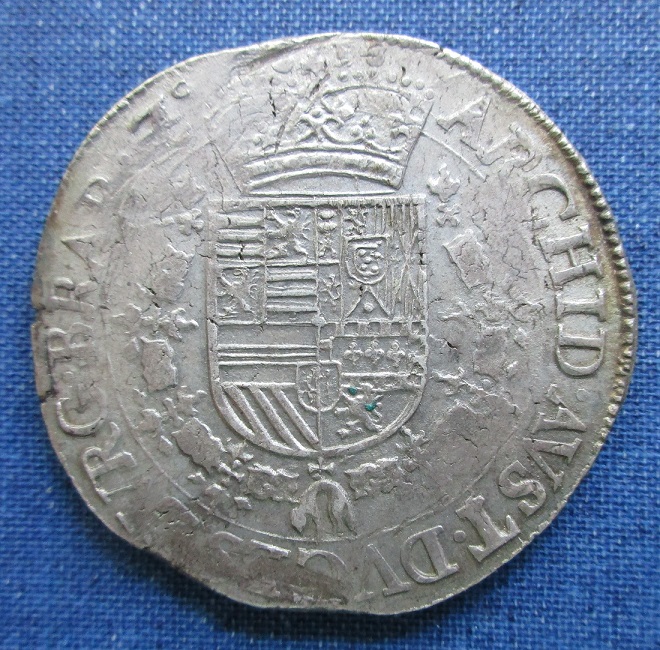
The reverse design was a large crowned shield of arms surrounded by the collar of the or of the golden fleece (again, similar to the earlier Ecu de Bourgogne but the central device is larger), but the lettering is just the continuation of the soverign's titles:
Dutch-Ducat-From-The-Province-Of-Zeeland-1774

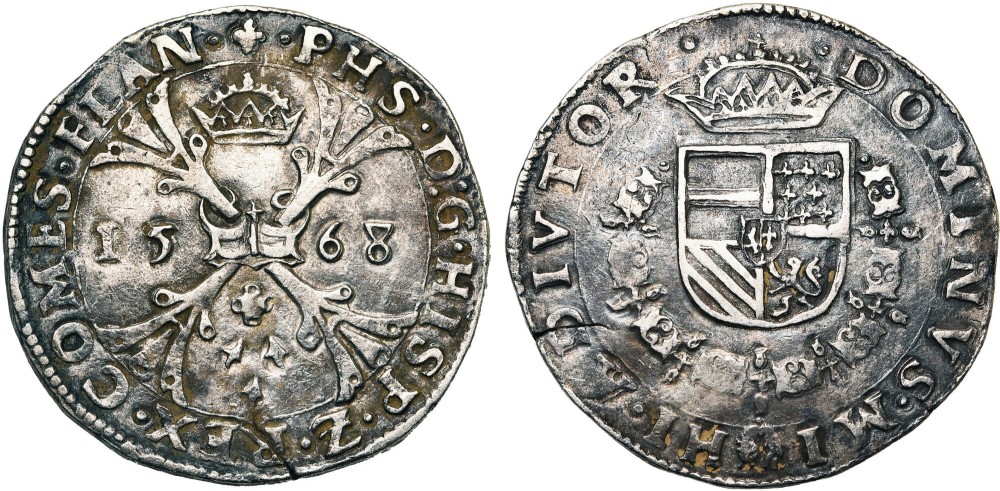
Here is the Ecu de Bourgogne / Bourgondische kruisrijksdaalder of Philip II (struck 1567-1592) from which the patagon evolved:
Dutch-Ducat-From-The-Province-Of-Zeeland-1774
© Jean Elsen et ses Fils
Edited by tdziemia
03/06/2024 07:35 am
Pillar of the Community
thq's Avatar
United States
3343 Posts
 Posted 03/06/2024  09:47 am  Show Profile   Bookmark this reply Add thq to your friends list Get a Link to this Reply
Thanks tdziemia. It's an odd word, and everything indicates Spanish origin, but there's nothing certain about it. I think about Magellan's giant South American Patagons, who predate the coins by 80 years or so. That's where all the Spanish silver came from.

I was picking them up in auctions for a while and have a half a dozen issued over the whole period. They appear to be Spanish equivalents of Dutch trade coins of crown size, like daalders and rijders. The weight and purity variation of all the silver crowns from this period is astounding to me. Fierce trade competition fuelled by the abundance of silver. In some ways similar to the massive coining of Morgan dollars.
"Two minutes ago I would have sold my chances for a tired dime." Fred Astaire
Edited by thq
03/06/2024 11:24 am
  Previous TopicReplies: 10 / Views: 2,392Next Topic  

To participate in the forum you must log in or register.


Disclaimer: While a tremendous amount of effort goes into ensuring the accuracy of the information contained in this site, Coin Community assumes no liability for errors. Copyright 2005 - 2026 Coin Community Family- all rights reserved worldwide. Use of any images or content on this website without prior written permission of Coin Community or the original lender is strictly prohibited.
Contact Us  |  Advertise Here  |  Privacy Policy / Terms of Use

Coin Community Forum © 2005 - 2026 Coin Community Forums
It took 0.38 seconds to rattle this change. Forums