Reckheim, now Rekem, is located near the Maas river in Belgian Limburg not far north of Maastricht (NL). The oldest known lord of Rekem is Arnold van Rekem (1108). Reckheim became a free baronie in 1356. On March 31, 1623, the free baronie of Reckheim was installed by the Emperor Ferdinand II as a state-owned county. In addition, the right to mint gold, silver and copper coins was given again. Like the cities Deventer, Kampen and Zwolle, Reckheim was directly under the authority of the holy Roman Empire. The earliest coins of Reckheim date back to the 14th century, in the name of the lords from Stein.
The county of Reckheim was a ministry consisting of the towns of Rekum, Uikhoven and Boorsem and the hamlets of Kotem, Halle, Geneut and Weset (now Veld-Wezelt). Rijckholt was added on January 10, 1596. On this date he bought it from Willem van Vlodrop. Some time later, it returned to the Vlodrop family.
In 1631 the county consisted of about 160 houses and so it wasn't really a big county. Nevertheless, it was possible to overcome the Dutch market mainly with copper coins. The huge amounts that have been minted and the variety can only indicate one thing: they were minted for export to elsewhere. The county was small so there was no outlet. Also, most minted types did not match the coins that were in circulation around the Reckheim region.
In 1590, when Herman van Aspremont-Lynden (baron from 1590-1603) came to power in Reckheim, the large-scale minting were starting. He was the son of theiry of Aspremont-Lynden and Marie van Elderen. Herman had exchanged Reckheim with Willem Quadt van Wijkradt who got his German possessions in place. Among other things, Zobbenbroek with many vineyards in Bacharach on the river Rhine. Next to his title, Baron of Reckheim, he also had the title Baron van Boorshem. He was also Baron of Rijckholt, Lord of Houtain-St.Simeon, Once-sur-Geer, Tongrenelle, Wanfercee-Baulet and Crenwyck. He was married to Marie van Hamal.
Emperor Rudolf II (1576-1612) granted Herman all the old rights and privileges including the minting right. He also declared the barony hereditary both in the male and in the female line. In 1595 Herman completely dismantled the old ruined castle and rebuilt it from the ground up. After his death in 1603, his son Ernestus, born in 1583 succeeded him as baron.
Ernestus called himself the free baron of Reckheim, Boorsem and Rijckholt. He married in 1609 with Anne Antoinette Gouffier (1580 -1620) with whom he had four children, one son and three daughters. She was the lady of Thiennes and her father was Henri Gouffier, Lord of Crèvecoeur. Her great grandfather was married to Philippe de Montmorency, lady of Vitry-en-Brie, daughter of Jean II, the Lord of Montmorency. Therefore it is, that on the Reckheim coins, small eagles may also be used from the Montmorency weapon. Ernestus was a diplomat and was in favor of future emperor Ferdinand II (1619-1637). On March 31, 1623, Reckheim was promoted by this emperor to county and was reaffirmed the right to mint gold, silver and copper coins. In the same year, Ernestus received the skull of Saint Petronella, an important relic. In order to save it in a dignified way, he built a new chapel. From 1625 to 1630 he completely walled the Rekem village with two entrance gates. In 1635 a second wall was raised inside the 1st. All these construction activities will undoubtedly have had an effect on the coinage. Ernestus would have the money needed for this work partly funded from the profits of the minting. From 1620-1636, we see an increased activity in the minting. The copper price was also very favorable in these years, which helped significantly to make a profit. In 1626, the price of Swedish copper on the Amsterdam staple market was 64 guilders per 100 pounds. In the 1630s, the price dropped to 50 guilders per 100 pounds while not changing the weight and value of the copper duits and oords. Only after 1650 the price of the copper began to rise again.
A very moved period of imitations took place during the reign of Ferdinand D'Aspremont-Lynden (1611 -1665). After the death of his father Ernestus in 1636, he obtained the county. In addition he
inherited the baronies Thiennes and Steenbeek and the delights of Blaringen, Houtain-St.Simeon and Once-sur-Geer. Rijckholt is no longer available, so before 1636 he had to go back to the Vlodrop family. Ferdinand married in 1643 with Isabel, Countess of Fürstenberg-Heiligenberg who gave him 16! children. like his father, he continued to massively encourage copying of money. He continued his mint types, and introduced some new types. He began again with the creation of mainly liards of the Prince bisdom Liège and of South Dutch liards.
Many imitations are composed on such a manner, that when one had complaints about the Reckheim currency, one could immediately give a defense. The figures on the coins were often very ingeniously assembled and looked a lot like the originals. Often only interchanges and accountants could distinguish the Reckheim's imitations from the real ones. The minting of these coins was possible because most people in that time could not read and therefore could not read the inscriptions on the coins. The profit achieved by Reckheim's Lords with their coinage resulted from the appearance of the coins. They looked like the originals, but the quality and weight were a lot less. For example, many Reckheim coins weighed only less than half of that of a good one, while the silver coins contained a too high copper percentage. Therefore it is not so strange that Reckheim had complaints about the coinage. In Liège, after 1650 under Maximilian of Bavaria (1650-1688), even places of a new type were introduced because the old was almost no longer accepted because of the many falsifications. In 1652 a commission of inquiry was formed by Emperor Ferdinand III (1637-1657) and everybody who had a dispute with Reckheim was challenged.
Liege complained that the count mimicked the weapon of their sovereign on his coins. The Count of Reckheim defended himself by pointing out his right to mint coins. Both in his castle in Reckheim and in Weset. However, after this date the minting of these types came to a halt date. At a trial in Groningen in 1659 against one Dirk Hamer, the Count of Reckheim wrote that his dies were cut by the die cutter of the mint in Liège. Something I think would not have happened if he had still minted imitations of Liege. The minting of duits and oords after the north-Dutch types will have been a safer activity for Ferdinand. One could complain about his coins but there was not much to do about it. Reckheim was far away in the southern Netherlands and enjoyed protection from the German emperor.
In 1665, Count Ferdinand died, but his children were still underage. Bishop Frans Egon of Fürstenberg, Ferdinand's brother-in-law, and Isabelle Henriette d'Aspremont-Lynden, princess abdis of Munsterbilzen, were appointed as guardian until one of the children became a contender. Frans Egon of Fürstenberg was an important figure in the area of #8203;#8203;the Principality of Liege and the surrounding areas. He had a great influence on Maximilian of Bavaria, cousin and successor to Prince Bishop Ferdinand of Bavaria, together with his brother Willem Egon. Maximilian had little interest in ruling the princebisdom and led a retired life as an alchemist. He left the governing to both brothers Frans Egon and Willem Egon. They were the youngest generation of a long list of delights and abbeys including those of Stavelot. The German emperor raised them in 1644 as princes. Frans Gobert of Aspremont-Lynden was the eldest son of Count Ferdinand and left the board in 1673 when he became a senior. His uncle Frans Egon had provided him with many profitable ecclesiastical titles. Because Frans Gobert was a priest, officially he couldn't have children, so the rights to the county were transferred to his brother Ferdinand Gobert. However, Frans Gobert managed the county in his name. It is noticeable that many sons have the nickname Gobert and the daughters called Gobertina. This name was to honor an ancestor, Gobert van Aspremont, Monk of Villers and Crusader.
In the northern provinces, the duits (and oords) who were minted in Reckheim were used next to the official copper coins. Most coins were imitations of Friesland, Utrecht and some cities. In 1702, however, the province of Holland introduced a new type of duit, which was larger and heavier than the old ones. In the meantime, only these were allowed to circulate and the old and odd types were reduced to a half duit. All other provinces began to mint the new and heavier duits since 1702. Due to the better production, due to the use of the screw press and the heavier weight, Reckheim stopped minting inferior coins.
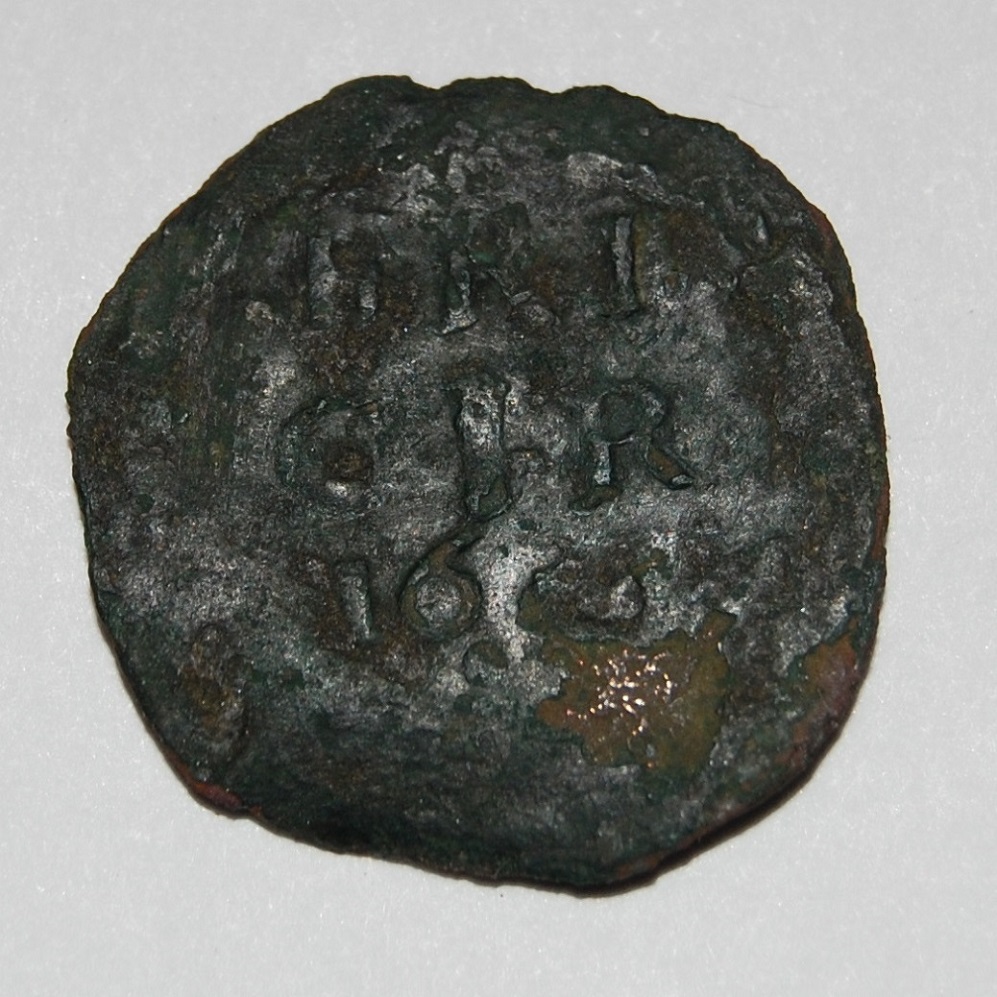
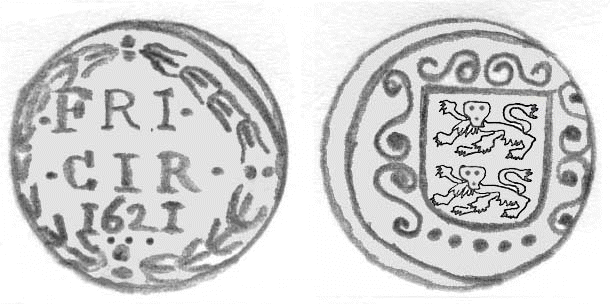
Obv: A tulip wreath with FRI CIR (or variant). The legend resembles the province name of Friesland as it appears in the German language. In fact, it is a very strong abbreviation of the name and titles of Emperor Ferdinand and the name of the Reckheim County.
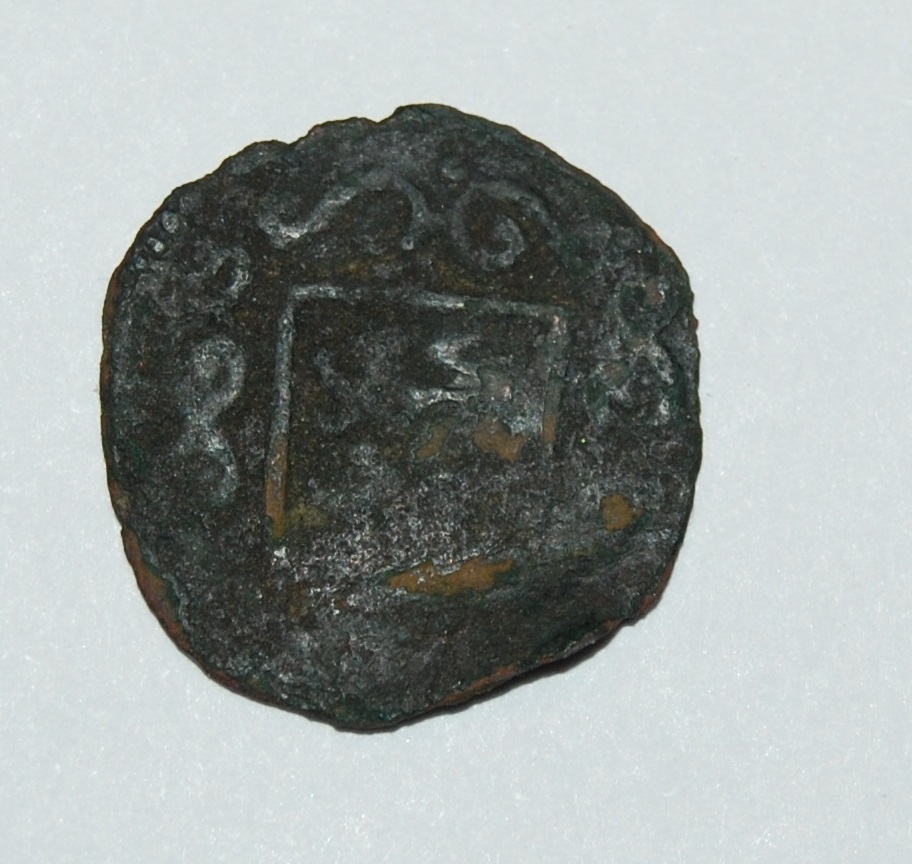
Rev: An uncrowned coat of arms that resembles that of Friesland, with all-round decorations. However, the lions now look at the viewer as in the arms of West Friesland.
Diameter: 21mm
Mass: 1,04 gramm







 Posted 10/29/2017 12:05 am


