| Author |
 Replies: 11 / Views: 2,567 Replies: 11 / Views: 2,567 |
|
|
New Member
United States
2 Posts |
I found this coin in circulation a few months ago and would like some help identifying the different types of mint errors it contains, as well as an estimate of what it could be worth. Thank you for your help ahead of time. 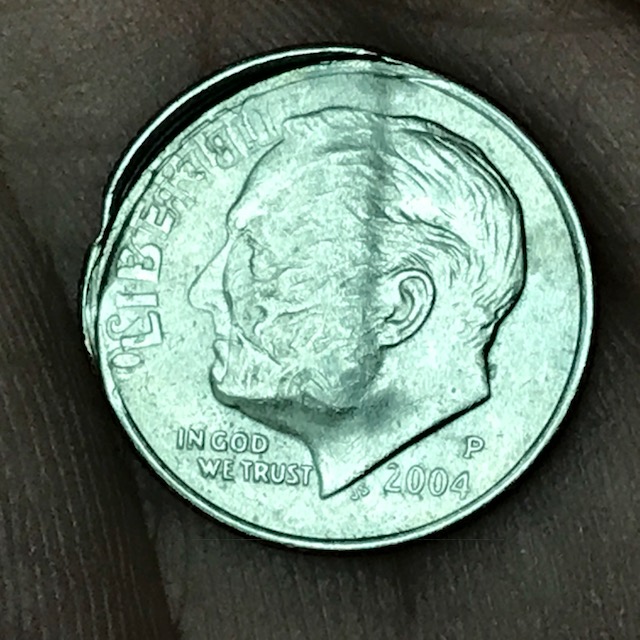 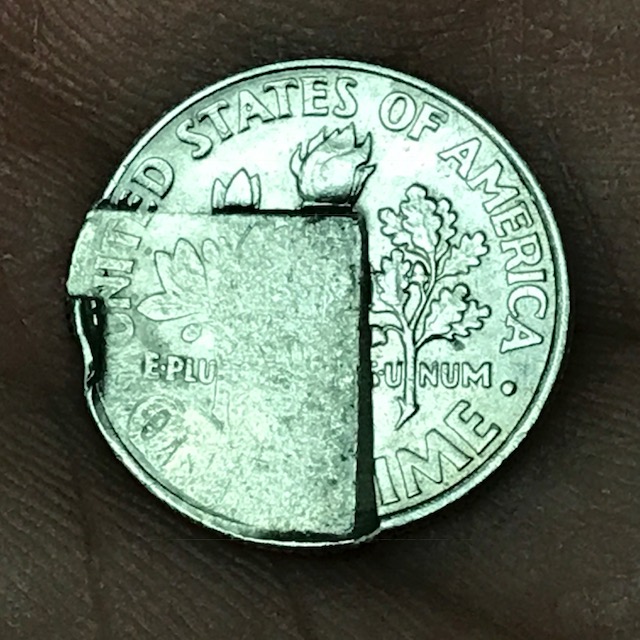 Edited by energyman9275
11/07/2017 07:51 am
|
|
|
|
Pillar of the Community
United States
5825 Posts |
Certainly an intriguing coin.
No idea about the cause.
|
|
Pillar of the Community
United States
5196 Posts |
 , it looks PMD to me |
|
Pillar of the Community
United States
1901 Posts |
vise job someone took and squeezed it in a vice with a nickel Edit Oh yeah Edited by Mrzllewellyn
11/07/2017 09:41 am
|
|
Moderator
 United States
195559 Posts |
to the Community! |
|
Moderator
United States
23522 Posts |
Welcome to Coin Community. The first step in identifying a potential error is answering the question, "Could this have happened at the Mint?" In this case, it's very unlikely.
1) There are Mint-original scenarios which could result in a reverse impression of one coin onto another. However, the nature of a coin press precludes such a small area of impact when this happens; one would expect evidence of such an overstrike across the entire face of the receiving coin. Under 100+ tons of pressure, stuff does not stay tilted.
2) Although there are scenarios - a strikethrough - which could conceivably lead to a square cutout such as this coin shows, if that happened it would not have been possible for a rim to have formed under it. A successful rim requires proper contact between die and collar, which cannot happen if a foreign object has inserted itself between them. This coin is no longer round, and the process by which that rim is formed can only result in a perfectly round coin. Further, one can see the outline of that square on the obverse, and this is simply not possible is the coin were struck that way.
The inevitable conclusion is that this happened post-Mint, likely a situation where one Dime was squeezed against another in a smooth-faced vise. Possibly a hydraulic press, as the pressure involved in wiping out that much detail on a coin has to be tremendous.
|
|
Bedrock of the Community
United States
94367 Posts |
Good explanation. to the CCF! |
|
Formerly coinlover1899
 United States
3058 Posts |
www.InGodWeTrustCoins.com
|
|
Pillar of the Community
United States
1901 Posts |
Oh yeah and the reason we know it was squeezed then another coin is the mirror image of the word liberty and the date under the word liberty tells me it is quite possibly a nickel but I'm still learning trying to get out here and see if I'm right on a few errors and man made things..
Very nice explanation Dave and yes I agree tremendous pressure was used here
|
|
Bedrock of the Community
United States
62064 Posts |
You can see the date mirrored on the left side under LIBERTY on the obverse. So the coin was altered.
|
|
New Member
 United States
2 Posts |
Thank you for all the welcome wishes and for the responses :)
I am no coin expert, but I feel like I am more knowledgeable than the average person. I really thought this was something special, but it's good to know exactly what I have. I will probably throw this coin out to avoid more instances of this happening in the future. Thanks again!
|
|
Bedrock of the Community
United States
62064 Posts |
Or save it as a teaching aid to new collectors. That is what I would do with it.
|
| |
Replies: 11 / Views: 2,567 |
|





 Posted 11/07/2017 08:47 am





