First Page


 Posted 09/19/2020 01:35 am


Recently I have had some luck with regards to this search. I found a new database of sales that has allowed me to confirm visually 16 more Cap and Ray 8Rs in addition to the 47 in my last report.
The statistics for the Cap and Ray 8 Reales are now:
Total C&R 8Rs listed on NGC submission forms 333
Total C&R 8Rs rejected for grading by NGC 34
Total C&R 8Rs encapsulated by NGC 299
Total C&R 8Rs inspected visually 63
Total C&R 8Rs Contemporary Counterfeits 5
Rate of CCC C&R 8Rs (based on number seen) 7.94%
Potential number of CCC's encapsulated 24
This means that I have now seen roughly 21% of the total number of encapsulated C&R 8Rs. In my opinion a statistically valid sample with which to test Riddell's estimates of counterfeit dollar coins in circulation in the New Orleans area in 1845.
Riddell reported variable rates of counterfeits in his book, but 10% seems to be his rough average. After almost 3 years working on the project, the percentage of counterfeits that I have actually confirmed is about 8%.
In the process, I have of course also seen many other coins including all of the various US silver types and so far I have seen no counterfeits at all in those areas. This tends to confirm Riddell's observation in 1845 that the products of the US mint, being more standardized, were observed far less frequently as being counterfeit.
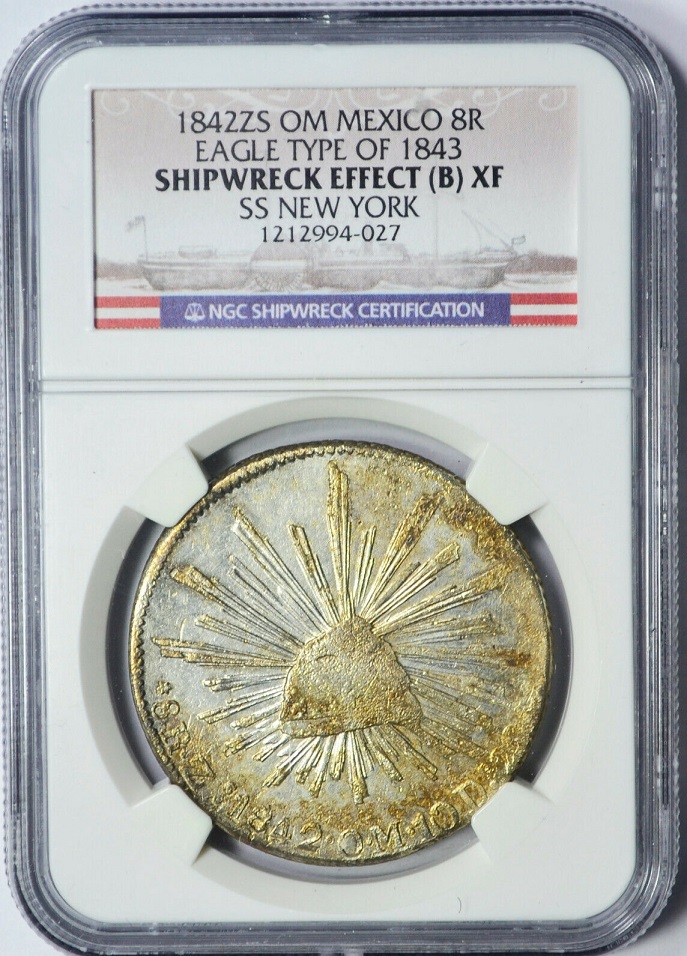
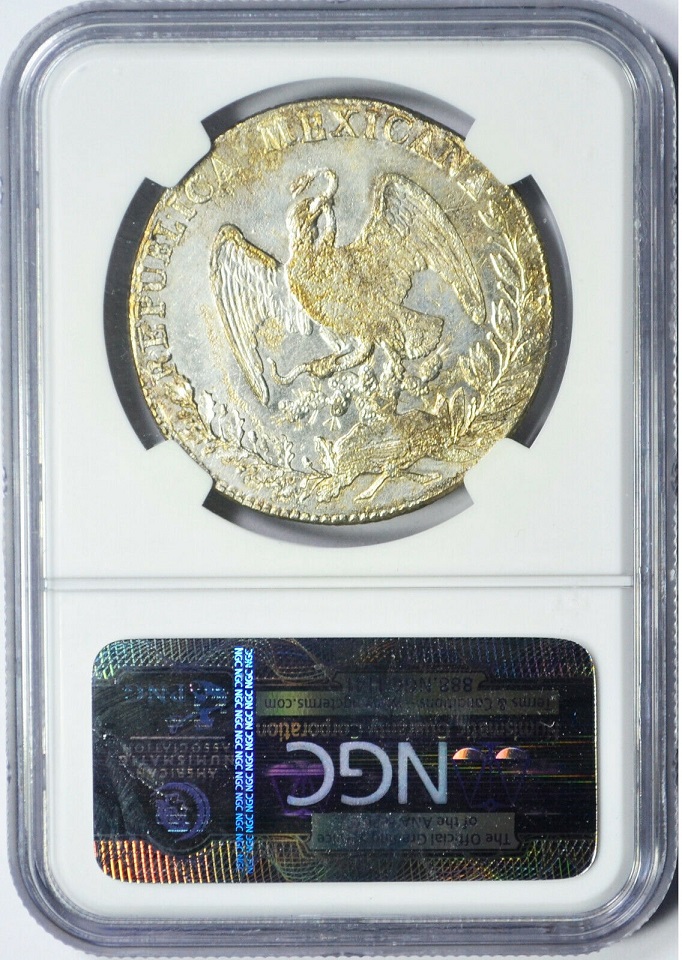
The 5th confirmed example of a circulating counterfeit Cap and Ray 8R is actually a mule of the Riddell type shown above in this thread paired with the 1844 Pi obverse die. This new case, shows the same eagle die was mated with a completely different obverse die bearing a different mint mark. Until I can get clearer photos of the Cap side it may be impossible to fully identify if that die is also listed in Riddell. However this is the 3rd counterfeit coin out of 5 I have seen which uses this same eagle design. My earlier listing included an 1843 Zs OM Riddell # 279 coin. I will advise if the owner (whom I have contacted) provides any better pictures of the coin.
Another comment regarding the coins encapsulated by NGC, two of the encapsulated coins seen to date are so poorly preserved that I found it very difficult to be 100% positive that they were genuine using only the owner/seller's photographs. In one case, an 1832 Mo, the coin was virtually uniface. I decided in those cases that I would accept the NGC verdict of authenticity unless, I could see them in person and determine conclusively that they are counterfeit. This has introduced a slight +/ potential for variation in the counterfeit rate. The stated rate of 7.94% includes both as if genuine. If one of the two is a counterfeit the rate would be 9.50% and if both are counterfeit the rate would be 11.11%.
So as of this date with 63 coins visually reviewed the CCC rate is a minimum of 8 and a maximum of 11%. This rate matches Riddell's 1845 estimate of 10% fairly well.
The statistics for the Cap and Ray 8 Reales are now:
Total C&R 8Rs listed on NGC submission forms 333
Total C&R 8Rs rejected for grading by NGC 34
Total C&R 8Rs encapsulated by NGC 299
Total C&R 8Rs inspected visually 63
Total C&R 8Rs Contemporary Counterfeits 5
Rate of CCC C&R 8Rs (based on number seen) 7.94%
Potential number of CCC's encapsulated 24
This means that I have now seen roughly 21% of the total number of encapsulated C&R 8Rs. In my opinion a statistically valid sample with which to test Riddell's estimates of counterfeit dollar coins in circulation in the New Orleans area in 1845.
Riddell reported variable rates of counterfeits in his book, but 10% seems to be his rough average. After almost 3 years working on the project, the percentage of counterfeits that I have actually confirmed is about 8%.
In the process, I have of course also seen many other coins including all of the various US silver types and so far I have seen no counterfeits at all in those areas. This tends to confirm Riddell's observation in 1845 that the products of the US mint, being more standardized, were observed far less frequently as being counterfeit.
The 5th confirmed example of a circulating counterfeit Cap and Ray 8R is actually a mule of the Riddell type shown above in this thread paired with the 1844 Pi obverse die. This new case, shows the same eagle die was mated with a completely different obverse die bearing a different mint mark. Until I can get clearer photos of the Cap side it may be impossible to fully identify if that die is also listed in Riddell. However this is the 3rd counterfeit coin out of 5 I have seen which uses this same eagle design. My earlier listing included an 1843 Zs OM Riddell # 279 coin. I will advise if the owner (whom I have contacted) provides any better pictures of the coin.
Another comment regarding the coins encapsulated by NGC, two of the encapsulated coins seen to date are so poorly preserved that I found it very difficult to be 100% positive that they were genuine using only the owner/seller's photographs. In one case, an 1832 Mo, the coin was virtually uniface. I decided in those cases that I would accept the NGC verdict of authenticity unless, I could see them in person and determine conclusively that they are counterfeit. This has introduced a slight +/ potential for variation in the counterfeit rate. The stated rate of 7.94% includes both as if genuine. If one of the two is a counterfeit the rate would be 9.50% and if both are counterfeit the rate would be 11.11%.
So as of this date with 63 coins visually reviewed the CCC rate is a minimum of 8 and a maximum of 11%. This rate matches Riddell's 1845 estimate of 10% fairly well.