Coin Community Family of Web Sites Join Thousands of Coin, Bullion, & Money Collectors
Shop for APMEX Bullion on eBay!Coin, Banknote and Medal Collectors's Online Mall Vancouvers #1 Coin and Paper Money Dealer 300,000 items to help build your collection! Join Thousands of Coin, Bullion, & Money Collectors Royal Canadian Mint products, Canadian, Polish, American, and world coins and banknotes. Specializing in Modern Numismatics


Username:
Password:
Save Password
Forgot your Password?


This page may contain links that result in small commissions to keep this free site up and running.

Welcome Guest! Registering and/or logging in will remove the anchor (bottom) ads. It's Free!

Prooflike Coins Vary In Their Degree Of Clear Reflectivity

To participate in the forum you must log in or register.
Author Previous TopicReplies: 3 / Views: 1,145Next Topic  
Forum Dad
Learn More...
bobby131313's Avatar
United States
24150 Posts
 Posted 05/13/2008  4:52 pm Show Profile   Bookmark this topic Add bobby131313 to your friends list Get a Link to this Message Number of Subscribers
Prooflike-Coins-Vary-In-Their-Degree-Of-Clear-ReflectivityProoflike coins vary in their degree of clear reflectivity

By Eric Von Klinger for Coin World

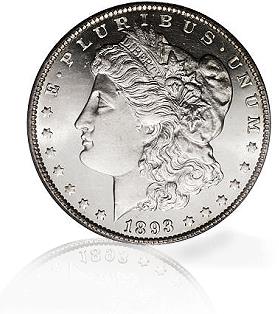
In virtually any series of coins, collectors may run across a designation of "prooflike" surfaces, but the term is most often encountered in regard to Morgan silver dollars.

It gained currency in the 1950s and 1960s as the last of silver dollar releases from Treasury Department vaults took place. Seemingly vast quantities of decades-old coins suddenly were becoming available in "Uncirculated" condition.

It was apparent even among all these never-used coins that there were substantial differences in overall appealing qualities. Some were "bag-marked" (heavily affected by contact marks). Some were toned from contact with canvas. Some had dull surfaces and others - exceptional pieces - were, well, "prooflike."

"Proof," as collectors learn early in their grading lessons, is not a grade but a manufacturing process. A Proof generally is exceptionally well struck, but the surface might vary by process chosen. A Matte Proof, for instance, has a grainy-looking surface.

When collectors talk about "Proof surface" or "prooflike surface," however, they mean a more usual, brilliant, highly reflective finish in the fields. (Fields are the flat, plain areas away from the design and inscriptions.)

A "prooflike" Uncirculated coin, then, is one with such fields, often described as "mirrorlike."

Read Full Story
All Recent News
Pillar of the Community
Amazon99's Avatar
United States
2443 Posts
 Posted 05/14/2008  03:14 am  Show Profile   Bookmark this reply Add Amazon99 to your friends list Get a Link to this Reply
Good article. I like collecting proof like coins.
Pillar of the Community
longnine009's Avatar
United States
1247 Posts
 Posted 05/15/2008  06:12 am  Show Profile   Bookmark this reply Add longnine009 to your friends list Get a Link to this Reply
Uh-Oh, did they forget to put that in the paper? I read all Eric Von Klinger's stuff and I didn't remember that. So I went through the 5/12 issue 3 times and still can't find it. I even though some slob in the Post office must have cut it out with razor so I checked all the pages. They're all accounted for.

This is starting to bug me now. Does anyone have the 5/12 issue with that article in it?
Valued Member
United States
265 Posts
 Posted 05/18/2008  6:12 pm  Show Profile   Bookmark this reply Add dom to your friends list Get a Link to this Reply
This is a good article. Although I have been collecting for some time, I still don't consider myself that proficient at grading. I love my Morgans and one day I may come close to completing my set. I have always looked for the best coins I could afford, but I have been taken many times. In particular, if any Morgan experts are out there, is the 1902-p. I have purchased 3 in the past 4 years that I felt were BU. The first one was in a Numistrust holder graded ms64. I sent it in to PCGS and they said it was cleaned. I bought the second off of ebay and thought this one was pristine. Under my loop I thought I saw some hairlines that I did't think were bad. Again PCGS said altered surface. Thirdly I was at the FUN show in Orlando and looked at a beautiful 1902-p which was reflective. I played with it a few times looking for reflectivity, lines, marks, you name it. The dealer said it was PL. Ok, one more time, back to PCGS, guess what CLEANED....ugh.......So now I am really confused. Does anyone have any insight......?
  Previous TopicReplies: 3 / Views: 1,145Next Topic  

To participate in the forum you must log in or register.


Disclaimer: While a tremendous amount of effort goes into ensuring the accuracy of the information contained in this site, Coin Community assumes no liability for errors. Copyright 2005 - 2026 Coin Community Family- all rights reserved worldwide. Use of any images or content on this website without prior written permission of Coin Community or the original lender is strictly prohibited.
Contact Us  |  Advertise Here  |  Privacy Policy / Terms of Use

Coin Community Forum © 2005 - 2026 Coin Community Forums
It took 0.22 seconds to rattle this change. Forums



