| Author |
 Replies: 30 / Views: 5,241 Replies: 30 / Views: 5,241 |
|
|
|
Bedrock of the Community
United States
17884 Posts |
Can't tell from the edge image, but if it shows that it is a "sandwich" structure like the regular 40% silver clad, then it is struck on a rolled thick planchet (and I think it does). We were one of I believe only three countries using clad strip at that time. The other two being Panama and Germany. We struck the coins for Panama and we used the same planchets that we used on our coins. Germany used copper clad steel.
|
|
Valued Member
 United States
107 Posts |
I have to decide whether to drive to NH to a dealer who has a tester, can't find any around here ( about $25 in gas, also tolls so about $30 and a almost 2 hour trip each way) or send it to PCGS, which if it is legit then I have to do PCGS anyway.
I am leaning towards sending to PCGS to be sure.
I cannot see any hint of a sandwich, although in on part under 16x magnification where the a single reed is pushed down there may be a hint of copper about 1/100" x 1/100" more imaged than seen and only under certain light.
You may be correct that it is a very heavy thick planchet, but I would rather be sure than take the "it must be a thick sandwich" It is like a friend who goes deer hunting, he still tries and enjoys the process even if he doesn't get a deer. The $80 that it will cost me is not going to break me. And it is just thicker than normal at least I am sure and can move on.
|
|
Moderator
 United States
196572 Posts |
Can you compare its thickness with other examples? If so, how does it look?
|
|
Valued Member
United States
107 Posts |
I only have a caliper that measures in inches.
the rim on a 1968 is 85 hundredths and on the 1967 is 87 hundredths
Micrometer 1968 on ear is 27 1967 on ear is 5 1/2 beyone the 27
in hundredths 1964 seems to be 29 1/2
seems to be thicker but will risk the money to confirm
planchet seems a little thicker
|
|
Moderator
United States
196572 Posts |
It seems like we may have the answer, but it might be a worthwhile investment to get confirmation.
|
|
Valued Member
United States
107 Posts |
Here is another shot of the reeding, in the one that has a bang in it, I see what might be a smidge of copper, not sure, 7th full reed from right edge 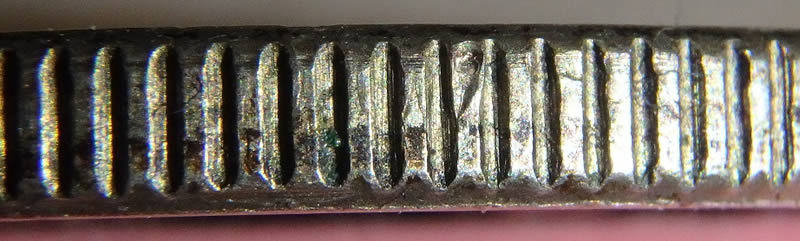 |
|
Moderator
United States
196572 Posts |
The 40% silver clad core is not pure copper. It has 20.9% silver mixed in; just enough to make it more grey than red/brown. Once the 80% silver outer layer gets some edge toning, the core becomes really hard to see. This assumes the "bleeding" from the stamping process did not obscure too much of it to begin with.
|
|
Pillar of the Community
United States
2963 Posts |
Quote:
what I have heard is that sometimes the mint strikes coins for other countries and have heard of planchets getting there incorrectly that way.
That would be the only way I could think of it other than someone at the mint creating an error on purpose, after all it wouldn't be like the silver would sit there for years.
That is why I think that it might not be an error Let's not forget though that the mints struck 1964-dated coins well into 1966... so, it's not totally beyond the realm of possibilities that some 90% half planchets were still around in 1967. CRH Nickeloholic. 1,600,000 nickels searched in eight years! Have found FOUR complete Jefferson sets!
|
|
Moderator
United States
196572 Posts |
Quote:
Let's not forget though that the mints struck 1964-dated coins well into 1966... so, it's not totally beyond the realm of possibilities that some 90% half planchets were still around in 1967. This is true. |
|
Pillar of the Community
United States
2963 Posts |
CRH Nickeloholic. 1,600,000 nickels searched in eight years! Have found FOUR complete Jefferson sets!
|
|
Bedrock of the Community
United States
17884 Posts |
Check the article again, Denver stopped the 90% silver halves in 1965, so a 90% silver planchet would have had to hang around some where for close to two years. (All 1967 halves were struck in Denver.)
|
|
Pillar of the Community
United States
2963 Posts |
Give or take 4 months then... The planchets could've been sitting there for any length of time from 1-2 years (or more) depending. 1967 was the first year since 1963 when all coins were struck in the same year as their date. So they could've been struck anytime during the 12 months...  CRH Nickeloholic. 1,600,000 nickels searched in eight years! Have found FOUR complete Jefferson sets!
Edited by John77
12/20/2017 4:11 pm
|
|
Valued Member
United States
107 Posts |
Got back the ANACS report
they slabbed it and said it was struck on a "Thick 40% Silver planchet" with a weight of 12.53 grams (I got 12.55, normal 90% is 12.50) they did a specific gravity test. this coin is 9.56 "which is within tolerance for 40% silver and a 90% is 10.3"
I had a dealer recommend cracking it and trying PCGS and see what they say. I am also going to try doing a specific gravity myself, will learn how.
Debating on whether to submit to PCGS to get their opinion or not.
|
|
Pillar of the Community
 United States
2843 Posts |
Thanks for the update. I was eager to learn what happened with this coin. Sorry that it was not a better result. Quote:
I had a dealer recommend cracking it and trying PCGS and see what they say IMO bad idea. ANACS says that they did a SG test, I believe them. Unless you are hoping that PCGS will just guess and label it as a '64 planchet without doing the proper testing (doubtful). |
|
Valued Member
United States
107 Posts |
BigSilver
Hadn't considered that, wouldn't that be nice. But if I crack it I could try a SG test myself to see what I get, but also get a second opinion on it.
|
| |
Replies: 30 / Views: 5,241 |








 First Page


 Posted 12/19/2017 06:41 am


