| Author |
 Replies: 8 / Views: 1,261 Replies: 8 / Views: 1,261 |
|
|
New Member
United States
10 Posts |
Another coin from Dad's cache. This looks to be a 4 Reale from 1541 or 2 based on the mint marks and assayers mark. I found a PDF from sedwickcoins.com that describes it well and this coin has the right marks in the right places. One concern I have is that the 4 looks like it was altered. I know from reading a few threads here that there were a lot of counterfeits and N.F. made in the 8 Reales but are not unknown in the 4s. Please let me know your opinions, 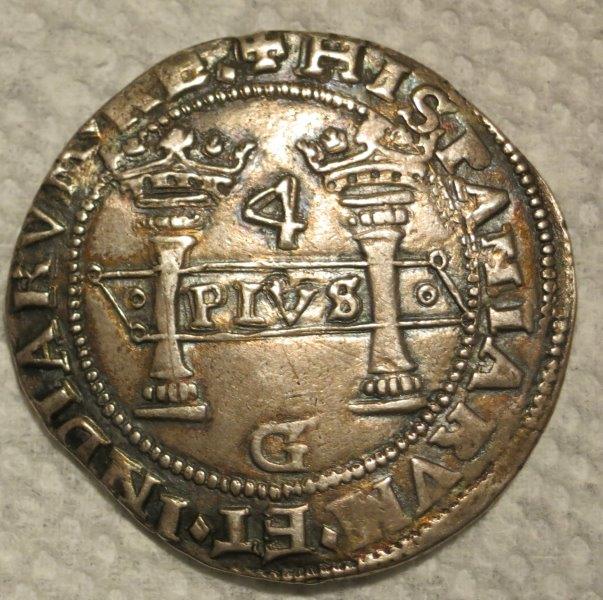 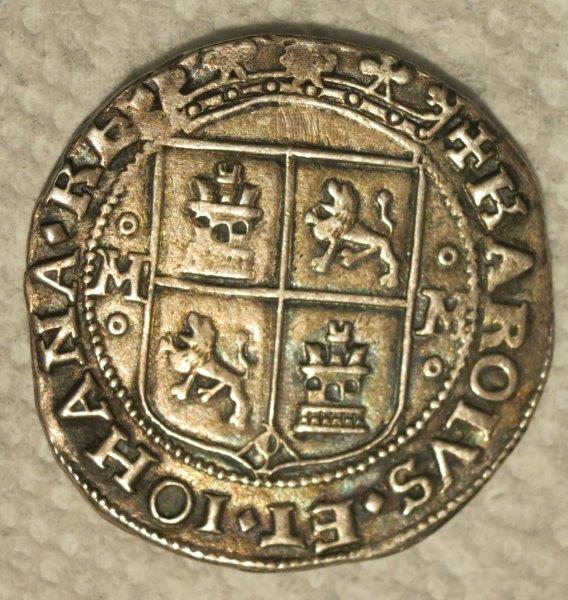 Thanks for your help. |
|
|
|
Pillar of the Community
 United States
8038 Posts |
|
|
Pillar of the Community
United States
1475 Posts |
My opinion is that this is a counterfeit coin.
It looks like a fake.
Characters are all wrong and it looks totally different from the referenced coin above.
|
|
New Member
 United States
10 Posts |
I have no idea how this coing may have come into my father's possession. our family spent a summer in Mexico in the late 60s and he and my mother traveled to Asia several times so the coin could have come from either location or someplace else entirely. It took a bit of time to find any info on these coins but when I did it just confused the issue even more.
It seems in these early coins there were some varieties(not surprising) There were dies with both Gothic and roman lettering, some made in Spain and some were locally produced in Mexico. source is from the sedwickcoins article that I found.
here is an excerpt:
Numismatists have come to call these coins "Charles and Joanna coins," and have divided them into two major periods using names proposed by Nesmith over sixty years ago—"Early Series" coins (from 1536 to 1542) and "Late Series" coins (from 1542 to 1571)—based on substantial design changes in 1542 when all-new dies from Spain arrived. The first dies of the Early Series bore Gothic lettering, but the die-punches wore out fast and were replaced by cruder, New World-made punches that tended toward Latin lettering (as Nesmith said, the number of dies must have been enormous). These die changes enable us to follow the evolution of the Early Series coinage. When the new-design dies came in 1542, however, the Early Series dies were discarded and the Gothic lettering was gone for good.
I never expected this coing to be real based on the odd marks on the 4 but I was still hoping it would be authentic just te same.
|
|
Pillar of the Community
United States
8038 Posts |
Given the value of the coins, I guess one would expect counterfeits to exist.
As for that 4, given what you posted from that reference, maybe it's just a re-punched die? Maybe you can also get a weight for it? I see a range of 13.26 - 13.65 g. for the three samples from that moneyer, though that's a small sample.
Again, I am sure you will get additional comments from those who have experience with old colonial silver like this. Even if it's a fake, it's pretty neat (and hopefully your dad didn't get taken to the cleaners for it).
|
|
New Member
United States
10 Posts |
The weight of the coin is 13.306 grams so it is in the range.
It is interesting that the more I look at the 4 reales the more I am convinced that they used a different die to strike each one of them. Further I cannot find any information on other fakes in this issue but I am still looking.
|
|
New Member
United States
10 Posts |
I found an image on a current HA auction for a NGC slabed coin. I did some cut an paste to place the image side by side and I think they are pretty close care to jumpin. 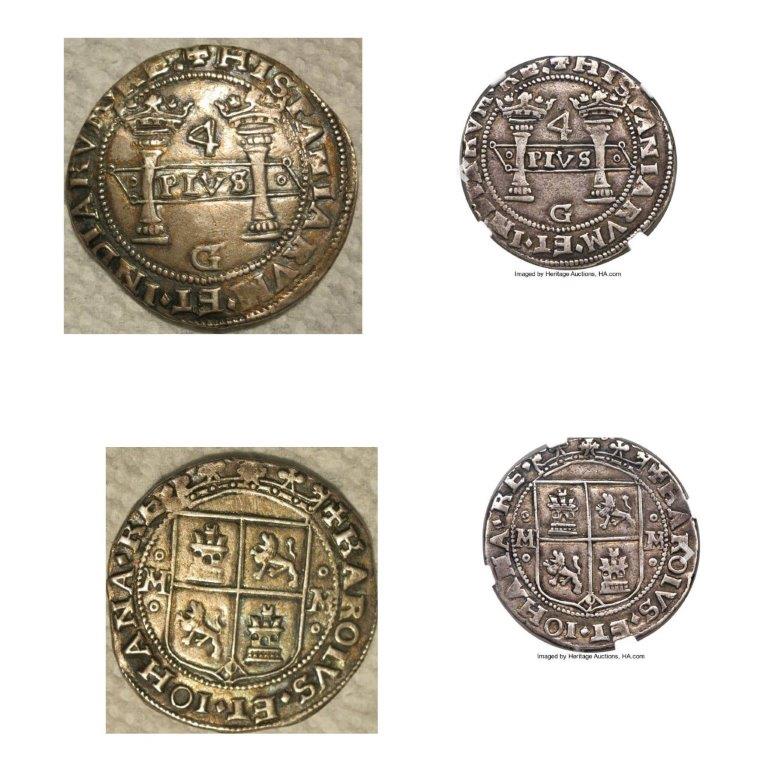 |
|
Bedrock of the Community
United States
12057 Posts |
It needs professional authentication from a third-party grader or expert in the area. Anything else is guesswork.
If it is authentic, the price to pay for authentication will be a small fraction of the coin's value.
Member ANA - EAC - TNA - SSDC - CCT #890 "Most of the things worth doing in the world had been declared impossible before they were done." -- Louis D. Brandeis |
|
New Member
United States
10 Posts |
Is there a consensus as to the way to go for this particular coin. I searched and did not find an expert who can authenticate this coin, I did find the leading grading services that will grade the coin only if it is not counterfeit so by default they authenticate it I suppose. However I did read on this very site that at least one member has seen several fakes in slab holders.
I found at least one dealer who will authenticate with out slabing it but I wonder if there is a leading dealer in this field who might be up to the task.
|
| |
Replies: 8 / Views: 1,261 |
|










 Posted 03/12/2018 04:22 am


