| Author |
 Replies: 12 / Views: 2,521 Replies: 12 / Views: 2,521 |
|
|
Pillar of the Community
United States
3499 Posts |
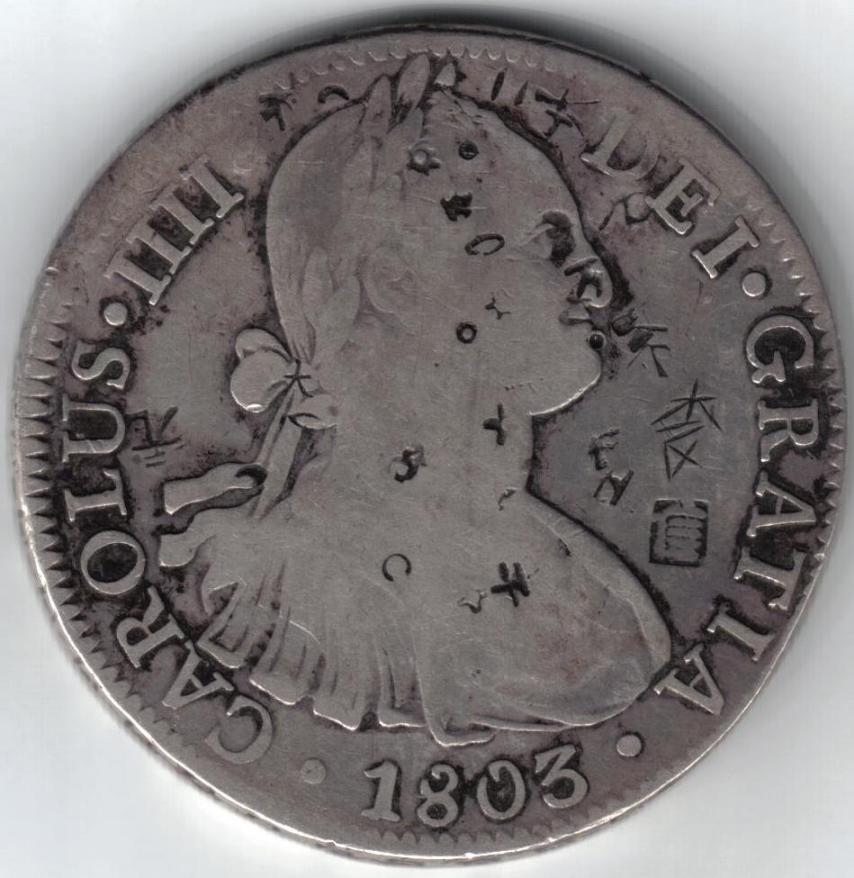
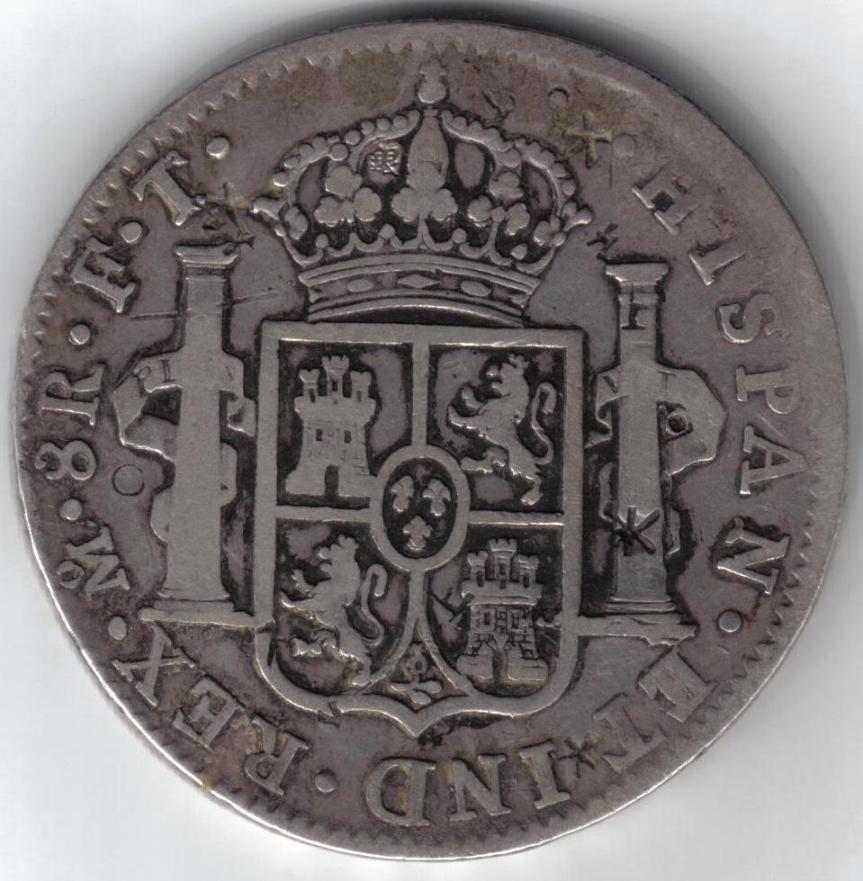
While I am fairly certain that this is a real piece of 8, I was hoping to get some information relating to some of the chop marks on both the obverse and reverse. The chop mark on the obverse between the bust and the "A" and the "T" of "GRATIA" and the chop on the reverse in the first left gap in the crown are of great interest to me. Any info and/ or comments would be greatly appreciated! Image:  Mexicocolonial8R1803obv2.jpg Mexicocolonial8R1803obv2.jpg91.12 KB Image: Mexicocolonial8R1803rev2.jpg99.65 KB |
|
|
|
Valued Member
United States
303 Posts |
The one in the crown on the reverse means silver or "yin". I see some others like big or "da" (one in his bow tie and several on the reverse) and yuan character (by his nose and the U in CAROLUS. Thats all the Chinese I know, wished I knew more. Don't know the other one that you mentioned.
Oh maybe one more, "sahn" or go up or high (by the castle in the shield and the right pillar on top).
I have one from 1798 and on the reverse has a tael character, has the style as the "yin" on yours.
Edited by hc8604
06/10/2008 7:40 pm
|
|
Pillar of the Community
 United States
3499 Posts |
hc8604- thanks for that info! What would the "big or 'da'" have indicated on this coin as it circulated in China?
|
|
Pillar of the Community
United States
819 Posts |
Generally, the chinese characters on silver trade coinage aren't standard chinese characters, but often combine two or more glyphs into a play on words. Each character is 'unique' to a particular merchant who examined the coin, and deemed it worth accepting as its weight in silver. Not part of your question, I can tell you that there are typically two sorts of Chops on silver coins. Type 1 and type 2. Type 1 chops are small, lightly scored, and tend to be placed where there is minimal damage done to the coin. These chops seem to range through the 19th century. The Type 2 chops are larger, and often placed indiscriminately. They can sometimes chop a coin so much that it literally falls into pieces. Chopmarks are a fascinating little corner of Numismatism! I have a small collection of about 8 pieces with chops on them, and I'm still delving into their study. I recommend finding and reading a copy of F.M. Rose's little booklet on Chopmarked coins. It's a bit expensive (about $20) on ebay, but it can be found. :) |
|
Pillar of the Community
United States
3499 Posts |
ElleKitty- thanks for the info!
|
|
Valued Member
United States
303 Posts |
Great info, ElleKitty. I just got my 8 reales last week and I probably overpaid mine though. But the dealer always give me great deals on other coins, so it was ok.
|
|
Pillar of the Community
United States
3499 Posts |
hc8604- you have piqued my interest. Do you have any pics of it to show us?
|
|
Valued Member
United States
303 Posts |
Here are some pictures Archraz,    Not sure what the chopmark on the front means... The other one is on the reverse on the bottom left of the sheild/crest. I paid $50 for it... Edited by hc8604
06/12/2008 03:25 am
|
|
Pillar of the Community
United States
3499 Posts |
hc8604- Thank you for the pics! That is a nice coin. The chops are really interesting and don't really detract from the aesthetic beauty of the original design. From what I can tell based on the pics (and not seeing the edges) this coin looks pretty legit. As for the price, $50 is not necessarily too bad of a deal. It all just depends on markets. In certain areas of the US there is a lot of interesting in these (since they have such a colorful history and were the coins that circulated in the American colonies), but in some places, such as where I live, there is almost no interest in foreign coins. So prices can vary.
|
|
Pillar of the Community
United States
3357 Posts |
It's funny how the dealers treat these coins. The specialists that carry a lot of them price them in the $50-100 range, somewhat less if they're heavily worn or chopped. But dealers who only get them incidentally treat them like bullion, whether buying or selling. I showed a few I had in my pocket to a dealer a couple weeks ago and was immediately offered bullion price for them. No sale! The dealers are also quick to point out all damage on your coins, whether it's from circulation or striking, but never on ones they have for sale.
Still turning up a few bargains here and there (a 1913 half crown in FVF last week for bullion), but not on the 8 reales.
"Two minutes ago I would have sold my chances for a tired dime." Fred Astaire
Edited by thq
06/15/2008 08:36 am
|
|
Pillar of the Community
United States
3499 Posts |
thq- But hey, if they want to sell you an 8 for bullion, then I say just let good times roll when it comes to attitudes about foreign coins in the US.
|
|
Pillar of the Community
United States
3357 Posts |
I've seen colonial 8R's at bullion twice in the last 6 months. The first one was shiny and worn. The others were heavily chopped and worn, and were also pre-sold (the dealer let me compare them with some I had). I've done better on other foreign silver crowns. A lot of them were priced using old Krause guides. I look for better date French 5F's, German 5M's, and the British coins pre 1919. Others turn up occasionally - Swedish, Dutch, Finnish, and even some Russian (though these are becoming expensive).
"Two minutes ago I would have sold my chances for a tired dime." Fred Astaire
|
|
Pillar of the Community
United States
3499 Posts |
thq- It is very true that some dealers don't update their Krause guides very often. And thanks to the fact that new editions of the 17th and 18th century books are only released every however many years rather than each year, it can lead to great prices for the buyer.
|
| |
Replies: 12 / Views: 2,521 |
|







 Mexicocolonial8R1803obv2.jpg
 Mexicocolonial8R1803rev2.jpg
 Posted 06/10/2008 7:59 pm





