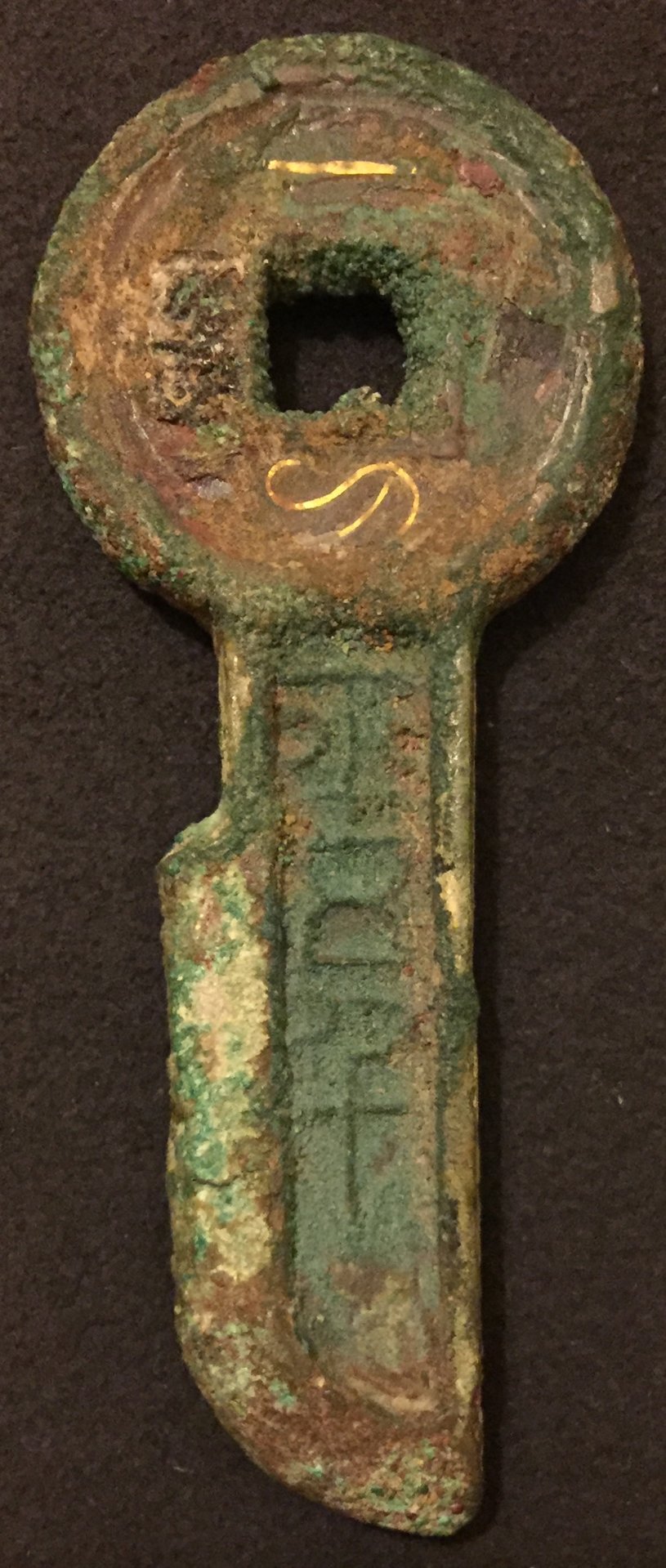
I apologize for not being as active as I have been in the past. Being abroad studying and traveling has pretty much sapped most of my coin time. But it is pretty much over now, so I will be sharing an exciting recent purchase with you. I was extremely excited to be able to buy it, and I was quite surprised for one to simply fall into my grasp like this one did. What you are looking at is a gold-inlaid knife cast by Wang Mang between 6 and 9 AD. The inscription reads "Yi Dao Ping Wu Qian," or "One Knife Worth Five Thousand." Since it will readily fit into your hand, you might be surprised how something so small can be worth five thousand cash. However, there is a reason for why this is, which I will explain below.
I am sure most of you have at least heard of Wang Mang, but I would guess that few of you are familiar with the details of his story. If so, then there is no time like the present to read about his fascinating tale. I find the lore surrounding Wang Mang's rule to be some of the most fascinating in all of world history as it began with brilliance and good intentions but ended in tragedy of the highest scale.
Wang Mang was born into the very wealthy and powerful Wang family in 45 BC ("Wang" translates directly to "King"), which was regarded as the most powerful family in China at the time. Though closely-connected to the imperial family, Mang's part of the family was the "poor" part and his father died while Mang was young, so he did not have the access to power and luxury that other members of his family enjoyed. In contrast, his cousins abused their extreme wealth; they lived expensively and often tried to compete with each other to see could spend more money on increasingly-exorbitant projects. Mang saw this, and he detested such a vicarious lifestyle when so much of China's population had barely enough food to survive. Mang, on the other hand, chose to live thriftily and humbly, gaining the respect of many of his peers. Despite his limited political power, Mang had extensive access to resources (both financial and social), which he used to study rather than engage in sport and "frivolities." Mang was fascinated with science and the arts, which lead him to found a university in the capital on Chang'an, as well as take time to pursue studies in manned flight, human dissection, and musical composition. Throughout his scholarship, Mang became enamored with Confucian ideology, which would shape his decisions and policies. More on that later.
I will not describe in detail Mang's rise up the political ladder as it involves dozens of similar-sounding names and a very complex family tree. If you are desperate to know more, there are many sources out there, but I recommend Wikipedia as it is quite detailed yet concise (linked at the bottom). Anyhoo, Mang gained the support of the people with his intellect and generosity. Mang refused to accumulate wealth for the sake of being wealthy, so he would give most of it away, which garnered much popularity and praise. This would lead to an increase in power, which was his end goal. In one instance, there was a petition urging Mang's promotion with 487,572 signatures sent to the emperor. Untainted by corruption and graft, Mang would take advantage of the corruption of those in his way, and, let's say, have them moved out of the way. He would also take advantage of the superstitions thickly interwoven into the Chinese culture to legitimize his decisions and eventually take total control. Cold-blooded murder was also not above Mang when so much was on the line.
In 7 AD, before he had become emperor, Mang had nearly absolute control over China by ruling through an infant puppet emperor (whom he had intentionally chosen). At this time Mang ordered the nationalization of gold, where all gold was turned in to the government in exchange for extremely-high-value bronze knife coins (often called "key coins") like the one posted above. My example, the value 5000, was worth about a half-cattie of gold, where one cattie of gold weighed 120g. The other variety of the knife coins had a value of 500, and a value-50 coin was minted as well. Mang's Confucian ideals are evident in the shape of this coin. Confucians looked upon the Zhou Dynasty for perfection when it came to running the country, so it was natural for Wang Mang to model his currencies off of coins from this era (though, ironically, he copied coins from the turbulent Warring States period). The knife-shaped and round coins had similar design elements to the Wu Zhus currently circulating to add a bit of familiarity and thus acceptability.
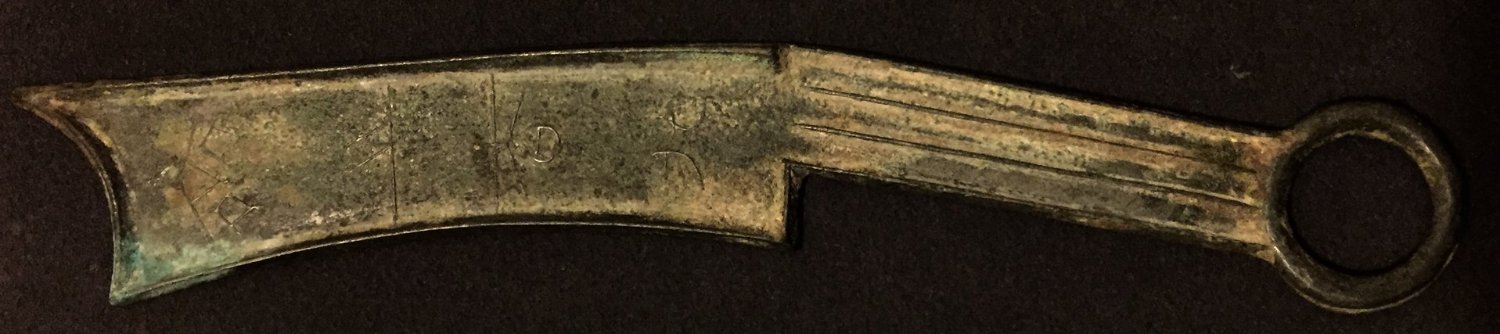 A Qi Knife
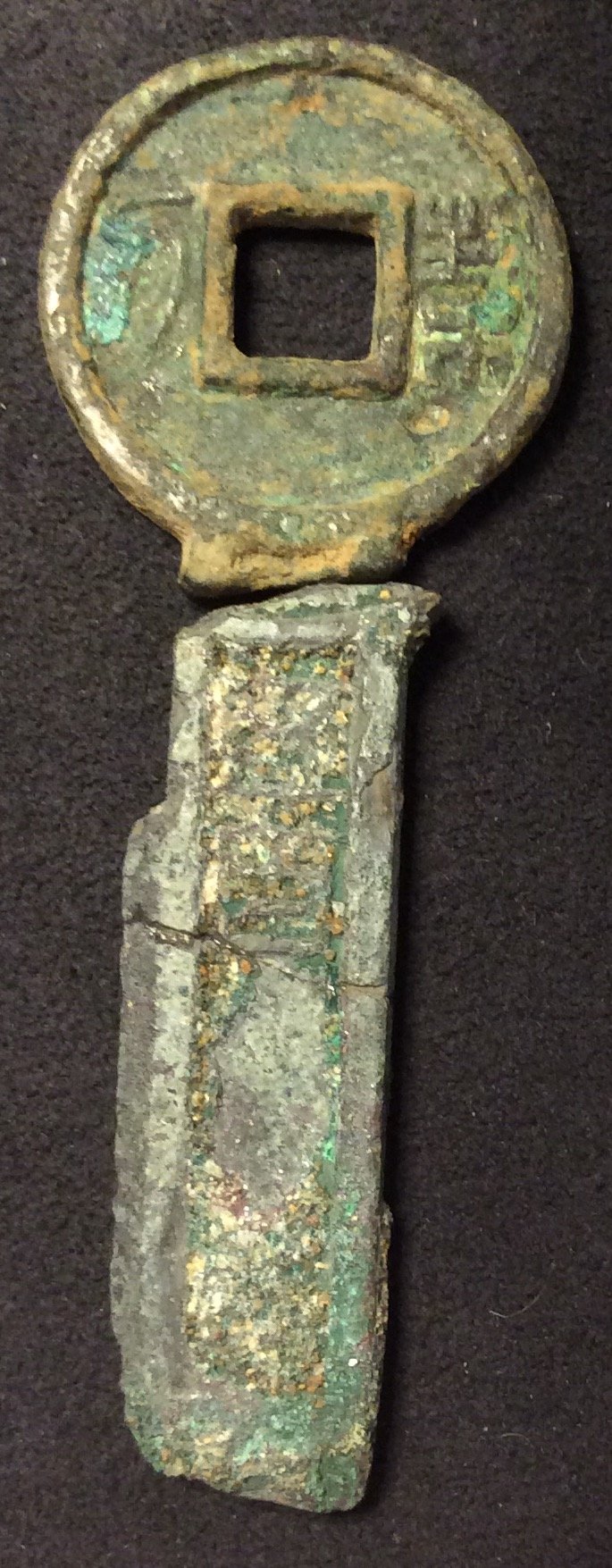 The value-500 knife: "Qi Dao Wu Bai" ("Qi Knife Five Hundred")
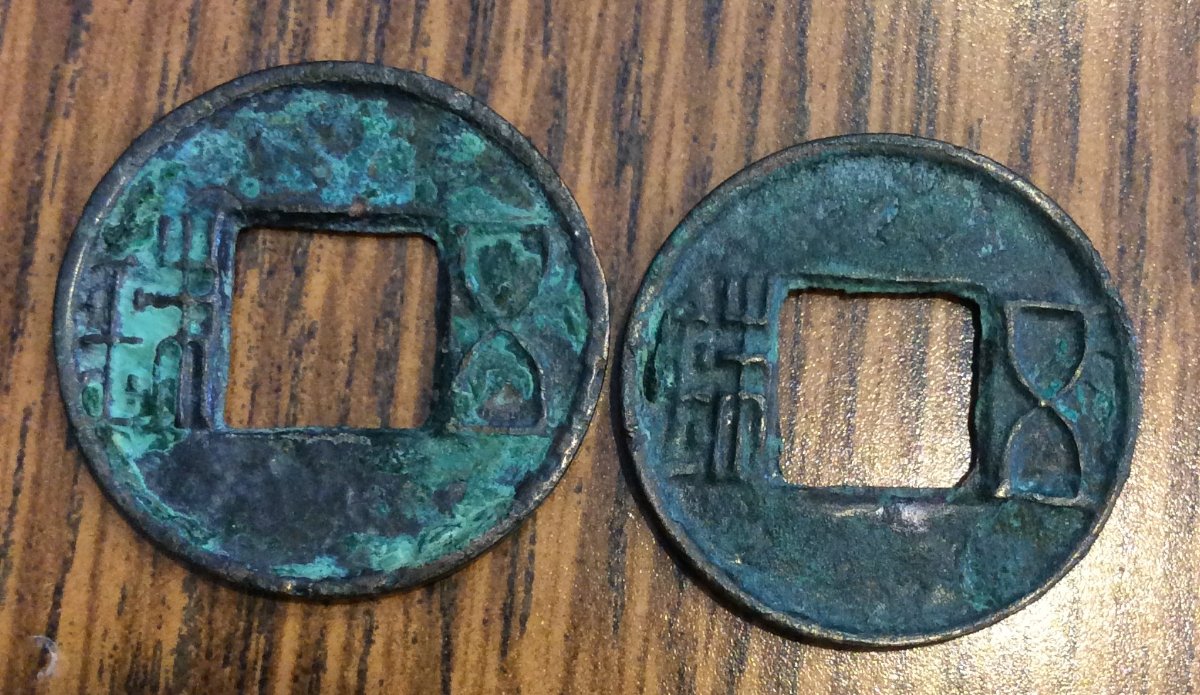 A couple Western Han Wu ("Five") Zhus
The program was obviously quite successful as 150 tons of gold was found in the treasury upon Wang Mang's death. In addition, the Roman Emperor Augustus banned the purchase of Chinese silks when it became apparent that the Roman gold used to purchase them just seemed to be sent to a black hole. It is unknown what the penalty for continuing to hoard gold was, but we know that many of the aristocracy was executed during this period.
Two years later, these knife coins were demonetized, which destroyed the wealth of the aristocracy overnight. Wang Mang had planned this so that all the hard wealth and power would be centrally controlled by him and his government. By having no money, the aristocracy had no power. Unfortunately for Mang, he had thus set a precedent that any fiduciary coins he issued were not guaranteed to hold their values. This will haunt him later.
Now that you know the context for my new coin, let's explore the rest of Wang Mang's short reign.
In 9 AD, Mang seized firm, absolute control over China, establishing his Xin ("New") Dynasty. He immediately began a series of significant reforms which, in his mind, would improve the conditions of the poor disfranchised by the wealthy. His main reforms were:
1. The abolition of slavery through a ruinous tax on slave owners. Wang Mang detested slavery, which shows he had a bit of a humanitarian side
2. The nationalization of land, essentially making the government own all of it. Since no one would have outright ownership of the land, no individuals can prey on the misfortunes or desperation of fellow landowners and eventually monopolize the land in the area. This would protect the poor during unpredictable maladies.
3. Distributing the land evenly among the population, so each family would have around 5 acres. These families were expected to cultivate the land responsibly; failure to do so would lead to having to pay the substantial "sloth tax," which punished those who left arable land uncultivated.
4. Families were grouped into "chings," which consisted of 6-8 families. This was an attempt to return to the traditional "well field" system, where each family would have access to the best ground in their area.
5. A national bank that will offer fair interest rates to everyone in the population. This would prevent unscrupulous private bankers from taking of other people through loan sharking.
6. The government will intervene in the markets to control and stabilize prices. It would buy up good when they are cheap to raise the price, and it would sell the excess during hard times to lower the price.
7. A coinage system with 15 denominations ranging from a value of 1 to 1000. Wang Mang's justification for these coins: "If all currency is large, when one needs a small amount it is not available. If it is small [like the Wu Zhus currently in circulation], transporting it is troublesome and expensive. If large and small exist, then their use is convenient." This sounds a lot like the currency system in place today.
It is not specified whether these coins were valued in "zhus" or "cash" (wu zhus). For example a value-500 coin was simply stated to have a value of 500, not 500 of something. Because the records do not say these coins were denominated in "cash" (wu zhu coins), coupled with the fact that the value-1 coin has a weight of 1 zhu, some think that the coins are denominated simply in zhu. But the records do not state they are denominated in "zhu" either. A plausible theory is that the coins are denominated in "cash," but Wang Mang was trying to limit all references to the Wu Zhus to make them as illegitimate as possible. Maybe he thought that saying his coin is worth 500 wu zhus would give some legitimacy to the coins he was trying to eradicate. Who knows...
Let's look at the coins themselves. If the Xiao Quan Zhi Yi was denominated 1 zhu with the weight of 1 zhu (around 0.65g), then it would have been the only coin to have circulated and probably would have been hoarded as well since it was "hard" currency. This would have had the opposite effect of what Wang Mang was trying to accomplish in getting all of his coins to circulate. With this in mind. It seems perfectly reasonable that Wang Mang's coins were denominated in Wu Zhus.
8. An annual income tax of 10% on money earned or crop yields per working individual. Those who failed to register for the income tax were punished with a year of hard labor. This is the first known instance of a tax that was levied at a set percent, regardless of income.
All of these things seem like good ideas that would benefit society, so how did they result in such a spectacular failure? Well, let me tell you.
The ching system was widely resented by the peasantry. Not only were all members of the ching made responsible for the actions of each other, but 5 acres of land per family was simply not enough to adequately support a family (10-15 acres was needed). Couple this with the famine caused by changes in the course of the yellow river, one can see why people were upset. This reform also shows that though Wang Mang wanted to help the peasantry, his position in society kept him at a distance from understanding their needs. Despite the good intentions, this reform along with the reform against slavery were rescinded within 2 years.
The new income tax also caused an uproar, which is strange because for the farmers the tax decreased from 50% percent of the yield to 10%. Perhaps it was the sudden and drastic change that scared the mostly-uneducated peasantry, or it was because a new state monopoly on wine was introduced to help make up the difference in revenue.
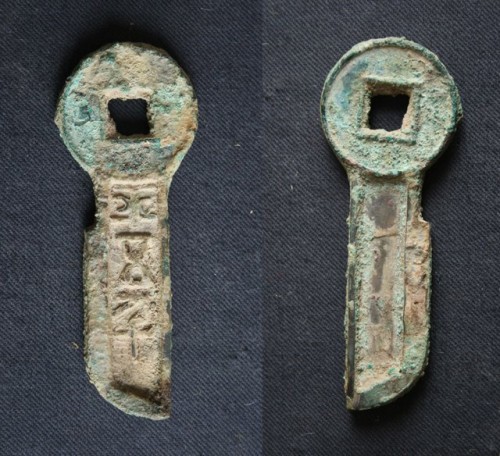
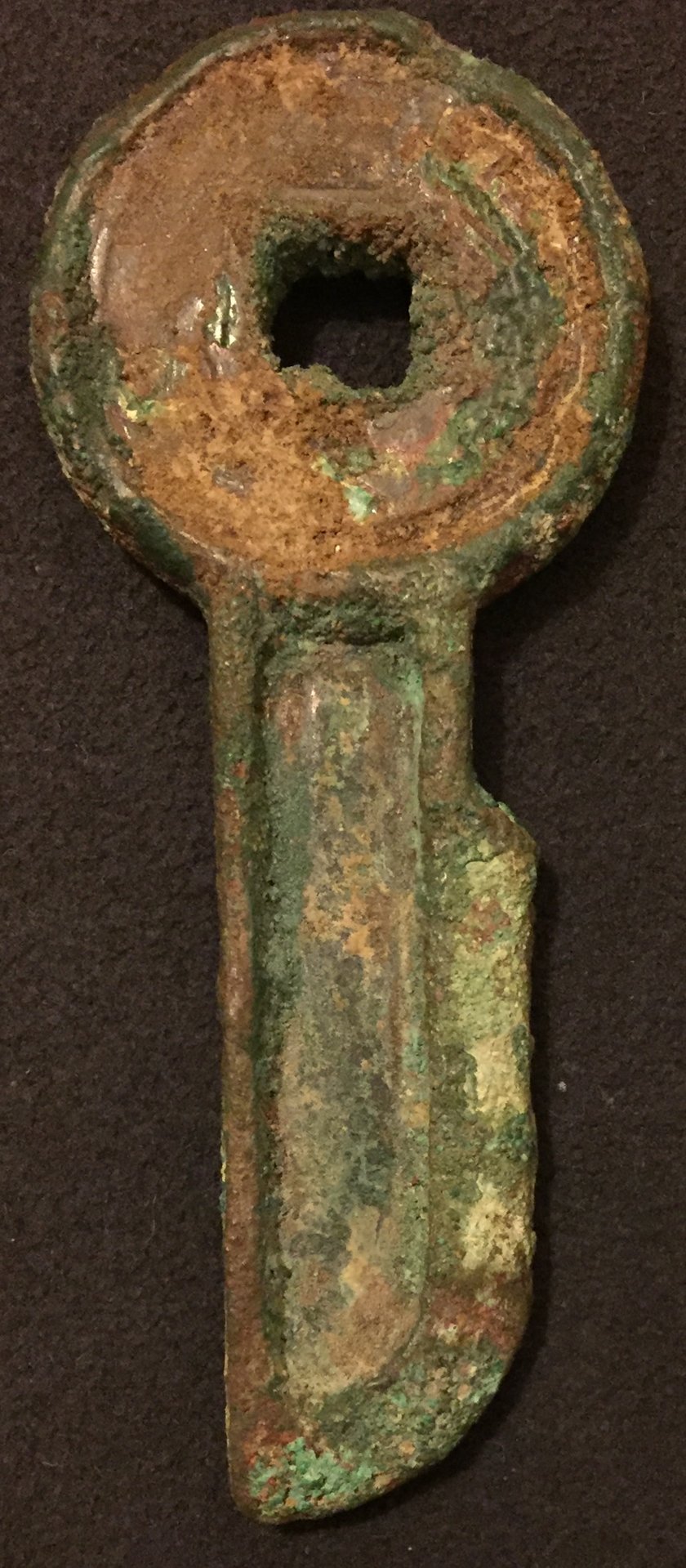
The population was not trusting of Wang Mang's new coinage, so they opted to continue transactions in wu zhus instead. Wang Mang countered this by making the use (and eventually the ownership) of the Han wu zhus a capital punishment (aka punishable by death). With this order, Wang Mang pretty much doomed the economy. As there was a general distrust towards the new coins, merchants refused them, effectively causing the economy to grind to a halt. There are accounts of people crying in the marketplaces, and "great mass[es] of half-starved humanity" cluttering the streets. Wang Mang later even made criticism of his new coins a capital offense. Of great concern was the sudden and drastic rise in counterfeiting. At first, those caught counterfeiting were simply put to death, but this was apparently not deterring enough. The penalty was then escalated so that the counterfeiter's family and the families of the nearest five neighbors would be sentenced to state slavery. It is not know whether this had any effect. Charcoal and copper also became state monopolies to aid in the prevention of counterfeiting. Pictured here is a contemporary counterfeit of the value-5000 knife coin, made obvious by the calligraphy style and genuine patina.
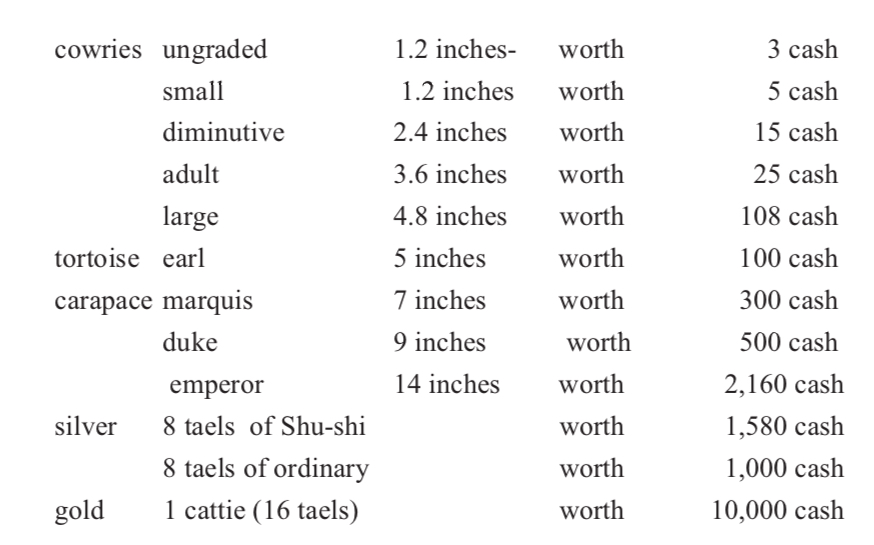
Now that wu zhus are banned and still no one trusts the new coins, the population begins reverting back to ancient forms of currency: cowries, tortoise shells, etc. Seeing the threat of this, Wang Mang (probably) ordered all alternate currencies to be turned in for new cash according to the table below (From Robert Tye).
Only 3 of the 15 coins actually circulated, the value-1 (Xiao Quan Zhi Yi), the value 50 (Da Quan Wu Shi), and the value-1000 spade (Da Bu Heng Qian), making them very common today.
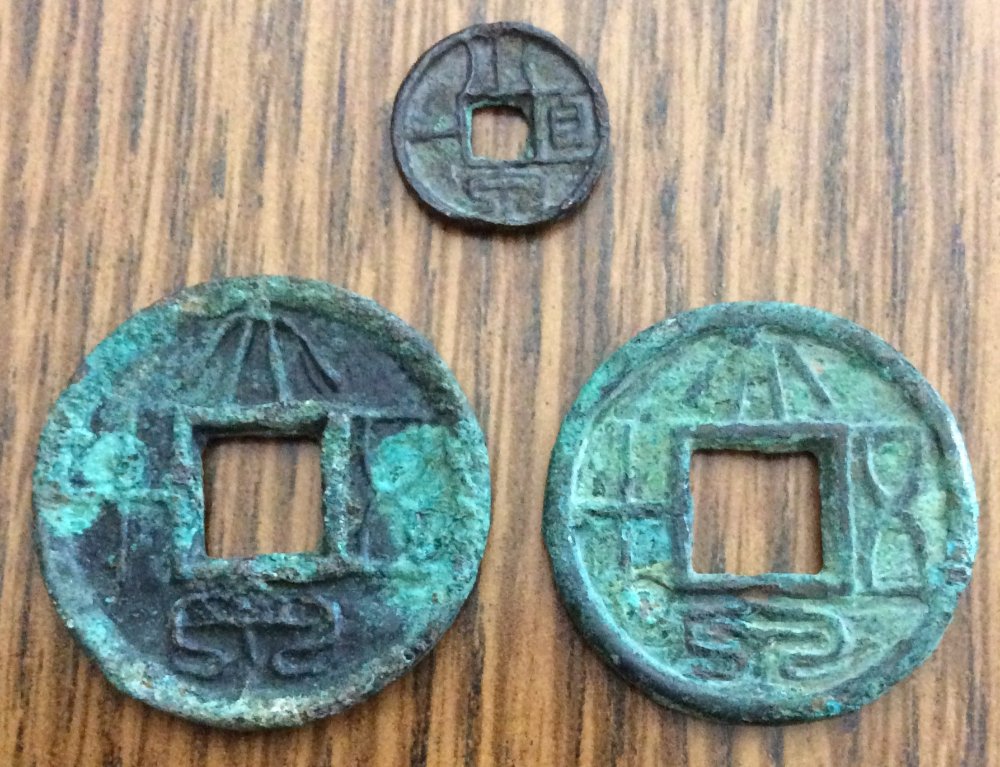 Xiao Quan Zhi Yi ("Small Coin Value One") at top, and 2 Da Quan Wu Shi ("Great Coin Fifty") coins at bottom.
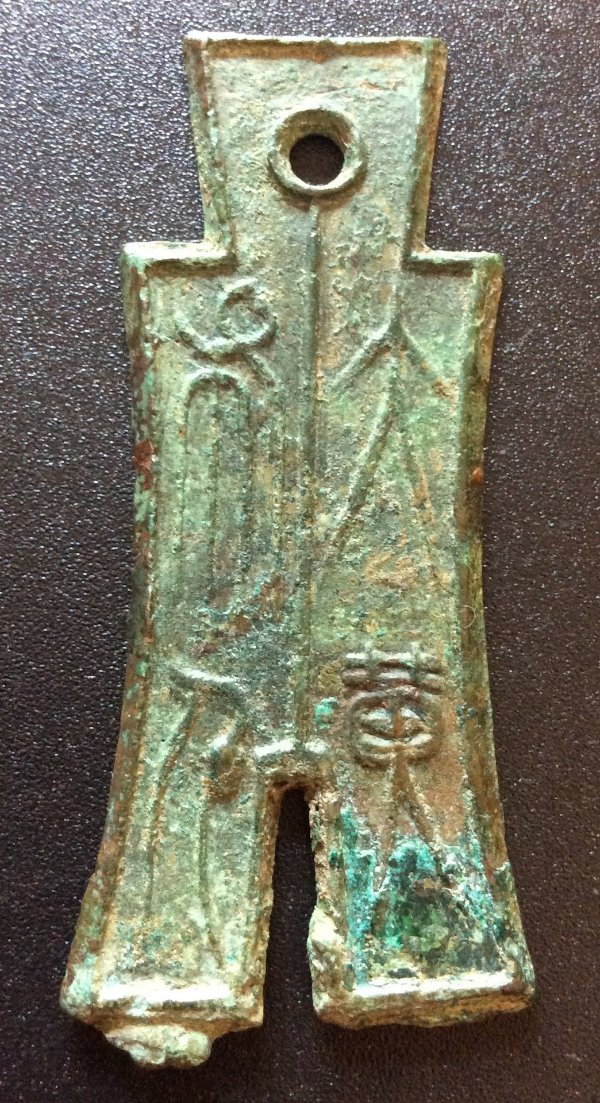 Da Bu Huang Qian ("Large Spade ? 1000"). I am not sure how "Huang" translates in this context as it means "yellow".
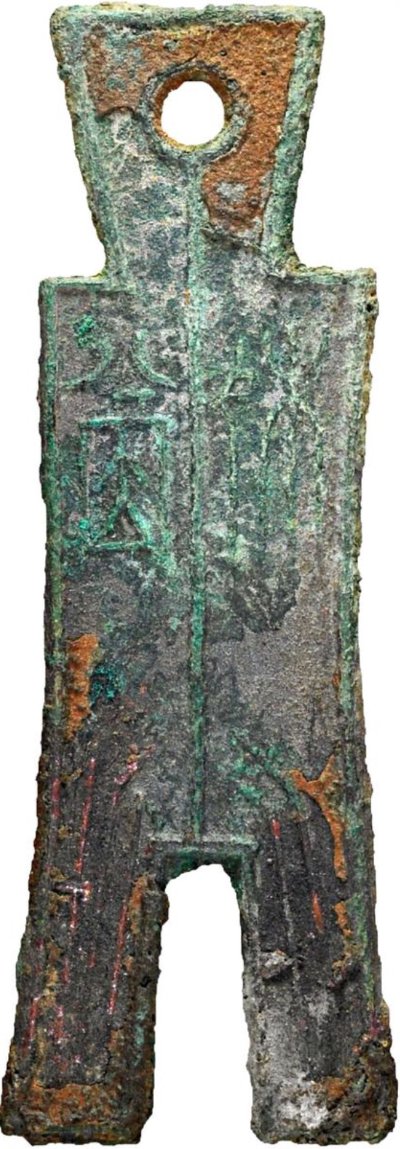 Pei Bi Dang Jin cast by the Chu State. You can see how similar in shape and style it is to the Wang Mang spades. It is thought that this type was the inspiration for Wang Mang's spades.
Due to the overall failure of the coins, the unpopular denominations were demonetized and recalled in 14 AD, being replaced by the Huo Quan, Bu Quan, and Huo Bu. These were valued much more closely to their intrinsic weights, making them far more accepted. These were all carefully and precisely cast to discourage counterfeiting, which is why the calligraphy is so beautiful.
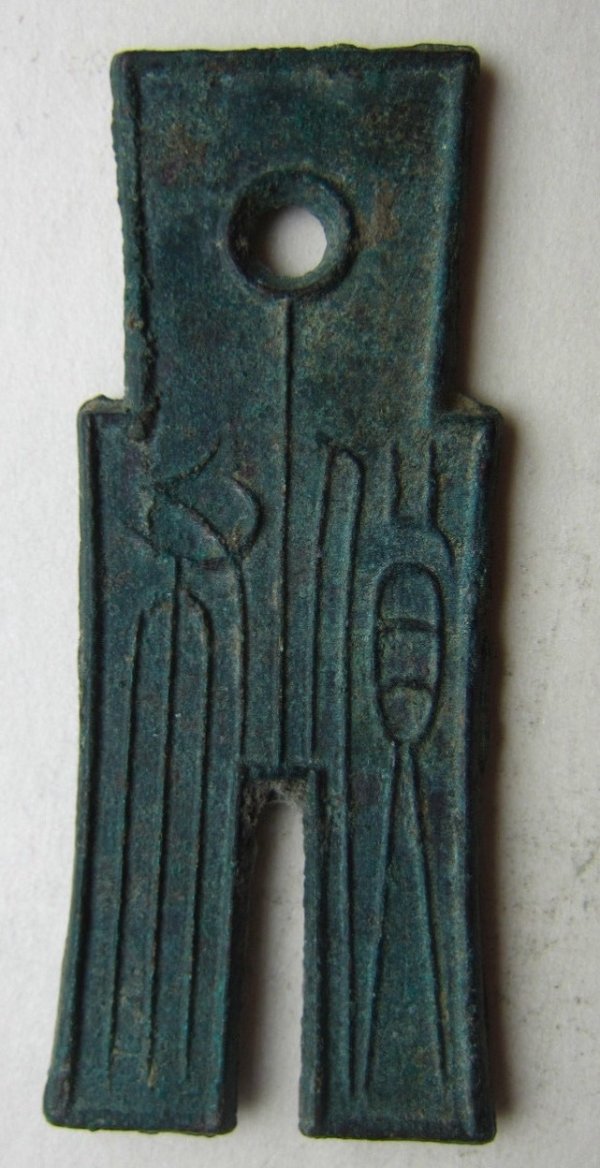 Huo Bu spade.
The economic breakdown additionally spurred total social breakdown as well. Freelance criminals became commonplace across the empire, and corruption from lack of pay in the civil service skyrocketed. Mang was ridiculed by most, and he daily feared assassination. His sophisticated ideas were rejected by the very people who they were meant to help because they were too sophisticated for their audience. Now that his expectations of reforming China into a utopia were gone, Wang Mang worked day and night desperately trying to keep the empire from collapsing into total chaos. Ha had massive numbers of the Huo Quan's and Huo Bu's cast to help pay the members in the civil service. He put forth a complex system that would reward civil servants for the results of their work, but since it was too complicated to follow they continued taking advantage of the population. The sophistication of Mang's mind had obviously done more of a disservice to the country than he could ever have imagined.
At the outskirts of the empire, there were severe famines that led to much starvation and some reports of cannibalism. From these areas, a rebellion began forming, becoming known as the "Red Eyebrows," which eventually became strong enough to defeat the imperial armies. An army supporting the Han lineage was also formed, defeating the 420,000-strong imperial army. Hundreds of thousands of the starving gathered outside of the capital begging for some kind of relief. The imperial granaries were opened to lower the price as per his reform, but the price remained high because the officials in charge of distribution chose to sell the grain on the black market instead. Because of this, 70-80% of these people perished. Out of desperation to stabilize the empire, Wang Mang ordered a recall of all his reforms. But it was too late. The resurging Han army descended upon Chang'an and overtook it. Mang, by now delirious from drugs and simply losing his mind from the situation, locked himself in a tower in his palace, along with the last few of his supporters. The Han troops made their way to his hiding spot and butchered him. Pieces of his body were sold as mementos. Famously, his tongue was removed from his head and eaten. His head was hung in the marketplace and then held in the imperial court vault until it was destroyed by a fire during the Jin Dynasty (The one during the Three Kingdoms period). With this, the Han Dynasty was finally in control once more, moving its capital to the east (hence "Eastern Han Dynasty").
Now that you know the greater historical contect for this coin, you can understand why I feel giddy every time I hold it. I am absolutely sure that it is genuine for several reasons: it comes from the Wang Yi-Xin collection, formed in the 1930's and 1940's; the characters are all perfectly sharp as I expect from coins cast while Wang Mang was in power; the patina is exactly what I look for in genuine coins; where the patina has gaps shows the "black mercury" fabric common to Wang Mang's coins; there are scrapes on the head from where the patina was forcefully removed to expose the gold inlay; and there is still a little bit of patina covering the gold inlay, which strongly suggests that the gold is original to the coin and not replaced as is often seen.
Another interesting thing I have noticed on this coin is that there are a couple significant rim bumps on the reverse. As the patina is not broken, I would think that they were there when the coin was buried. I like to think that its owner threw these coins at a wall (or some similarly-hard object) out of fury when hearing that they were made worthless. With that said, I wonder about who owned this coin and what happened to him/her. It had to be someone in the upper class as they had to have had at least two ounces of gold to trade for this knife. But I guess it will forever be a mystery, but one that is fun to think about.
The rim bumps I am talking about are along the upper rim of the handle.
Oh, and sorry for the huge wall of text. :/ This story is just too much fun! :) I hope you enjoy it as much as I do.
References:
http://www.anythinganywhere.com/info/tye/Wang Mang.htm
https://www.smithsonianmag.com/hist...ist-2402977/http://calgarycoin.com/reference/ch...#interregnumhttps://en.m.wikipedia.org/wiki/Wang_Mang



 Posted 04/21/2018 3:09 pm





 back. I wondered what happen to to you. I must say you made up for lost time with this outstanding thread.


