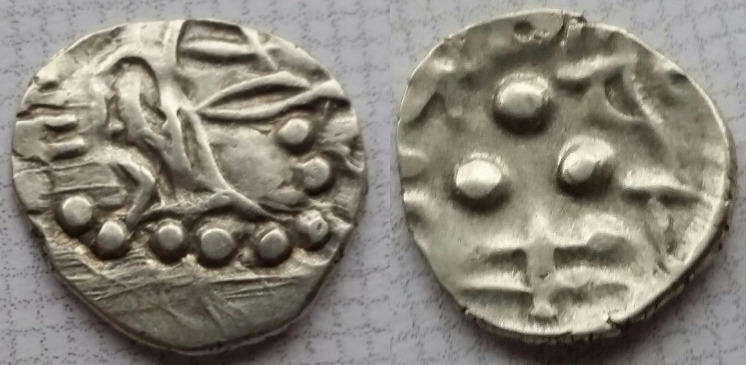
Who doesn't love a good mystery?
This coin type I believe was recently discovered, and has not been attributed. They come from historic Sindh in NW India/Pakistan, and are believed to be a product of a local kingdom around 600-700 AD, before the Muslim invasions in the early 8th century.
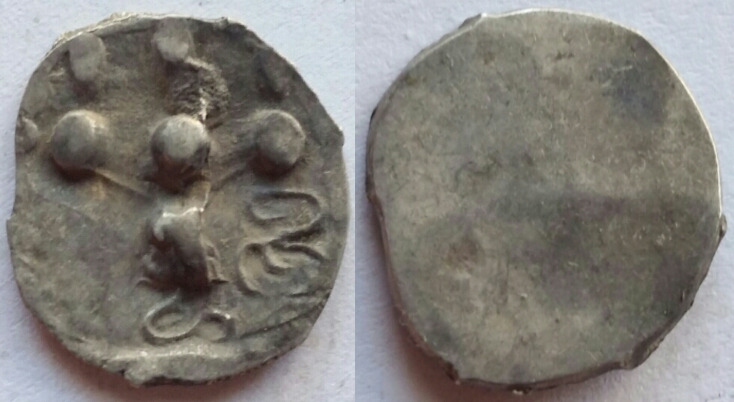
AR 15x14mm, 1.15g
Obv: Four dots and lines arranged to slightly resemble a candelabra, Brahmi "Ha Si"
Rev: Blank
Some things that make these particularly interesting:
- Despite the very crude fabric, the lettering is extremely well crafted and delicate - arguably the best calligraphy on an Indian coin since the golden age of the Kshatrapas.
- Contrasting the calligraphy, the design is so crude abstract that nobody is certain what it's supposed to be.
- These are the only uniface coins struck in India after about 180 BC. It's difficult to photograph, but the reverse is brought to a very slight point in the reverse, showing that these were placed in a slightly pyramidal dish to strike - there was never an obverse die.
- These coins come in a few legend variants, the most common being "Ha Si" and "Ha Gu"
- The area was primarily ruled by the kingdom of Sindh during this time; that kingdom struck silver coins, but of a very different fabric and lighter weight.
- The principal silver coins in India at the time would have been the post-Gupta (Maitraka, Kalachuri, and Sri Harsha types) which were a little heavier but of much lesser silver quality, and the coinage of the Hunnic invaders, at this time struck to the Sassanian-Attic standard of ~4g drachms. This doesn't seem to fit neatly with either monetary system. Which is unusual for this time and place.
At any rate, when these coins were discovered, they came in a great big hoard, so they are not expensive. This one was only $11; I have seen them go much cheaper than that!
Alex Fishman I believe is working on a reference to these coins; as far as I know it is not yet finished.






 Posted 04/23/2018 4:56 pm