| Author |
 Replies: 15 / Views: 6,785 Replies: 15 / Views: 6,785 |
|
|
Pillar of the Community
Canada
1928 Posts |
|
|
|
|
Valued Member
Canada
291 Posts |
|
|
Rest in Peace
10197 Posts |
This is "tecnically " a strike thru. The coin itself intruded into the striking chamber and became struck. It was a failue to fully eject. An indent usually refers to a planchet in the chamber. I would label this as "failed ejection strike-thru" if keeping or selling it on sleezeebay. This from http://www.error-re.comQuote:
Partial Indents
Definition:An "indent" is defined by the hobby as an indentation from an unstruck blank or planchet. Any other kind of indentation is referred to as a "struck-through error". Since most indents only cover part of the coin's surface, the term "indent" usually refers to a partial indent. Full indents are, however, referred to as "full indents" or "full uniface strikes".
Indents can appear on the obverse face or the reverse face, and sometimes both faces simultaneously. As many as three indents have been recorded on a single coin, reflecting the presence of three extraneous planchets in the striking chamber. Edited by Crazyb0
05/15/2018 3:45 pm
|
|
Moderator
 Canada
10477 Posts |
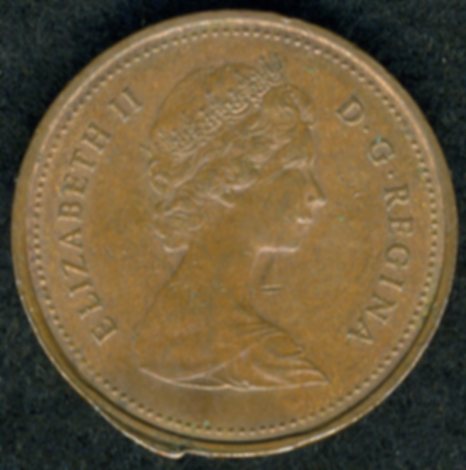
Wrong Crazyb0... you can see the beads inside the indent and the outline of a fully formed rim. This coin was struck with not only an overlapping planchet in the striking chamber, but a previously struck coin.
If you want to get "technical", this is an indent strike, with a partial brockage.
If you really want to get into the gory technical details, this is what Mike Diamond would call a "flipover partial brockage". What we are seeing is the partial brockage of the obverse beads inside the indent on the obverse (anvil die side). So the first coin that was struck was not only partially ejected, it was flipped over when the original poster's coin was struck...
"Discovery follows discovery, each both raising and answering questions, each ending a long search, and each providing the new instruments for a new search." -- J. Robert OppenheimerContent of this post is licensed under a Creative Commons Attribution-NonCommercial 3.0 Unported License. See: http://creativecommons.org/licenses...0/deed.en_USMy eBay store
|
|
Rest in Peace
10197 Posts |
Thank y'all! This is the absolute last time I comment on a Canadian generated thread. Thanks for such a rousing welcome!
Might even see what Mr. Diamond has to say, I'm not seeing a third coin involved hear.
Edited by Crazyb0
05/15/2018 7:02 pm
|
|
Pillar of the Community
Canada
1993 Posts |
dont let what someone says discourage you from voicing your opinion, I actually thought this was PMD until I saw SPP's post (i know SPP usually is right so I tend to believe what he says) your guess was closer than mine |
|
Pillar of the Community
 Canada
1928 Posts |
I appreciate all comments related to the coin as I am a beginner in Error coins.
So every comment right or wrong is good for me and the post that's what brings out what it really is it educates us and helps me as well as others that don't have the knowledge on error coins to understand somewhat. So please give your comments and thoughts on the error.
I'm not the best speller either but that's not what the post was really about so I'm not concerned about proper spelling as long as I can figure out what the person is trying to say its good for me.
Beleive it or not I have worked with older guys in my life that couldn't even read the news paper but very good tradesmen just no schooling like myself although I can read and wright my spelling lacks I started working at an early age 15 no time for school had to work to live a different kind of education.
|
|
Moderator
Canada
10477 Posts |
Quote:
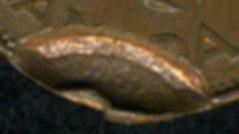
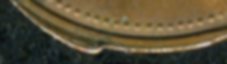
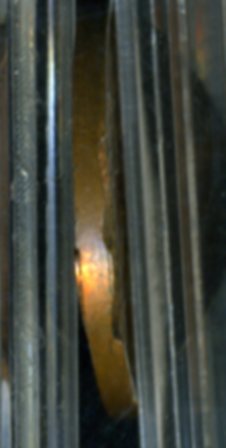
I'm not seeing a third coin involved hear. Who said anything about a third coin? Two coins are involved in making this error. Remember with Canadian coins, the reverse is the hammer die and the obverse is the anvil die. There are two possible scenarios that created this error. Scenario #1Planchet #1 is struck normally as a coin, but fails to eject completely and sits on the collar. In the process, it is flipped over. Planchet #2 enters the striking chamber, is loaded in the collar and the strike goes through the overlapping Coin #1, creating the indent strike and partial brockage. The other coin (mated pair) would look something like this:  Scenario #2 Scenario #2A Planchet with an incomplete clip is struck and in the process, the two pieces separate, creating a small football clip. Then a second planchet is loaded and the coin is struck through the football clip, creating the indent and partial brockage. The other mated fragment would look like a "football" clip, you can see the obverse design that was used to make the partial brockage in the indent.   The net result is the same. An indent strike with a partial brockage. "Discovery follows discovery, each both raising and answering questions, each ending a long search, and each providing the new instruments for a new search." -- J. Robert OppenheimerContent of this post is licensed under a Creative Commons Attribution-NonCommercial 3.0 Unported License. See: http://creativecommons.org/licenses...0/deed.en_USMy eBay store
|
|
Pillar of the Community
Canada
1928 Posts |
Thanks all for your input as well the explanation with two different scenario on how this coin could have ended up this way.
I'm guessing if I was to look for a coin that might have done this as in the picture in scenario #1 it would be a 1981 coin I would be looking for?
Not saying I would fine the exact coin but one like it with a 1981 date would be nice to make a double hard slab of, the hunts on.
|
|
Moderator
Canada
10477 Posts |
Finding the mated pair is always the challenge. Most smaller fragments did not make it past the riddler (shaking device with holes slightly smaller than the coins being struck) at the mint... if you find the mated pair, the combined value is many more times each individual piece...
"Discovery follows discovery, each both raising and answering questions, each ending a long search, and each providing the new instruments for a new search." -- J. Robert OppenheimerContent of this post is licensed under a Creative Commons Attribution-NonCommercial 3.0 Unported License. See: http://creativecommons.org/licenses...0/deed.en_USMy eBay store
|
|
Pillar of the Community
Canada
1571 Posts |
Has anyone ever found the match? That seems like a life long, unsuccessful challenge unless it had help leaving the mint
|
|
Moderator
Canada
10477 Posts |
Just got my Errorscope magazine in the mail today. Lots of excellent examples of indent strikes in the March-April issue.
"Discovery follows discovery, each both raising and answering questions, each ending a long search, and each providing the new instruments for a new search." -- J. Robert OppenheimerContent of this post is licensed under a Creative Commons Attribution-NonCommercial 3.0 Unported License. See: http://creativecommons.org/licenses...0/deed.en_USMy eBay store
|
|
Pillar of the Community
United States
2752 Posts |
It's a flipover partial brockage. In the U.S., the term "indent" is exclusively used to refer to an impression left by an unstruck planchet.
Error coin writer and researcher.
|
|
Moderator
Canada
10477 Posts |
In Canada, the term indent is used to describe the net effect on the coin. It may, or may not have a partial brockage.
"Discovery follows discovery, each both raising and answering questions, each ending a long search, and each providing the new instruments for a new search." -- J. Robert OppenheimerContent of this post is licensed under a Creative Commons Attribution-NonCommercial 3.0 Unported License. See: http://creativecommons.org/licenses...0/deed.en_USMy eBay store
|
|
Pillar of the Community
United States
2752 Posts |
A perfectly valid use of terminology. I realize that U.S. terminology is quirky. I've simply inherited it learned to live with it. Error coin writer and researcher.
|
|
Bedrock of the Community
United States
79456 Posts |
Very nice purchase and congratulations! That's a nice coin.
Errers and Varietys.
|
| |
Replies: 15 / Views: 6,785 |
|












 Posted 05/15/2018 3:42 pm


