| Author |
 Replies: 20 / Views: 6,896 Replies: 20 / Views: 6,896 |
|
Pillar of the Community
United States
3362 Posts |
I have been researching XRF Scanning, and finding conflicting information. If anyone here has subjected a Clad or Plated coin for an XRF scan, would you be willing to share the results of the scan?
|
|
|
|
Bedrock of the Community
Australia
21792 Posts |
One of the strong limitations of XRF is that only the surface of the coin can be examined. The test gives no clue whatsoever as to what metal is under the surface, be it a fake, or a genuine coin that is plated or clad. I presume genuine LMC's a pure copper plated, and the clad coins are 75%-25% copper-nickel clad. If this presumption is right, then XRF can be used to help confirm authenticity. The coin still may be rotten to the core, XRF won't tell you that. This is why XRF is pretty much useless for the investigation of pure gold clad, or pure gold plated, tungsten cored fake gold bars. Ultrasound or X-Ray are the right tests for these Tungsten and gold have the same density, so check for weight useless as well. XRF best used to investigate suspect coins that have a homogeneous composition. |
|
Pillar of the Community
 United States
3362 Posts |
Thanks, sel-691 What you are saying is the same thing I am hearing from a few other sources. On the one hand, I have been told by a sales rep that XRF ONLY analyzes the surface. This does not make sense to me because the X-Rays must penetrate the sample and escape from the sample to be read. The question seems to me to be the depth of penetration. Another sales rep says depth of penetration is about 10 µ. My suspicion is that they might be giving simple answers to a very complex question. The reason I am interested in examples is to be able to examine actual results of such scans on plated or clad coins. What am I missing in reading the following resources? My conclusion from reading them is that XRF should give helpful information when plated or clad coins are scanned. Here is an interesting discussion of penetration depth: Penetration Depth "In general, it is fair to assume that X-Rays will penetrate a few micrometers down to several millimeters, depending on the sample matrix. At best fluorescent X-Rays will be detectable from a few millimeters within the sample, but in many situations this could be reduced to a few micrometers or less. Variables are  The voltage setting of the X-Ray generator. Which elements are being detected (The lighter elements (e.g. Na, Mg, Al, Si) have very low energy X-Rays, and thus will be difficult to detect even at relatively small depths within the sample. Heavier elements (e.g. Cu, Ag, and Au) have much more energetic X-Rays which will be able to pass through large distances within the sample. The sample composition itself is also an important factor. The higher the concentration of heavier elements which absorb strongly, the more reduced the chance of X-Rays escaping from deep within the sample. To summarize, heavy elements (i.e. energetic fluorescent X-Rays) will be detectable relatively deep within a sample matrix primarily comprised of light elements (i.e. low absorption). Light elements (i.e. low energy fluorescent X-Rays) will be detectable only at the surface of a sample matrix comprised of heavy elements (i.e. strong absorption)." http://www.horiba.com/scientific/pr...tion-depths/Copper (for example) penetration and formula for calculating penetration depths: Cu Emission Line: Kα1 Energy (keV) 8.01 Depth 580µ Formula: http://www.xrf.guru/styled-12/page40/index.htmlPg 25 in the following paper specifically mentions an example of coating thickness: http://www.stahl-online.de/Cetas201...oads/A59.pdf |
|
Bedrock of the Community
United States
79348 Posts |
Interesting thread. I can't answer this for you since I've never done this before, but still very interesting.
Errers and Varietys.
|
|
Pillar of the Community
United States
2023 Posts |
Quote:
On the one hand, I have been told by a sales rep that XRF ONLY analyzes the surface. This does not make sense to me because the X-Rays must penetrate the sample and escape from the sample to be read. Depends on where the source and receiver are located. In a medical setting, for example, the rays are emitted from one place, pass through the body, and are received on a film on the other side. Bones absorb the rays more than skin/muscle do, so the film that is exposed by more rays are darker. With some scanners, the rays and detector are in the same unit, so it depends on the rays that are reflected, not penetrated. Back in this thread we discussed different types of scanners, starting around page 3. This device appears to use a different kind of technology and can analyze the core. |
|
Pillar of the Community
United States
3362 Posts |
Quote:
With some scanners, the rays and detector are in the same unit, so it depends on the rays that are reflected, not penetrated. I believe that this is the type of scanner used for coins and metals. I believe that in X-Ray of metals the X-Ray must penetrate enough for emissions to be produced. The prevailing "story" about XRF is that it scans surface only. However, in thinking about that, the X-Ray has to penetrate enough for the emission of characteristic "secondary" (or fluorescent) X-rays from a material that has been excited by high-energy X-rays. For example, Cu allows for a penetration of 580µ @ Energy (keV) 8.01. This is far more than enough to penetrate Cu plate of 8µ. Many scanners are capable of producing up to 50 keV. A quarter cladding on a strip out of which blanks are punched is 228.6µ +/- 25.4µ. I don't know if I am capable of doing the calculation for depth of penetration on a Quarter clad layer (75% +/- 2.5% copper and 25% +/- 2.5% nickel), but it seems that there may be energy in keV to spare? I was thinking that actual examples of scans might help me understand. I am probably missing something somewhere! |
|
Pillar of the Community
United States
3362 Posts |
I know that, at least for some metals, there is Lalpha1 line and Lbeta1 line which have escape depths more shallow than penetration depths. I hope someone can explain that to me!
|
|
Pillar of the Community
United States
3362 Posts |
Now that I think about it, any explanation which includes both L lines and K lines should be most helpful.
Edited by Pete2226
05/28/2018 06:15 am
|
|
Bedrock of the Community
Australia
21792 Posts |
Pete2226:
What is the typical penetration depth for hand held XRF scanners for:
1. copper?
2. copper nickel?
3. silver?
4. gold?
Thanks.
Edited by sel_69l
05/28/2018 08:30 am
|
|
Pillar of the Community
United States
3362 Posts |
Quote:
What is the typical penetration depth for hand held XRF scanners for:
1. copper?
2. copper nickel?
3. silver?
4. gold? I have not found the answer for all these elements yet. I do not understand K lines and L lines. I do not understand the nuances of the difference between penetration depth and "escape depth". Having said that, here is what I have found: "(The lighter elements (e.g. Na, Mg, Al, Si) have very low energy X-Rays, and thus will be difficult to detect even at relatively small depths within the sample. Heavier elements (e.g. Cu, Ag, and Au) have much more energetic X-Rays which will be able to pass through large distances within the sample." http://www.horiba.com/scientific/pr...tion-depths/Cu Emission Line: Kα1 Energy (keV) 8.01 Depth 580 microns (see the table below the first graph here): http://www.xrf.guru/styled-12/page40/index.html(Also I do not really understand what is being said about the SiO2 matrix?) Gold penetration @ 300 microns with 50keV, but practically speaking, only 10 microns to 18 microns. See this reference: (not allowing me to post this url, sorry |
|
Pillar of the Community
Canada
1747 Posts |
There are members on this forum that have Xrf machines and who are very willing to help people out testing their coins. you should PM SPP-Ottawa he uses one for work and will probably be able to answer all your questions.
Cheers.
|
|
Moderator
 Canada
10476 Posts |
Quote:
One of the strong limitations of XRF is that only the surface of the coin can be examined. This is incorrect, when you want to get into specifics. Penetration depth depends on many factors, but it all comes down to the power of the beam source (energy) and the matrix of the material being tested (density). The more powerful the beam source, the deeper the X-Rays penetrate. As each photon is emitted as a K or L shell line, the spectral peaks resulting from such fluorescence can be thought of as atom counts of sorts - though the quantity of photons is determined by both the voltage of the tube and the depth of penetration. The depth of penetration can be calculated by the following equation: I/I0 = e[-(μ/ρ)x] (1) where I is the quantity of photons returning from the sample, I0 is the quantity of photons entering the sample, μ/ρ represents the mass attenuation coefficient of a given element for a particular matrix, and x represents the density of the object. You can find mass attenuation coefficients at NIST: https://physics.nist.gov/PhysRefDat...ml/form.html For coins and other metallic alloys, you have to remember that while the penetration depth is one factor, note that electrons are dislodged from their orbital shells throughout the entire depth of analysis... so, in layman's terms, a gold-plated Cu-Ni coin will give results of gold, nickel and copper values. The thicker the electroplating, the more influence the surface material has on the analytical results. 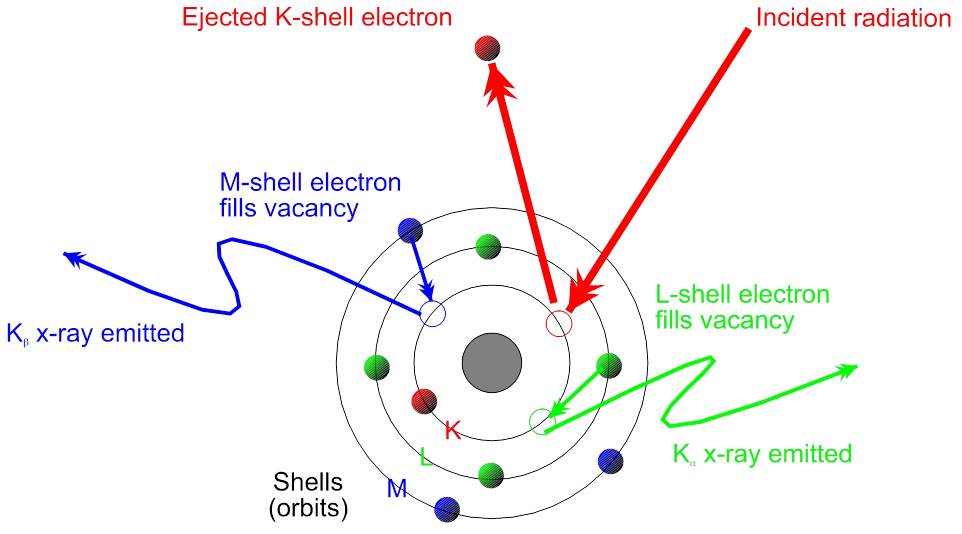 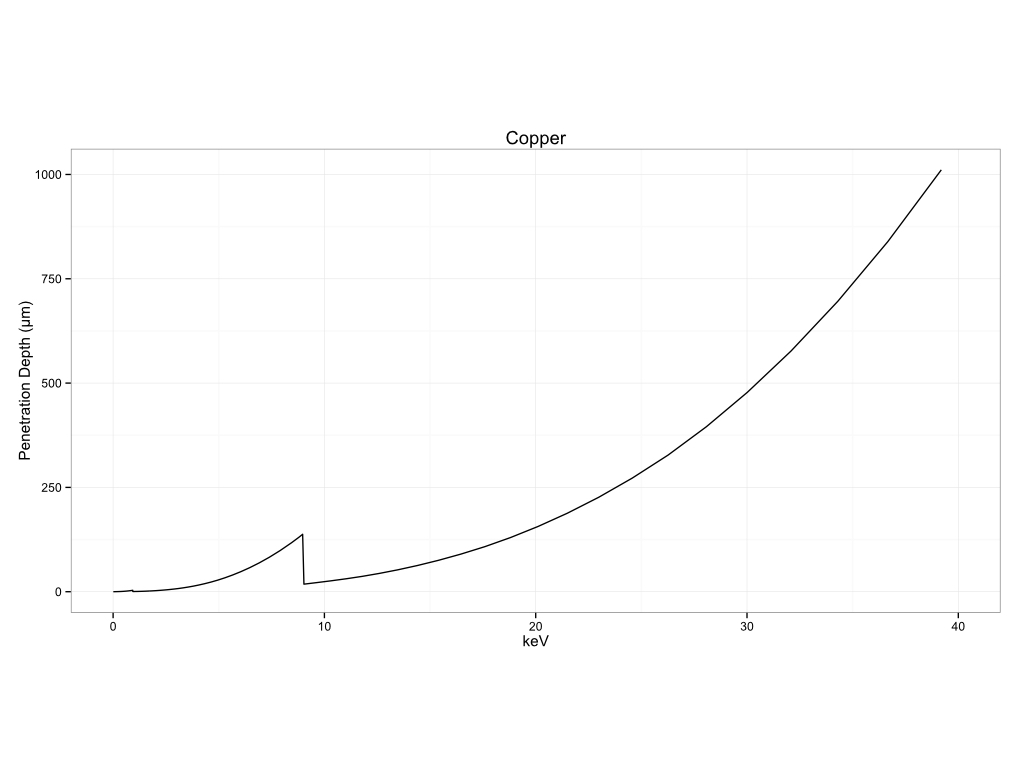 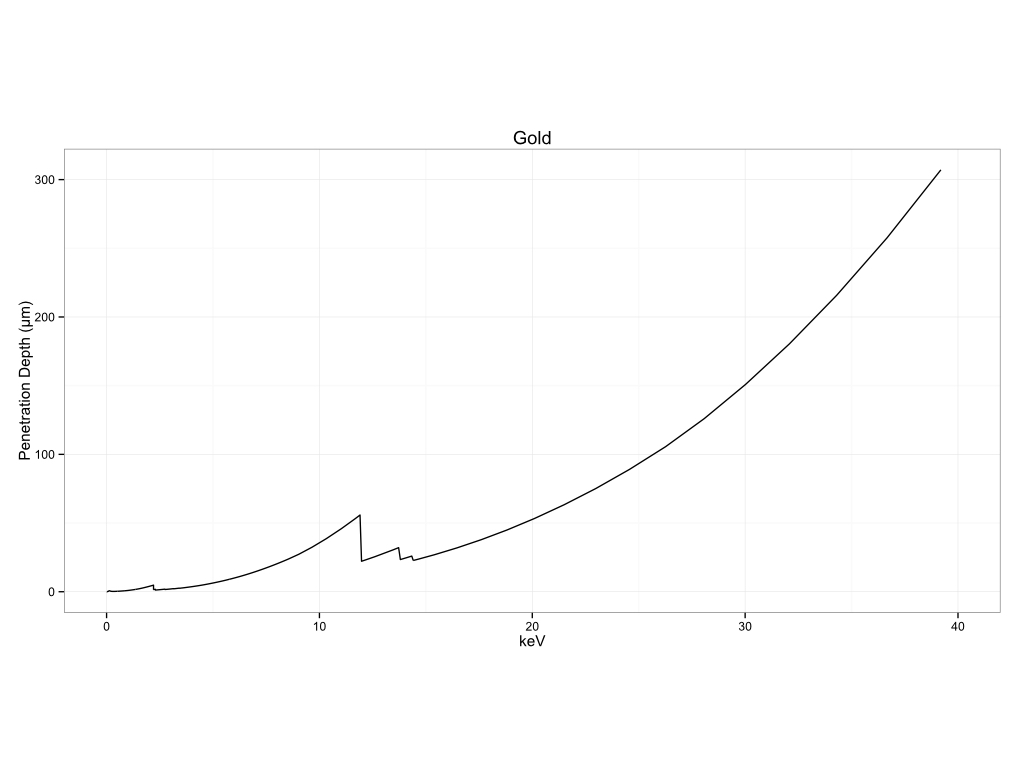 I test coins on the XRF in my lab, right inside the mylar 2x2s cardboard flips. Mylar barely attenuates the beam, as you can see by its penetration depth - hence why mylar film is used in handheld XRF instruments to protect the very sensitive detector from contamination and damage. 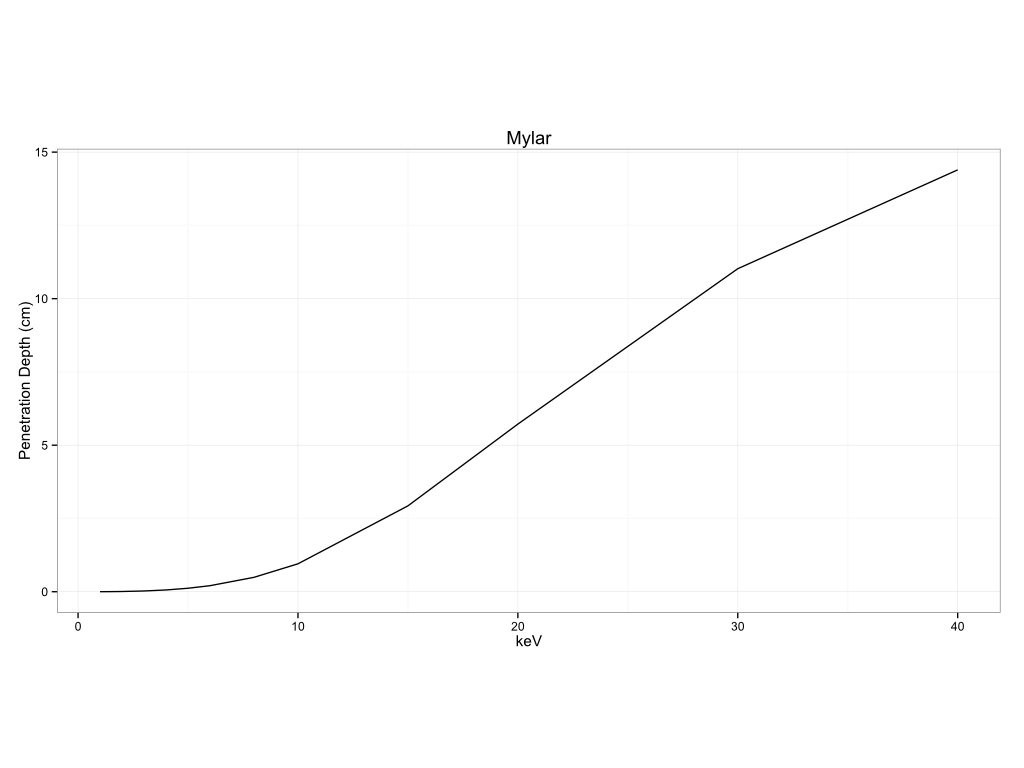 So yes - XRF can detected if a coin has been plated, because it picks up the other elements under the plating. The compositional values will be skewed to the plating. If the plating is too thick (cladding) then the energy beam cannot penetrate it to the underlying coin. But, if you know what you are doing, XRF is a powerful tool. In general, it is fair to assume that X-Rays will penetrate a few micrometers down to more than 100 microns of a coin's surface, depending on the sample matrix. Archeologists love using the XRF because it penetrates the oxide coatings (i.e., rust) of ancient tools without having to damage or clean them. "Discovery follows discovery, each both raising and answering questions, each ending a long search, and each providing the new instruments for a new search." -- J. Robert OppenheimerContent of this post is licensed under a Creative Commons Attribution-NonCommercial 3.0 Unported License. See: http://creativecommons.org/licenses...0/deed.en_USMy eBay store
|
|
Moderator
Canada
10476 Posts |
In short - to answer your question, yes, I have tested lots of plated coins... Dealers send me material sometimes because with off-metal error strikes, it can be tricky.
Clad coins no, as the cladding is too thick, but I was able to detect a silver-plated clad coin...
Gold bars and other bullion like ingots... it is not useful, as the cladding will be thick enough beyond the maximum penetration depth of the beam energy.
That said, a portable XRF is not black box technology. One must understand how the various elements behave when shell electrons are displaced and know their relationship in the Periodic Table when the detection software tries to interpret the energy peaks.
"Discovery follows discovery, each both raising and answering questions, each ending a long search, and each providing the new instruments for a new search." -- J. Robert OppenheimerContent of this post is licensed under a Creative Commons Attribution-NonCommercial 3.0 Unported License. See: http://creativecommons.org/licenses...0/deed.en_USMy eBay store
|
|
Pillar of the Community
United States
3362 Posts |
|
|
Pillar of the Community
United States
3362 Posts |
Would you be willing to allow for folks to send you coins for XRF analysis? If so, details on cost and where to send? (I don't mind if you send me a message instead of making it public.)
|
|
Pillar of the Community
United States
3362 Posts |
Another question: what is the expected penetration depth for Cupro Nickel (75% Cu and 25% Ni)?
|
| |
Replies: 20 / Views: 6,896 |










 Posted 05/27/2018 10:35 am


