| Author |
 Replies: 7 / Views: 1,897 Replies: 7 / Views: 1,897 |
|
|
Pillar of the Community
Canada
1931 Posts |
This is a coin kind of passed down through family. Not sure where it originally came from what it's grade may be and also if possible what the value might be. thanks malissa 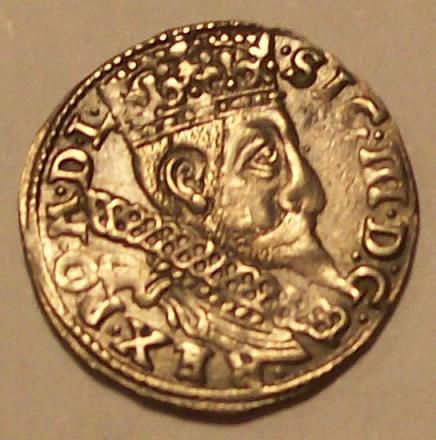 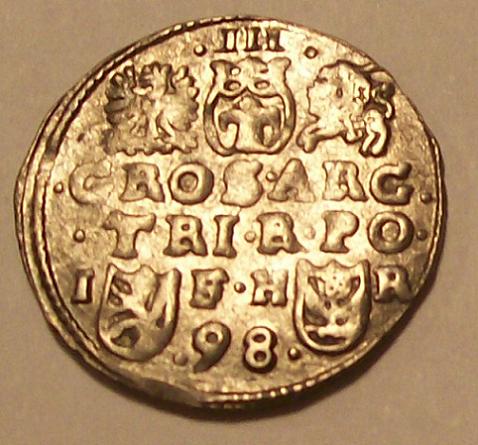 Edited by malissadawn
08/03/2008 06:44 am
|
|
|
|
Moderator
 Australia
16982 Posts |
Your coin is from Poland, a 3 groschen issued during the reign of King Sigismund III, the gentleman pictured on the obverse. The obverse legend translates to "Sigismund III, by grace of God King of Poland and Grand Duke of Lithuania. On the reverse are the national symbols of the two halves of his kingdom, the Polish Eagle on the left and the Lithuanian Knight on the right. The reverse inscription translates to "three silver groschen of Poland". The number "98" at the bottom is the date: 1598. The same basic type of coin was issued up to 1607 (listed in Krause as KM# 6), but since yours is from the 1500's, it's not actually listed in any of my catalogues, so I can't give you a "book value". This one on CoinArchives is a slabbed, uncirculated example, and sold for $150. Don't say "infinitely" when you mean "very"; otherwise, you'll have no word left when you want to talk about something really infinite. - C. S. Lewis
|
|
Pillar of the Community
 Canada
1931 Posts |
Hi,
Thank you for so much information! I couldn't find that coin anywhere I looked.
I have been collecting coins for a few years now but I have to be honest (at the risk of sounding a little bit stupid) I have not really learned any of the coin terminology, mostly I just buy what looks nice or interesting to me. What does slabbed mean?
Malissa
|
|
Bedrock of the Community
United States
12437 Posts |
A slabbed coin is one that has been aunthenticated and graded by a third party grading company( TPG). After grading, the coin is sealed in a plastic case, aka slab, with a label printed with the grading company logo, the type and denomination, and the numerical grade. |
|
Pillar of the Community
Canada
1931 Posts |
So how do I figure out the value and grade for something like this? I can't find it any of my books either as they don't go that far back. Also, I'm assuming that the grading system would be different for something this old and handmade?
thank you
|
|
Moderator
Australia
16982 Posts |
There are probably German and Polish price guides to cover these coins, but they'd be priced in euros.
My 1600's Krause is the 2003 edition, so it's somewhat out of date now. The price for KM# 6 (the similar coins, from the 1600's) varies by date and mintmark from $20 to $80 in Fine condition. Logically, it's likely to be somewhere in that range.
I don't think these coins were "handmade", in the sense of being "hammered" by hand. It looks too neat and tidy to be hammered to me. By 1600, much of Europe was using screw, rocker or roller presses to make higher quality coins than possible by the traditional hammered method.
On coins this old, it can be tricky to tell apart actual circulation wear from worn or poorly engraved dies. I tend to treat "wear" and "worn dies" the same when grading, since it has about the same effect on price. I'd grade yours around Fine to VF.
Don't say "infinitely" when you mean "very"; otherwise, you'll have no word left when you want to talk about something really infinite. - C. S. Lewis
|
|
Pillar of the Community
United States
1231 Posts |
Maybe DL20K can help with a more accurate price or he may have a book, since he is from Poland.
|
|
Pillar of the Community
Poland
3201 Posts |
It looks like the Kop. 1108 type according to my book. The mint is Poznan.
This type is rated R2 (the book uses a ''R*(unique)<R8<R7<R6<R5<R4<R3<R2<R1<R<zero(common)'' scale).
|
| |
Replies: 7 / Views: 1,897 |
|









 Posted 06/24/2008 2:20 pm


