| Author |
 Replies: 11 / Views: 3,064 Replies: 11 / Views: 3,064 |
|
|
Bedrock of the Community
United States
11963 Posts |
The PCGS website here ( https://www.PCGS.com/grades) has these definitions of Strike Types. 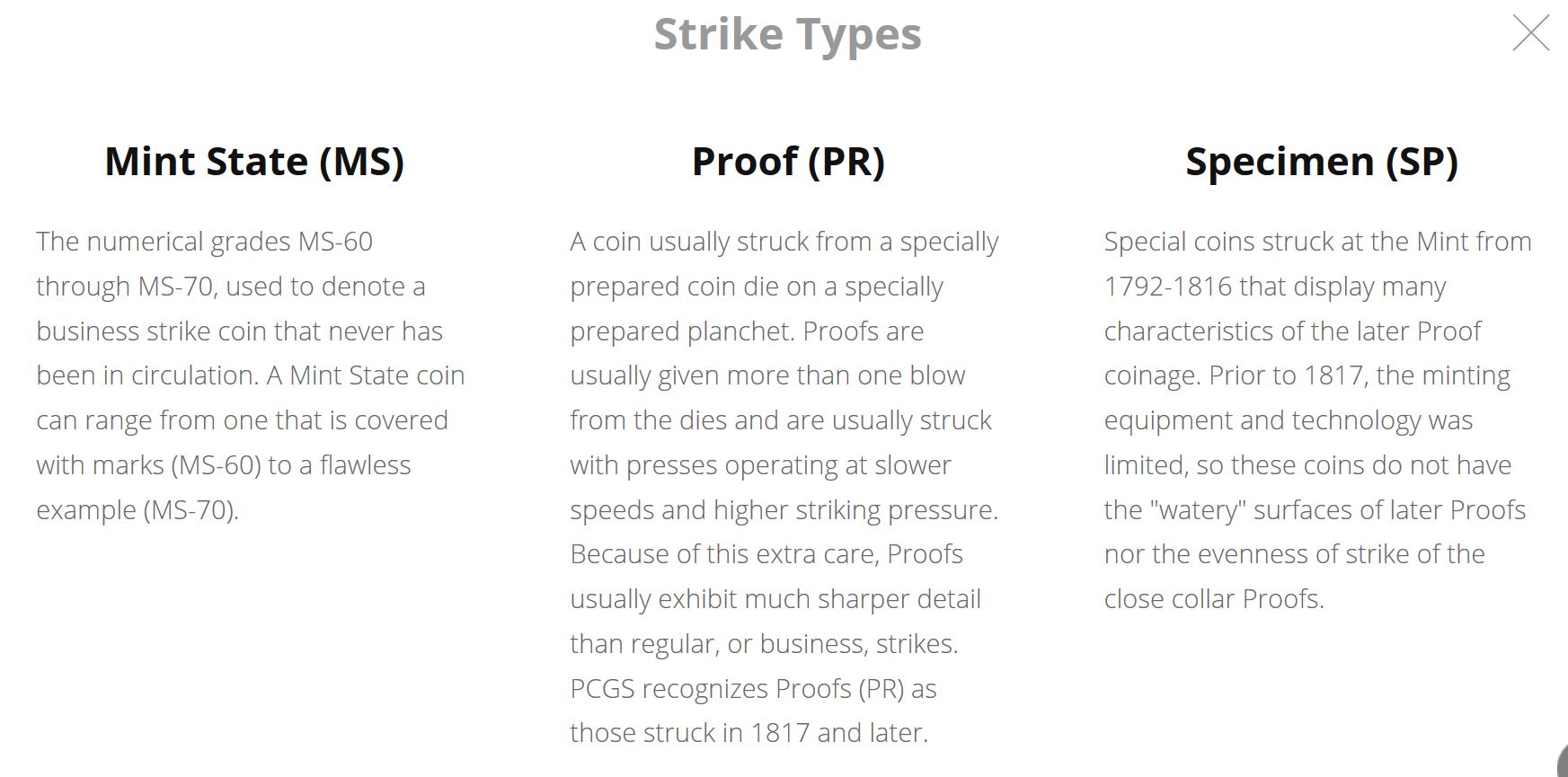 According to this explanation, only coins minted before 1817 are given the specimen strike designation, a proof strike prototype. And then we have this: 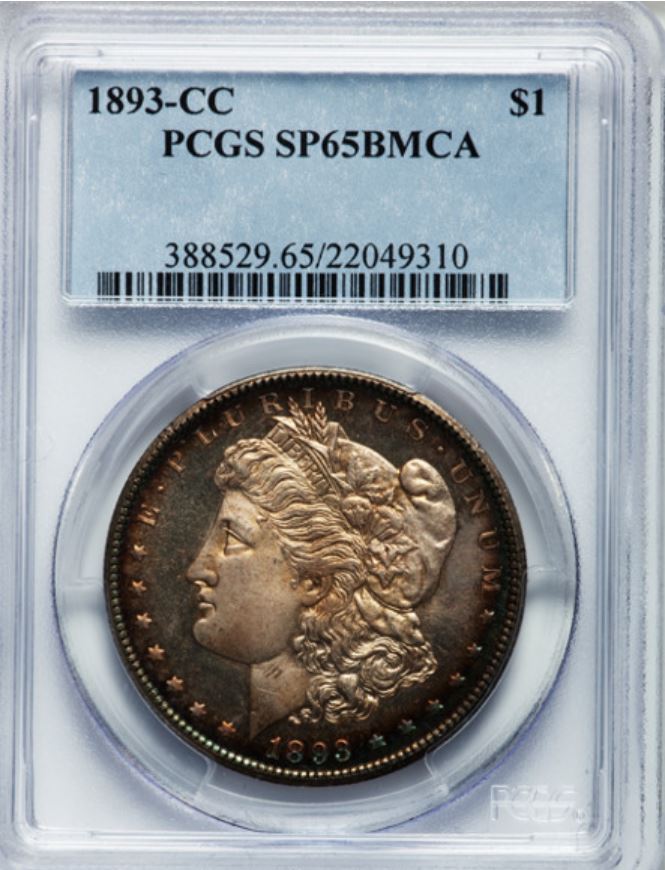 |
|
|
|
Bedrock of the Community
 United States
11963 Posts |
or this: 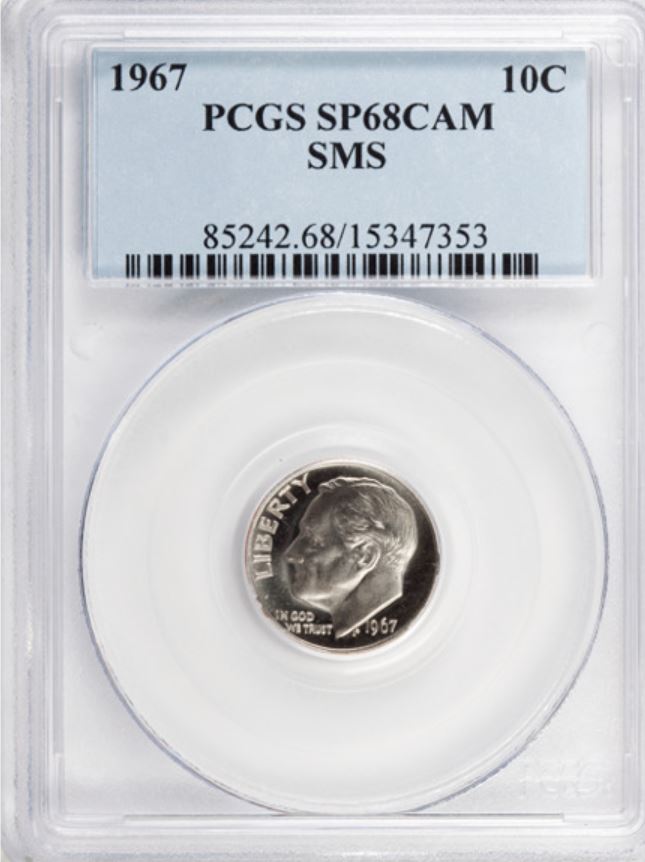 you get the idea but  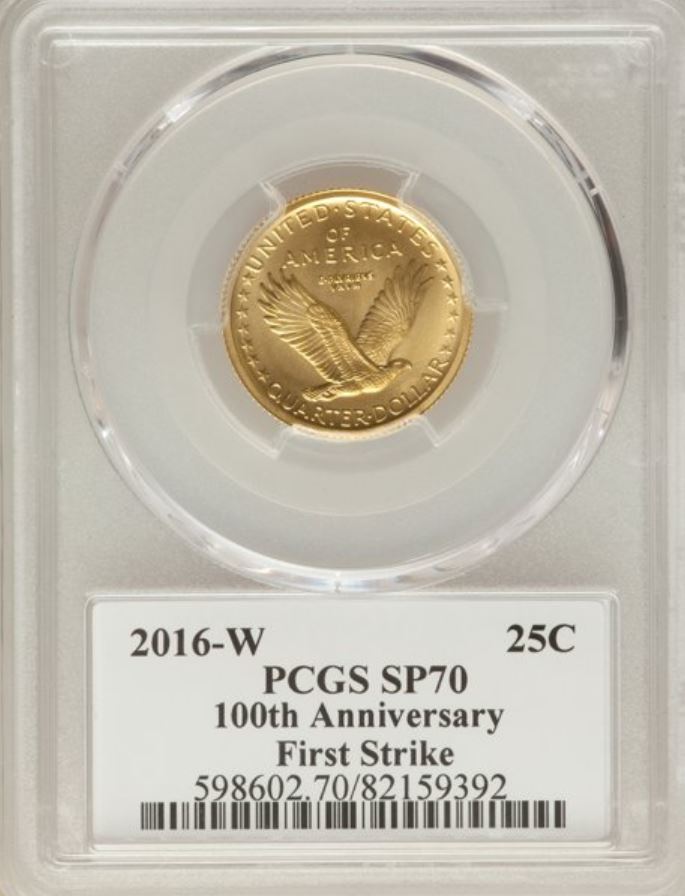 Edited by numismatic student
07/15/2018 10:28 am
|
|
Pillar of the Community
United States
835 Posts |
 , I do not know what is going on over there at PCGS. I sent a few coins last year to them for grading and about 25% were a complete shock to what the coins graded. This year I have sent many more coins thinking things were better, they were much worse. It was about 50% that were a total disbelief. I had coins that should have straight graded and were details, I had details coins that graded straight and I also had mis-attributed coins. I had a coin that came back as details - scratches and there was not even a scratch on it. I have lost faith in them and will not be sending any more coins to them.  |
|
Pillar of the Community
United States
8715 Posts |
PCGS will grade coins newer than 1817 as Specimen.
They will not grade any coins 1817 and before as proofs. They will label them as Specimen.
However, coins newer than 1817 will also be graded Specimen. For example, the Special Mint Sets will have a Specimen (not proof) grade.
|
|
Bedrock of the Community
United States
11963 Posts |
Quote:
However, coins newer than 1817 will also be graded Specimen. That's not what their strike type grading policy statement on their website says. What they say is not what they do. Hence the inconsistency. Edited by numismatic student
07/15/2018 12:13 pm
|
|
Pillar of the Community
United States
2023 Posts |
Last year's "Enhanced Uncirculated" coins also get "SP" designation. It makes sense to use some other kind of qualifier for these special editions when MS and PR either don't apply or are not enough of a distinction. For these later varieties, I just think of "SP" as "SPecial" rather than "SPecimen".
|
|
Bedrock of the Community
United States
10982 Posts |
Where does it state: "only coins minted before 1817 are given the specimen strike designation, a proof strike prototype." I don't see that in the text posted.
|
|
Bedrock of the Community
United States
11963 Posts |
When PCGS says that SP coins are those minted from 1792-1816 that precludes those minted outside those dates.
Edited by numismatic student
07/15/2018 12:28 pm
|
|
Pillar of the Community
United States
2023 Posts |
|
|
Bedrock of the Community
13014 Posts |
Obviously the SP definition is lacking but it's also a lot more complicated then a couple sentences would fit. The designation needs to be thought of as two separate ones in that modern SP and classic SP have two very different meanings. The modern SP has become a catch all for all the "different" finishes being used by the mints that aren't business strikes and wouldn't qualify as proofs. Clearly the modern things like that are no where close to the same class as the 10 million SP dollar. It probably would have been better to come up with a new designation for the moderns, but it didn't happen so for now we kind of have it as a catch all in that area if it doesn't really fit in the business or proof category. Quote:
They will not grade any coins 1817 and before as proofs. They will label them as Specimen. Before 1817 there were very few proofs but I haven't seen anything anywhere indicating any company ban on grading them as such. In fact some are in the population reports. There are a handful of 1802 and 1803 proof dollars that have been graded as such. There's also the 1804's and two 1804 gold $10 that are graded as such. Granted they were made later but they still have the date in that range. They're grade things with the designation they think they deserve. Any sort of ban for PF and SP is more just that none exist that we know of as opposed to them saying we will never grade something that even if we believe we should |
|
Bedrock of the Community
United States
12057 Posts |
The actual (in use) standard for SP applies to any coins which have a finish different from that of a Business Strike or Proof issue. For those of you who may not be familiar, the BM/CA designation is extremely rare and a source of occasional controversy. Without getting into excessive detail, there has been speculation off and on for years as to whether or not the Branch Mints (BM) - i.e. Carson City, New Orleans, and San Francisco - actually struck special runs of coins for dignitaries, Mint officials, politicians, financiers and other VIP's, a practice which supposedly took up in 1838 with the ultra-rare New Orleans bust half (per Breen's Encylopedia; see the Eliasberg piece, now graded PCGS PR64BM.) It has historically been assumed that these sort of VIP strikes were only done at Philadelphia using limited-use specially-prepared Proof dies, but we know that is not 100% the case; as an example consider the run of the first 100 1921 Morgan dollars being specially engraved after striking on highly polished business strike dies, resulting in prooflike surfaces with exceptional sharpness. These dies continued in use for regular business strikes as was often done in the 19th century, and were not "retired" like most modern Proof dies. The same practice apparently occurred at other branch mints up until 1893. For instance, a very very few of the first run of Carson City coins struck in 1893 as seen here feature impressively polished dies with cameo contrast but conventional wisdom held they cannot be Proofs because Proofs were only struck in Philadelphia and only using special Proof dies. So PCGS takes the middle road for Morgans and calls them Branch Mint Proofs, and gives them a SP designator (not PR or MS) since the finish and strike differ from business strikes and also from known Philadelphia proof issues; the BMCA designator stands for Branch Mint Cameo. Breen notes that several such "branch mint proofs" are held by the Smithsonian, and that most of the branch mint workers were certainly aware of the technique to achieve Proof-quality strikes (double strikes, polishing, die adjustment, etc.) Other coins that are considered "specimen" strikes include some of the Canadian and British commemorative and mint set coinage, the United States SMS (Special Mint Set) issues of 1964-1967 (no, that's not a typo, look it up), the US "Enhanced Finish" modern coins, etc. They are clearly of higher quality than business strike issues intended for circulation, with different finishes (matte, burnished, prooflike) but do not share all of the characteristics of coins intended to be Proofs only. Member ANA - EAC - TNA - SSDC - CCT #890 "Most of the things worth doing in the world had been declared impossible before they were done." -- Louis D. Brandeis |
|
Bedrock of the Community
United States
10982 Posts |
Quote:
When PCGS says that SP coins are those minted from 1792-1816 that precludes those minted outside those dates. It does not. That is an inclusive statement, not an exclusive statement. |
| |
Replies: 11 / Views: 3,064 |
|










 Posted 07/15/2018 10:37 am


