











 Posted 08/19/2018 7:26 pm


Several overstrikes (surfrappe in French) are well known in both the silver (Ecu) and copper coinage, pre-Revolutionary and afterwards.
For instance, examples are known of 2/1 decime and 5 centimes/1 decime, including one dated 1799-AA (L'An 8) of the latter type which was struck on a 31mm decime planchet.
They also come double-struck, and with partial and full brockages. There is also a "flip strike" known of a 1796 (L'An 5) Lyons-minted 5 centimes over a decime, where the reverse of the 5 centimes was struck over the obverse of the decime and vice versa.
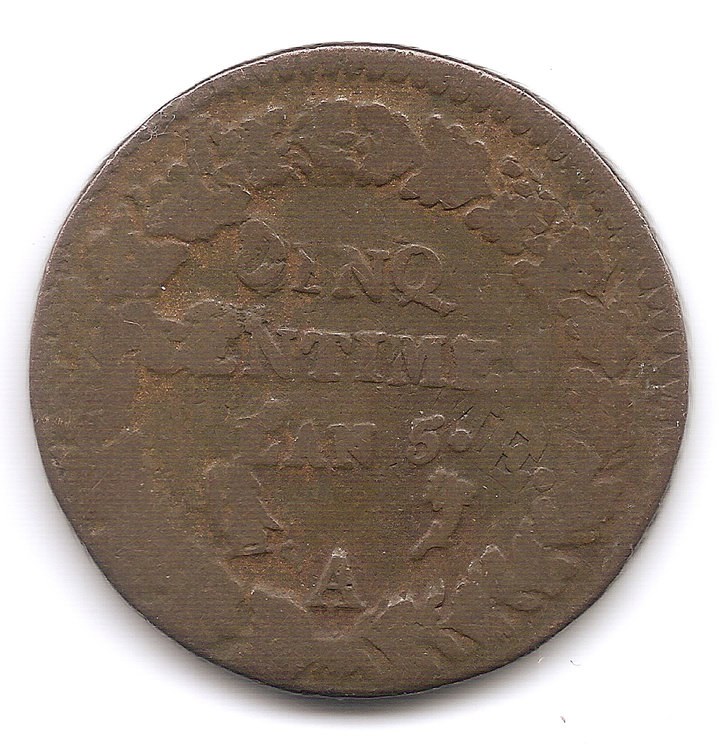
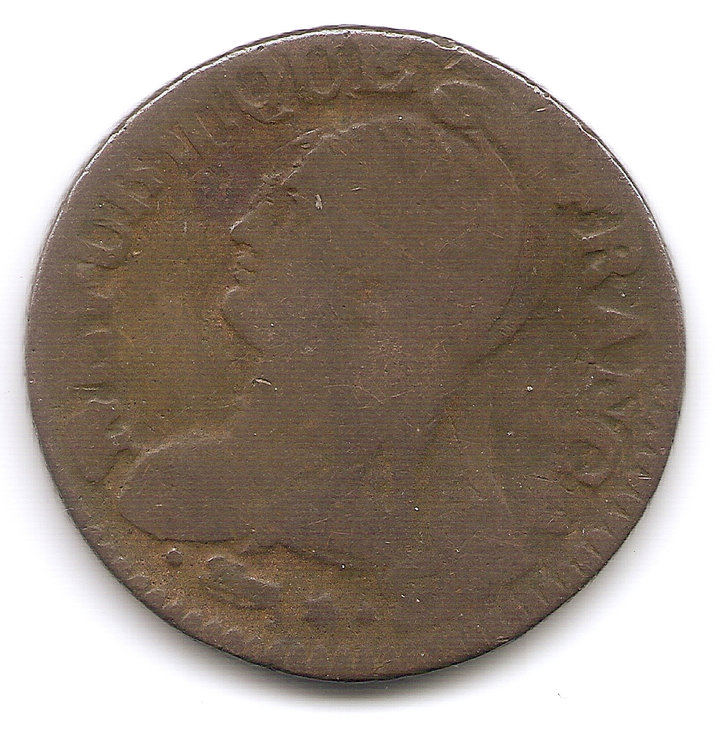
Looking at your coin, the obverse has FRANCAISE and not FRANCOISE; rev. has CINQ and MM is A for Paris. The obverse rotation appears to be about 40-45 degrees CW, the reverse nearly the same CCW, as would be expected from a coin-turn strike which was the orientation of 5 centimes issues.
A large planchet 5 centimes of An 5 has a diameter of 28mm, even with 28mm for An 5 (small planchet) decime vs. 31mm for a large planchet decime of An 5.
This means that if the 5 centimes were overstruck on a large planchet decime, the undertype should be readily visible towards the periphery due to the 3mm larger planchet.
It is not; and the privy marks are below the date, instead of even with the date. Therefore, the undertype is a small planchet decime of L'An 4-5 (i.e. Gadoury 184.) The overtype is a large planchet 5 centimes issue of L'an 5. This places the coin squarely in the transitional period for L'an 5 from small to large planchet for the decime and 5 centimes; this might very well have been a die trial strike. Perhaps there was a shortage of blank 28mm planchets with the mid-year changes to the 5 centimes and decime; this would have created the need to "recycle" existing 28mm-planchet decimes to coin the new 28-mm 5 centimes issues.
(For those not aware, during L'An 5, the size of the planchet for the 5 centimes was increased from 23 to 28mm and that of the decime from 28mm to 31mm; French collectors refer to these as "petit module" and "grand module".)
Scarce and quite interesting, and probably worth a rather decent premium to French Revolutionary collectors. Interestingly, similar strike issues occurred with US Colonial issues such as the Vermont and Connecticut coppers, as well as the contemporary counterfeit British and Irish halfpennies.
For instance, examples are known of 2/1 decime and 5 centimes/1 decime, including one dated 1799-AA (L'An 8) of the latter type which was struck on a 31mm decime planchet.
They also come double-struck, and with partial and full brockages. There is also a "flip strike" known of a 1796 (L'An 5) Lyons-minted 5 centimes over a decime, where the reverse of the 5 centimes was struck over the obverse of the decime and vice versa.
Looking at your coin, the obverse has FRANCAISE and not FRANCOISE; rev. has CINQ and MM is A for Paris. The obverse rotation appears to be about 40-45 degrees CW, the reverse nearly the same CCW, as would be expected from a coin-turn strike which was the orientation of 5 centimes issues.
A large planchet 5 centimes of An 5 has a diameter of 28mm, even with 28mm for An 5 (small planchet) decime vs. 31mm for a large planchet decime of An 5.
This means that if the 5 centimes were overstruck on a large planchet decime, the undertype should be readily visible towards the periphery due to the 3mm larger planchet.
It is not; and the privy marks are below the date, instead of even with the date. Therefore, the undertype is a small planchet decime of L'An 4-5 (i.e. Gadoury 184.) The overtype is a large planchet 5 centimes issue of L'an 5. This places the coin squarely in the transitional period for L'an 5 from small to large planchet for the decime and 5 centimes; this might very well have been a die trial strike. Perhaps there was a shortage of blank 28mm planchets with the mid-year changes to the 5 centimes and decime; this would have created the need to "recycle" existing 28mm-planchet decimes to coin the new 28-mm 5 centimes issues.
(For those not aware, during L'An 5, the size of the planchet for the 5 centimes was increased from 23 to 28mm and that of the decime from 28mm to 31mm; French collectors refer to these as "petit module" and "grand module".)
Scarce and quite interesting, and probably worth a rather decent premium to French Revolutionary collectors. Interestingly, similar strike issues occurred with US Colonial issues such as the Vermont and Connecticut coppers, as well as the contemporary counterfeit British and Irish halfpennies.
Member ANA - EAC - TNA - SSDC - CCT #890
"Most of the things worth doing in the world had been declared impossible before they were done." -- Louis D. Brandeis
"Most of the things worth doing in the world had been declared impossible before they were done." -- Louis D. Brandeis
Edited by paralyse
08/19/2018 7:31 pm
08/19/2018 7:31 pm


