| Author |
 Replies: 162 / Views: 36,657 Replies: 162 / Views: 36,657 |
|
|
|
Valued Member
Lithuania
386 Posts |
Glogowian groat 1506 one more time   |
|
Pillar of the Community
  United States
8062 Posts |
Thanks for contributing that nice Glogauer groschen!
And on slabbing, I am wondering if the sellers of these coins have been advised by the auction house to get their coins slabbed, or if it is something else. Out of curiosity I looked at the slabbed 16th c. 1/2 groats that sold at a recent Polish auction and saw 7 that sold for 51 euro or less, which does not seem to justify the cost of slabbing. It seems the grading system (I, II, III) used by the Polish suction houses (and the photos of course!) works fine for these types of coins.
|
|
Pillar of the Community
United States
8062 Posts |
giedrius coin is interesting for several reasons. First, it is minted in Glogau/Glogow, Silesia, which in 1506 was not part of Poland. Sigismund I, (youngest son of the late Polish king Kazimierz Jagiello, and next in line for the Polish throne) was the duke. Nothing strange about the obverse legend, SIGISMVNDVS DVX GLOGOVIE (Zygmunt, duke of Glogau). The reverse legend is the interesting one: KAZIMIR I REX POLONIE NATVS, "Born of King KAZIMIERZ I of Poland." So on this coin, is Zygmunt merely pointing out the historic linkage between the dukes of Glogau and Polish kings? Or reminding everyone that HE will be next on the Polish throne (his older brother King Alexander of Poland had died in August 1506, but Zygmunt would not be crowned king of Poland until December 1506, so perhaps this coin was minted in the interim?). Also worthy of comment is that this is the first coin posted here with the combination of the Polish eagle and the Lithuanian knight. As mentioned upthread, the Jagiello dynasty of Polish rulers had its origin in the late 1300s when Queen Jadwiga of Poland married Jogaila of Lithuania, who took the Christian name Wladyslaw. Wladyslaw ruled concurrently as King of Poland and Grand Duke of Lithuania, as did his son Kazimierz, and then two of his grandsons, Alexander and Zygmunt whose coins we are covering this week. For nearly 200 years, there was considered to be a "personal union" between Poland and Lithuania due to this arrangement. From a numismatic point of view, the Gumowski catalog lists the coins issued by Alexander (1501-1506) at both the Krakow mint and the Vilnius (Lithuania) mint. The first bears the legend MONETA REGIS POLONIE (crown and eagle type), the latter MAGNI DVX LITVANIE. Here is the latter: 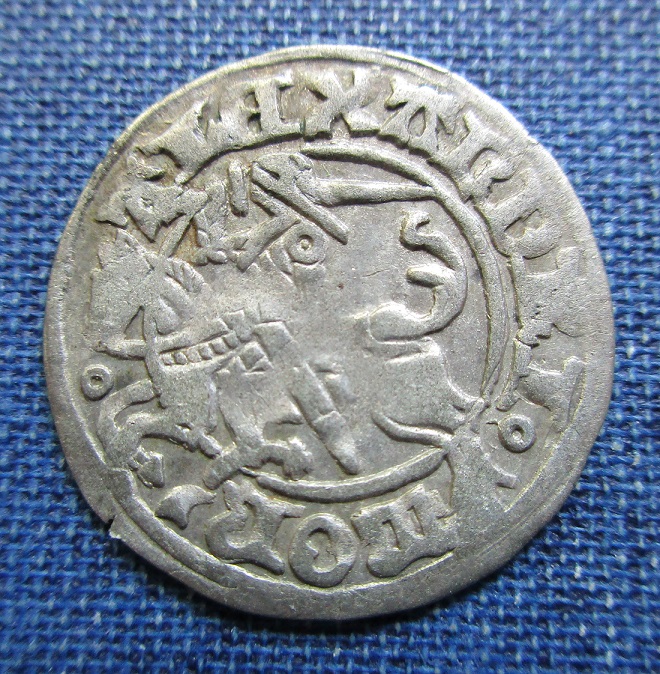 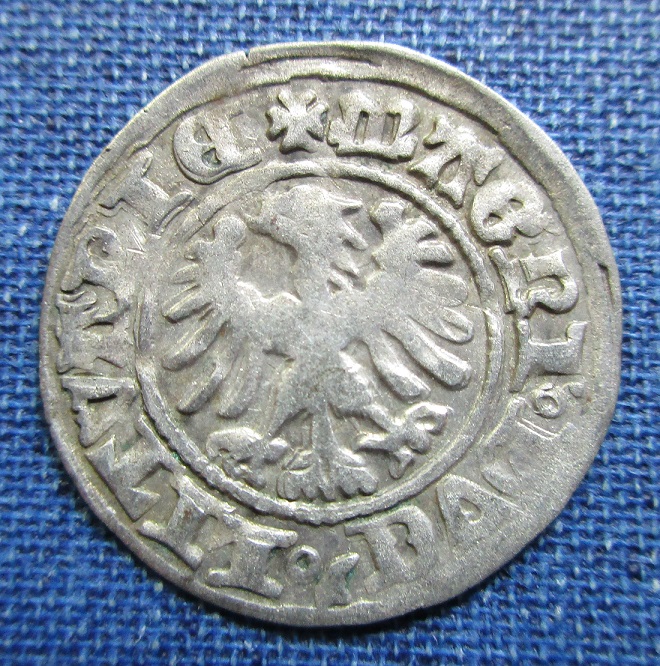 |
|
Valued Member
Lithuania
386 Posts |
@tdziemia well, but this Lithuanian half-groat of Alexander Jagiellon (6A in our book http://goccf.com/t/282866 ) is'nt the coin of Polish Kingdom. This is the coin of 4th emission (1498-1500 about), before the Alexander became King of Poland, minted in Wilno for the purposes of Grand Duchy Lithuanian. „Lithuanian half-groats penetrated the Polish market since their value was 20 per cent higher than of the Polish ones. This aroused dissatisfaction among the Polish nobility. At the Piotrków Congress in 1501, Polish representatives for the first time demanded to equal Lithuanian and Polish coins in weight and value, as Lithuanian coins were by a fifth more valuable than Polish." http://www.pinigumuziejus.lt/wp-con...atalogas.pdf ) Edited by giedrius
10/24/2018 6:13 pm
|
|
Pillar of the Community
United States
8062 Posts |
Thank you! Very grateful for your expertise and feedback on this coin. This came in an auction lot of small denomination coins I received earlier this year, so I hope there aren't more that I've mis-attributed.
I have one other 1/2 grosz of Alexander, so I must photograph it, too for your comment.
Edited by tdziemia
10/24/2018 8:06 pm
|
|
Valued Member
Lithuania
386 Posts |
|
|
Pillar of the Community
United States
1186 Posts |
I have an interesting one of those. A 1442/43 Hungarian Denar under King Wladislaus I with a brockage error;Huszar 607,Unger 472,Pohl 145.  |
|
Pillar of the Community
United States
8062 Posts |
Very neat to see these examples of the Lithuanian knight spread across central Europe by the Jagiello dynasty. It was quite an impressive family from the mid 15th to mid 16th century. For nearly 50 years members of this family simultaneously occupied the thrones of Poland, Lithuania, Bohemia and Hungary. I think we have not yet seen an example of this knight on a coin of Zygmunt I while king of Poland, so I will post this recent auction win (in transit between Warsaw and Ohio). Polgrosz (1/2 grosz) 1512. Ivanauskas 1S59-4  Edited by tdziemia
10/25/2018 9:33 pm
|
|
Pillar of the Community
United States
8062 Posts |
And, since there is some discussion of the Jagiello family and their broad influence, here is a coin issued in Swidnica (Scheidnitz) Silesia. Swidnica was one of the many tiny duchies in Silesia, which, since the late 1300s, were under the rule of Bohemia. This 1520 1/2 grosz is issued in the name of King Louis II of Hungary, another member of the Jagiello family. Louis was the grandson of Wladyslaw I mentioned by EddieDIz, and the nephew of Zygmunt I of Poland. 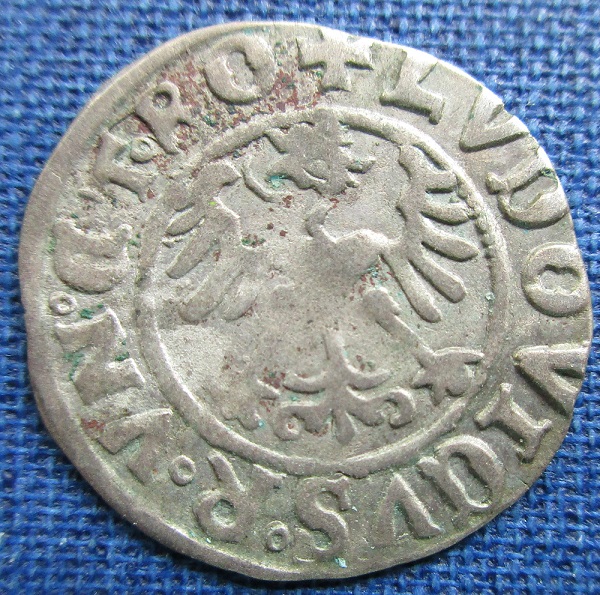 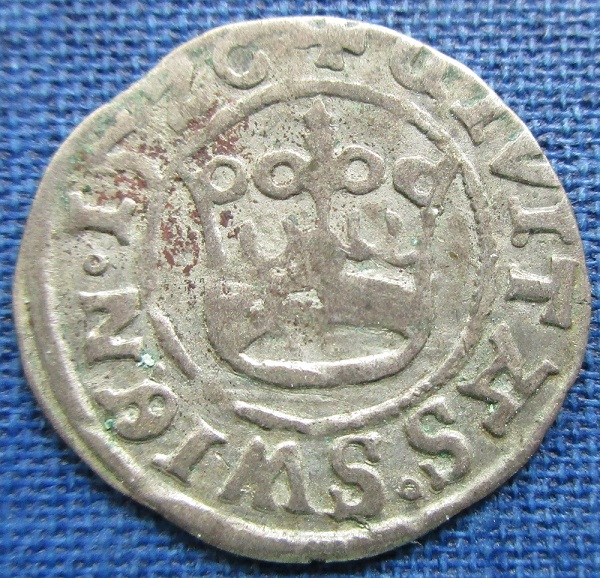 Edited by tdziemia
10/25/2018 11:41 pm
|
|
Pillar of the Community
 United States
5029 Posts |
Some fantastic adds. Really like the Polgrosz (1/2 grosz) 1512  |
|
Valued Member
Lithuania
386 Posts |
|
|
Pillar of the Community
United States
8062 Posts |
Quote:Lithuanian half-groat 1512- 40AC in our book http://goccf.com/t/282866 . Nice coin, but some damaged by double struck. Thanks for yours and scopru's comments. I had a large gap between 1510 (1/2 g Krakow) and 1527 (grosz Krakow), so I am trying to fill a few dates between. The best candidates are the Vilnius 1/2 groats (for which I should have your book!), and maybe some schillings. WCN had this one graded as I- (I think AU in US system), and there indeed are some badly struck areas of the legend, but I liked the strong rider and eagle. And I was surprised to not get outbid at a rather low price. On the Schweidnitz groschen, Gumowski also mentions this coin (Google translation from German): the Schweidnitz half-groschen of King Ludwig (Louis), which are an imitation of the Krakow half-groschen, were considered a fake in Poland. Not only have they led to internal quarrels in Schweidnitz itself and other Silesian cities, but also violent protests on the part of Poland, which provoked a trade war and finally the closure of the Polish borders. The mentioned Schweidnitzer coins contributed much to the Munzreformen of King Sigismund in Krakow Intersting that his close relative would allow this to happen, and it was only after Louis' death in battle in 1526 that his Hapsburg successor stopped the practice. Edited by tdziemia
10/26/2018 07:35 am
|
|
Valued Member
United States
167 Posts |
Quote:
Polgrosz (1/2 grosz) 1512. Ivanauskas 1S59-4 Very nice piece, I think I'm having difficulty in following the denominations without a better reference book. In any event weights and sizes would be much appreciated! The 1506 Groschen was also quite impressive. This has to be one of the earliest dated coins. Interesting that neither England nor France or other major powers today made early dated coinage. Perhaps it's due to Poland: Krakow being at the center of the textile trading routes in the late Middle Ages? |
|
Pillar of the Community
United States
8062 Posts |
Very good points, gallienus.
1. At this point in the numismatic history of Poland-Lithuania there is mostly small silver/small gold.
For the coins posted here from late 1400s/early 1500s, I have these dimensions:
1/2 groat = 1/2 grosz = polgrosz 19 mm (size of U.S. penny)
1 groat = grosz = groschen 24-25 mm (size of U.S. quarter, though much thinner)
As new denominations get posted, I will try to remember to cite the size.
2. There are others out here who have studied the "dating angle" more than I have. As a newbie to the topic of early dated coins, I would simply observe that I see mostly issues of Holy Roman Empire fiefdoms before 1500, which fits with England, France, Spain and Poland-Lithuania NOT having coins dated before 1500. I know this is too simplistic, but ...
Edited by tdziemia
10/27/2018 07:25 am
|
|
Pillar of the Community
United States
8062 Posts |
Before moving on (I am again a few hours behind schedule!), two coins illustrating mints and a type we haven't seen. Groats/groszy were minted minted in 5 places under Zygmunt I: Krakow and Torun have already been covered. Former Prussian cities Elblag/Ebing and Gdansk/Danzing also minted coins under the authority of Zygmunt I, and there are Lithuanian groats minted in Vilnius which are rare. Here is a 1535 ELbing groat, Kop. 7082. 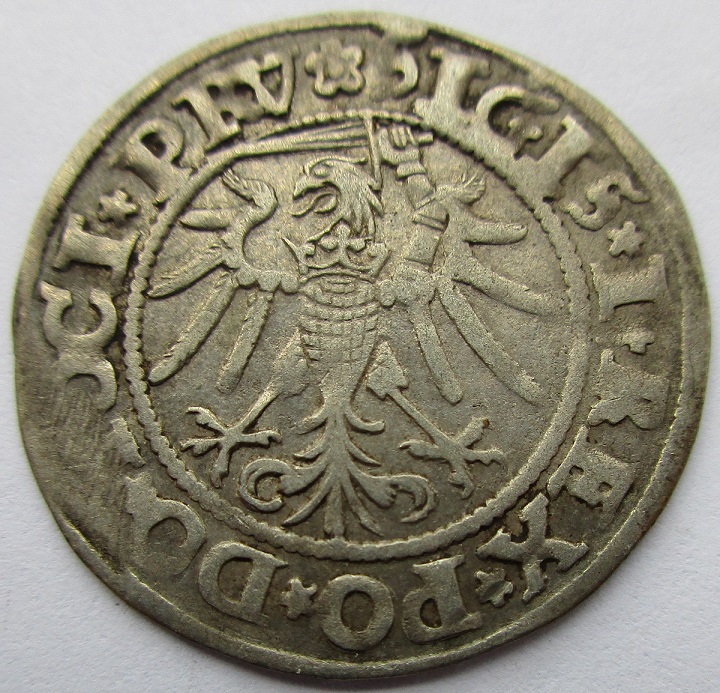 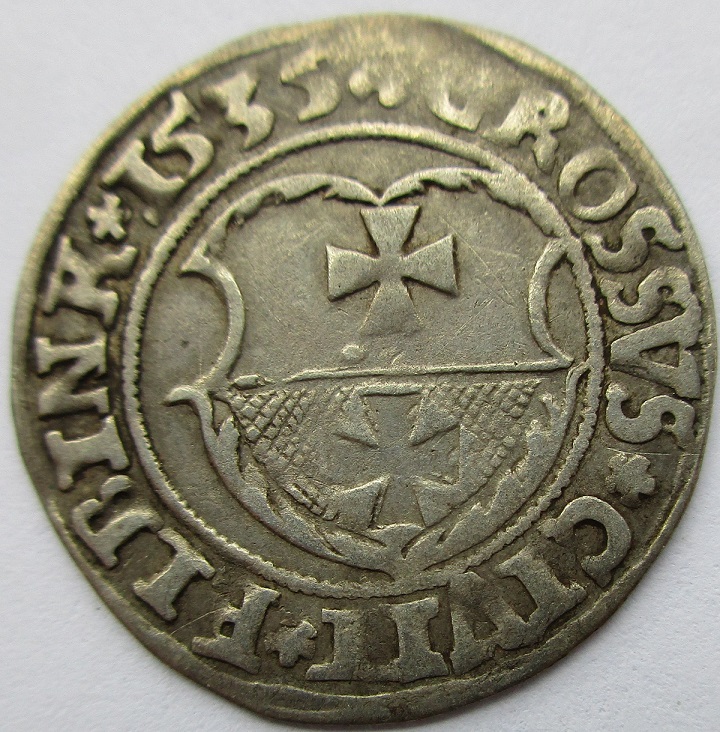 And a trojak (3 groats) from Gdansk, Kop. ?,Iger G.37.2.e. The trojak was smaller in diameter than the groat, but considerably thicker. 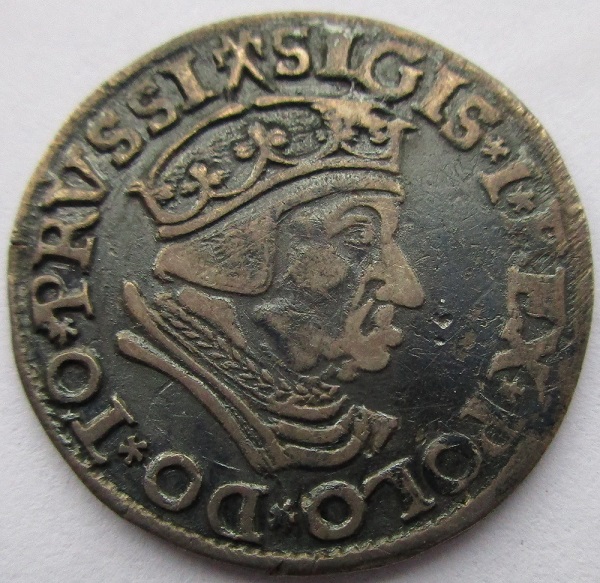 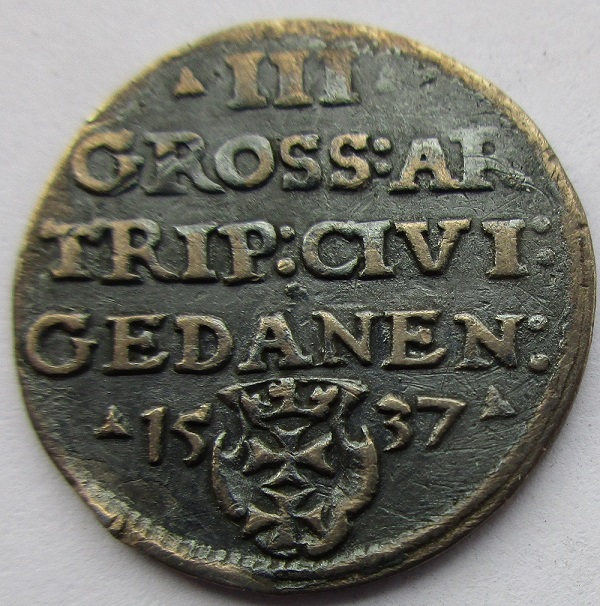 And now onward! Please post coins from the reigns of Zygmunt/Sigismund II, and Stefan Bathory. Between these two, we have Henry III of France also ruling as king of Poland, and the siege coinage of Danzig during its rebellion against the election of Bathory. As well as other coins related to Polish history during this period. |
| |
Replies: 162 / Views: 36,657 |








 First Page
 Previous Page


 Posted 10/23/2018 05:28 am


