| Author |
 Replies: 28,608 / Views: 1,198,156 Replies: 28,608 / Views: 1,198,156 |
|
|
|
Bedrock of the Community
 United States
26695 Posts |
|
|
Pillar of the Community
Sweden
1843 Posts |
I Will do a rinse in acetone tx hondo. Great Britt coin there
Great coins Marve
Congrats silverskunk on the gold Britt I sense a disturbance in the force.
Glb Great horse, I see a pattern horses and birds
Hookie 66+ thats a marvelous coin
Edited by Moniker
10/04/2025 12:52 am
|
|
Bedrock of the Community
United States
26695 Posts |
Thank you, Moniker.
2026 is the year of the horse so there will be several more coins eventually. I like bird coins, especially eagles.
|
|
Bedrock of the Community
United States
25912 Posts |
A neat pair arrived today. Uruguay 1000 Pesos 1969 FAO (0.900 silver) 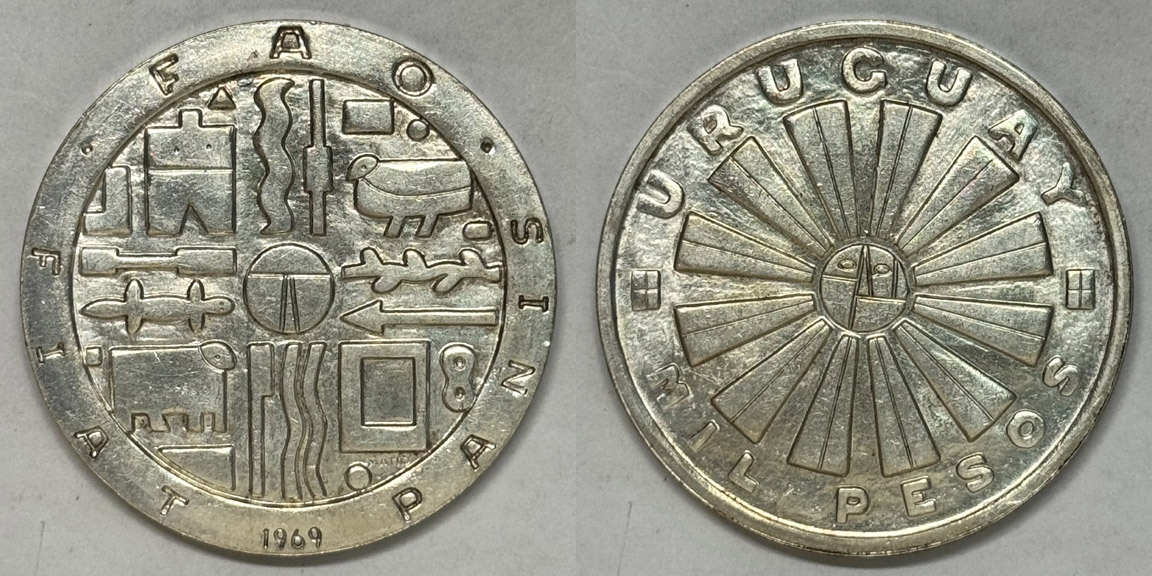 Uruguay 1000 Pesos 1969 FAO (copper pattern) 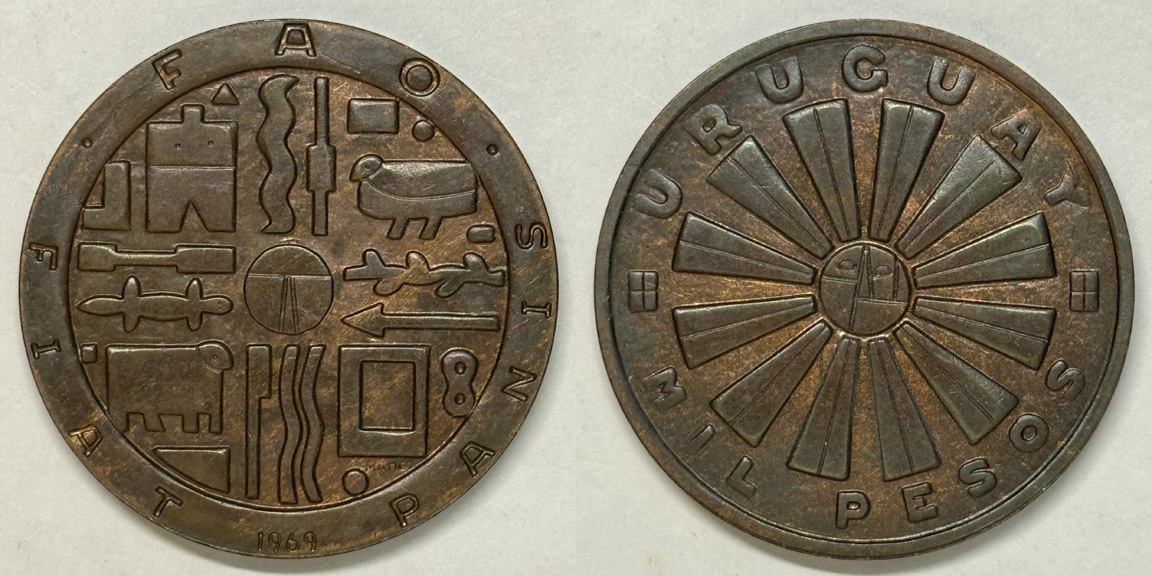 Inordinately fascinated by bits of metal with strange markings and figures
|
|
Bedrock of the Community
United States
26695 Posts |
|
|
Bedrock of the Community
United States
75558 Posts |
Nice additions!  Errers and Varietys.
|
|
Bedrock of the Community
United States
26695 Posts |
Thank you, Errers and Varietys.
|
|
Pillar of the Community
Australia
3306 Posts |
Great additions hokiefan, Silverskunk, GLB and Hondo.
Cheers Bryan
|
|
Bedrock of the Community
United States
26695 Posts |
Thank you, Bryan. |
|
Pillar of the Community
United States
765 Posts |
While at the coin shop the other day I picked up a few interesting coins to add to my wall. A WW1 era 10 Piastri coin from Egypt. Egypt of course was controlled by the UK and the canal was very strategic, as was control of the Mediterranean Sea, and the ability of the Royal Navy to do so in large part contributed to its status as the worlds great power up to the rise of the USA post WW2. 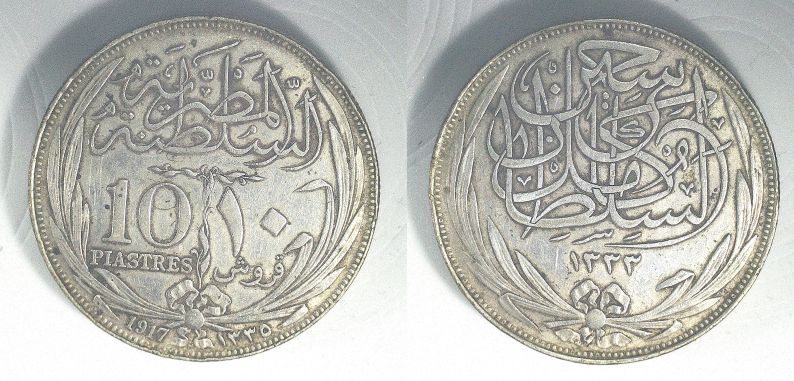 Two coins remembering 1929 as the world tried to heal from WW1. The UK most of all who suffered atrocious casualties in the Great War. A 2 shilling coin and a 1/2 crown. 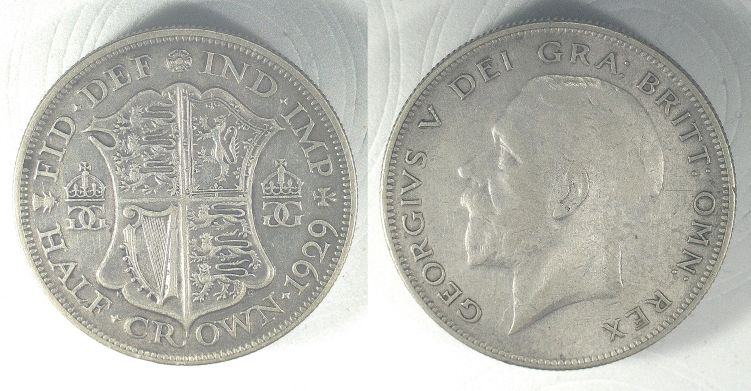 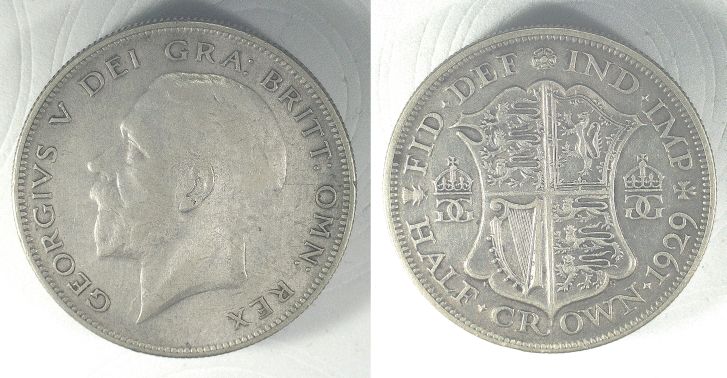 |
|
Pillar of the Community
United States
765 Posts |
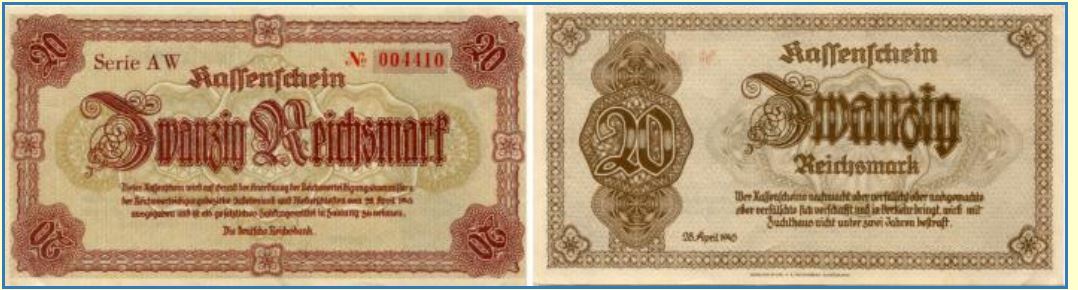 This German 20 Reichsmark note was issued by the German Reichsbank in Sudetenland and Lower Silesia at the very end of World War II. Sudetenland and Lower Silesia were areas of Czechoslovakia and Poland had been forcibly incorporated into Germany at the start of World War II. Because of the advancing allied armies, shipments of regular Germany currency were no longer available from Berlin. The note is dated April 28, 1945, less than two weeks before German surrendered. This German 20 Reichsmark note was issued by the German Reichsbank in Sudetenland and Lower Silesia at the very end of World War II. Sudetenland and Lower Silesia were areas of Czechoslovakia and Poland had been forcibly incorporated into Germany at the start of World War II. Because of the advancing allied armies, shipments of regular Germany currency were no longer available from Berlin. The note is dated April 28, 1945, less than two weeks before German surrendered. |
|
Pillar of the Community
United States
765 Posts |
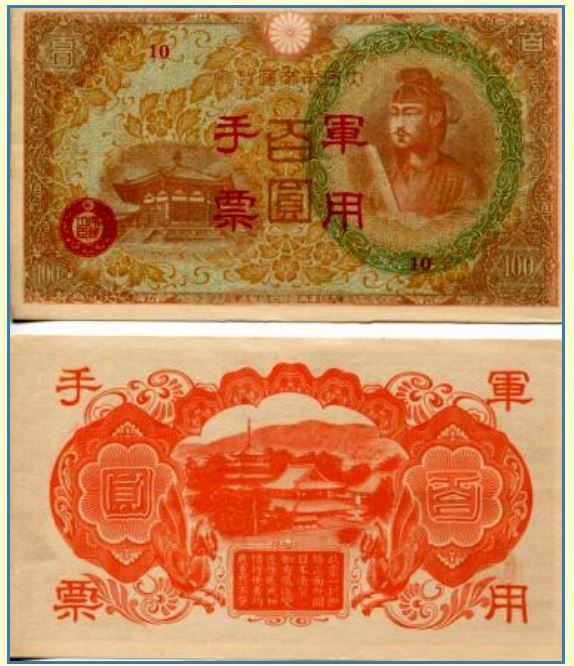 Japan issued this 100 Yen note for use in Hong Kong in the closing months of World War II. It was the highest denomination military currency issued by Japan. The note, apparently printed in Hong Kong, utilized the basic design of the 1944 Japanese homeland 100 Yen note, however with modified legends on the back and the front has an overprint that translates as "Military Currency". The note pictures the Yumedono Pavilion, or Hall of Dreams. It was constructed in 739 as a monument to the semi-legendary Prince Shotoku Taishi on the site of the prince's palace. The prince is pictured to the right within a green circle. Because civilians were forced to accept were forced to accept the unbacked Military Yen it cost the Japanese government virtually nothing to purchase whatever they wanted. Japan issued this 100 Yen note for use in Hong Kong in the closing months of World War II. It was the highest denomination military currency issued by Japan. The note, apparently printed in Hong Kong, utilized the basic design of the 1944 Japanese homeland 100 Yen note, however with modified legends on the back and the front has an overprint that translates as "Military Currency". The note pictures the Yumedono Pavilion, or Hall of Dreams. It was constructed in 739 as a monument to the semi-legendary Prince Shotoku Taishi on the site of the prince's palace. The prince is pictured to the right within a green circle. Because civilians were forced to accept were forced to accept the unbacked Military Yen it cost the Japanese government virtually nothing to purchase whatever they wanted. 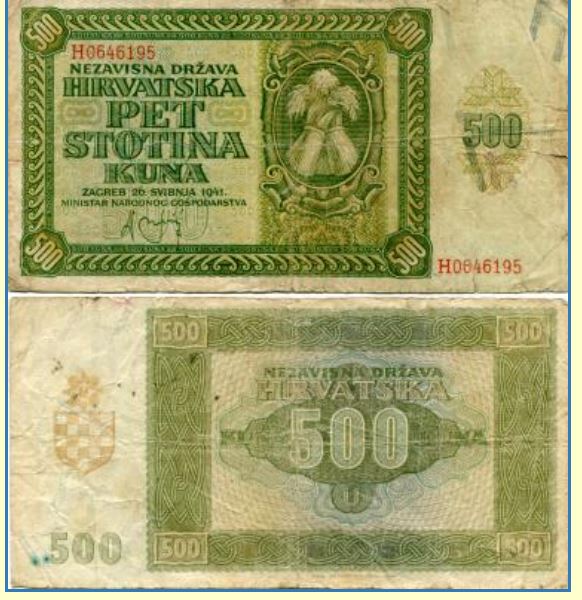 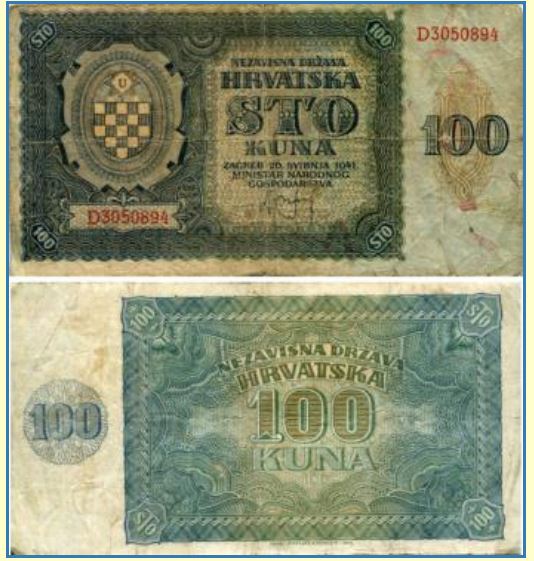 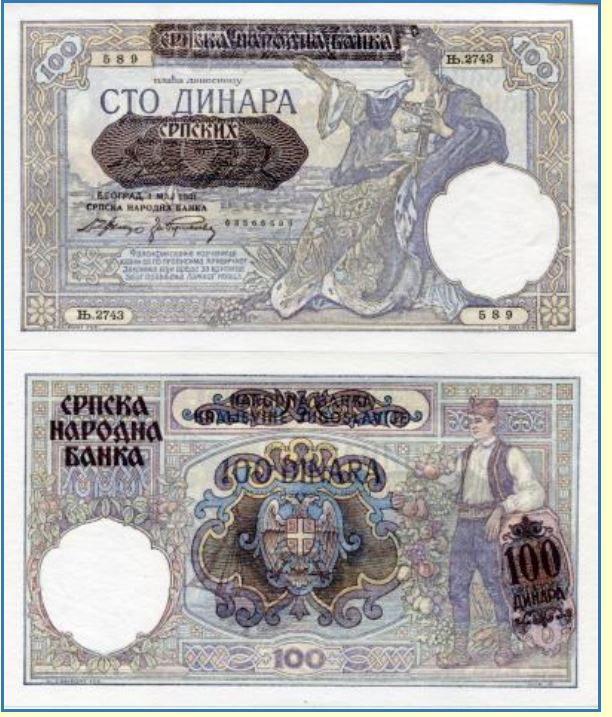 From Croatia we have the first notes issued by the Nazi puppet state, the 100 and 500 Kuna dated May 26, 1941, just seven weeks after the invasion. The 100 Kuna features the Croatian coat of arms and is 150 x 80mm. The 500 Kuna three sheaves of wheat and is 160 x 84mm. The notes were printed in Germany Giesecke & Devrient, a private company which is still a major banknote printer. From Croatia we have the first notes issued by the Nazi puppet state, the 100 and 500 Kuna dated May 26, 1941, just seven weeks after the invasion. The 100 Kuna features the Croatian coat of arms and is 150 x 80mm. The 500 Kuna three sheaves of wheat and is 160 x 84mm. The notes were printed in Germany Giesecke & Devrient, a private company which is still a major banknote printer.
From Serbia we have the overprinted 100 Dinara note dated May 1, 1941. After invading Yugoslavia, the Germans found a large quantity of the beautiful 1929 Yugoslavian 100 Dinara banknotes in the vaults of the Central Bank. The front of the notes picture a seated woman holding a sword overlooking a village on a bay. The back pictured sailboats and a young man with fruit leaning on the arms of Yugoslavia. The Germans put an ugly brown overprint on what was one of the world's prettiest banknotes in an attempt to cover up all references to Yugoslavia. The note measures 172 x 101mm.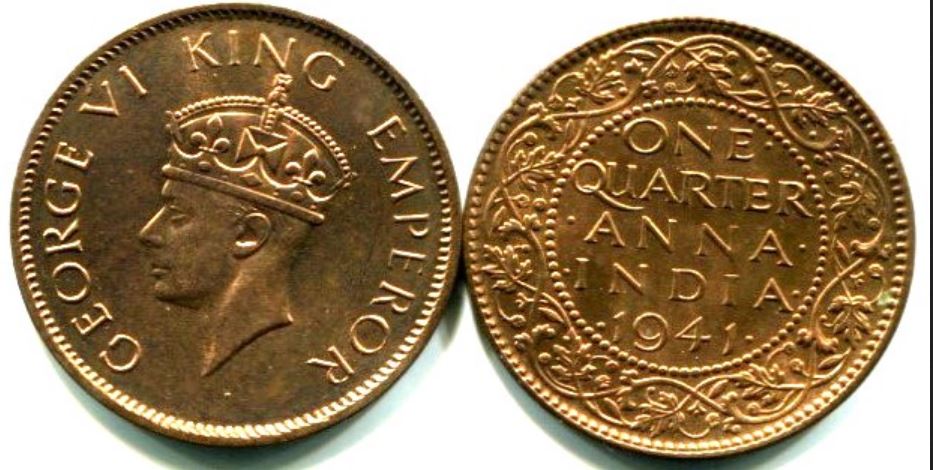 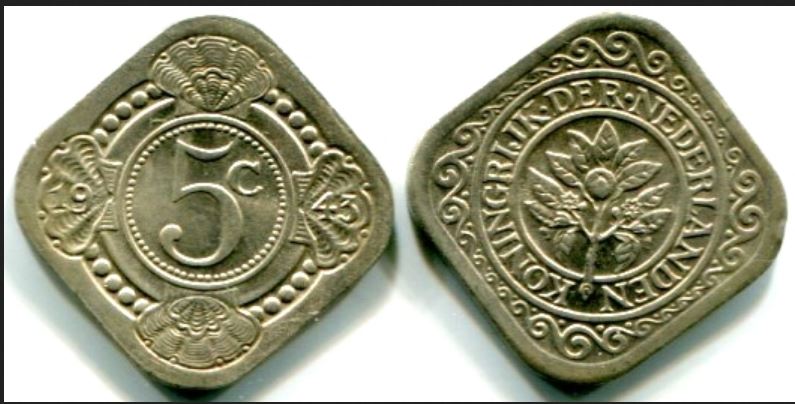 India was critical to the Allied effort in World War II. It contributed over 2.5 million troops and was a major producer of armaments and equipment. Two versions of the World War II era bronze 1/4 Anna were produced. Both depict King George VI on the obverse and denomination and date on the reverse. In the first versoin which was struck in 1938 and 1939 the tips of the fleur-de-lis in the King's crown touched the jeweled band of the crown. In the second version which was struck from 1940 until 1942, the fleur-de-lis were shorter. The king's head flatter but with more distinct features in the second version. By 1942 the bronze 1/4 Anna had minimal buying power and it utilized copper that was needed for the war effort. Production was discontinued that year. The same year a much smaller, 17.3mm square nickel-brass 1/2 Anna was introduced. It might buy a cup of tea or a small snack. The 1/2 Anna has the denomination written in English, Urdu, Bengali, Telugu & Devanagari on the reverse. India was critical to the Allied effort in World War II. It contributed over 2.5 million troops and was a major producer of armaments and equipment. Two versions of the World War II era bronze 1/4 Anna were produced. Both depict King George VI on the obverse and denomination and date on the reverse. In the first versoin which was struck in 1938 and 1939 the tips of the fleur-de-lis in the King's crown touched the jeweled band of the crown. In the second version which was struck from 1940 until 1942, the fleur-de-lis were shorter. The king's head flatter but with more distinct features in the second version. By 1942 the bronze 1/4 Anna had minimal buying power and it utilized copper that was needed for the war effort. Production was discontinued that year. The same year a much smaller, 17.3mm square nickel-brass 1/2 Anna was introduced. It might buy a cup of tea or a small snack. The 1/2 Anna has the denomination written in English, Urdu, Bengali, Telugu & Devanagari on the reverse. |
|
Pillar of the Community
United States
765 Posts |
Very nice Hondo. I love your coinage.
|
|
Bedrock of the Community
United States
25912 Posts |
Very impressive acquisitions, Silverskunk, and thank you for the historical perspectives.
Inordinately fascinated by bits of metal with strange markings and figures
|
|
Bedrock of the Community
United States
26695 Posts |
Nice acquisitions, Silverskunk.
|
| |
Replies: 28,608 / Views: 1,198,156 |








 First Page
 Previous Page


 Posted 10/03/2025 7:25 pm


