| Author |
 Replies: 8 / Views: 13,226 Replies: 8 / Views: 13,226 |
|
|
New Member
Canada
3 Posts |
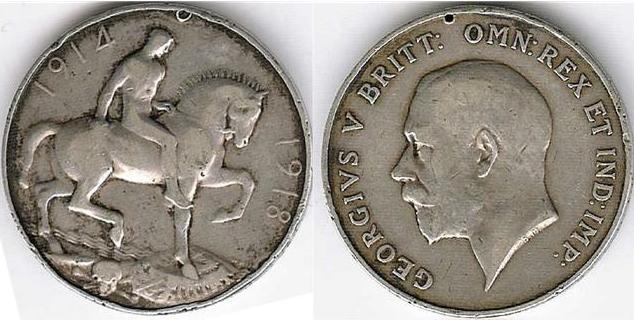
Hey Guys, I'm new the the forum... and somewhat new to coin collecting. I'm interested in buying the coin shown below. The seller asked me to give him an offer. He states that "At the end of World War One, King George the fifth issued to the soldiers of the 24th Canadian Infantry Division a Silver coin. It was a full Ounce of Silver and has KG the Vth on one side and a man mounted on a horse amidst a battlefield on the other. Above the mounted man there is a starburst and on the ground is a skull and crossbones. This coin has the name, rank and serial number of the man it was issued to along with 24th Canadian Infantry Division printed along the outside edge." Can any of you guys verify this? and the worth as well? Thanks in advance. Image:  coin.jpeg coin.jpeg46.72 KB |
|
|
|
Pillar of the Community
Canada
1106 Posts |
Edited by chrycopaul
07/17/2008 12:04 pm
|
|
New Member
 Canada
3 Posts |
Ya I just did a search for it on ebay.. nothing close came up. I'm pretty sure its still considered a coin, even though it has no denomination on it. |
|
Pillar of the Community
Canada
1106 Posts |
Go to the link above. It is a medal, and a damaged one at that.
|
|
New Member
Canada
3 Posts |
Edited by RAFakaSB
07/17/2008 12:15 pm
|
|
Moderator
 United States
6563 Posts |
Dang it ya beat me by 5 minutes! Quote:
Instituted in 1919 to commemorate the successful conclusion of the Great War, and the arduous services rendered by His Majesty's Forces. The Medal was later extended to include service in North and South Russia, Eastern Baltic, Siberia, the Black Sea and the Caspian, and mine clearance post armistice up to 1920. The British War Medal Quote:
Description: 36mm diameter silver or bronze*, with non-swivelling suspender. Obverse: the coinage head of King George V and the legend: GEORGIVS BRITT: OMN: REX: ET: IND: IMP: . Reverse, St. George on horseback holding a short sword. The horse is trampling on the shield of the Central Powers and a skull and crossbones. The dates "1914" and "1918" are around the edge.
Naming: issued in a variety of naming styles - see below for the common examples.
Ribbon; Orange with blue / black / white edge stripes.
Bars; proposed - 68 for the navy and 79 for the army. Naval bars were authorised, but in the end the award of bars was abandoned, although naval bars are frequently encountered on miniatures. Listed below is the naval proposal.
notes.
* Bronze issues were awarded to Maltese, Indian and Chinese Labour Corps. They are outnumbered 60:1 by the silver issues (6,500,000 silver 110,000 bronze) dangerous fakes of the bronze issue are numerous.   
|
|
Moderator
United States
6563 Posts |
What name is engraved in the side?
With 6,500,000 being "minted" I'm not sure it would be worth more then 5% above melt. If the original ribbon were still attached and in better condition it'd have a much higher premium
|
|
Pillar of the Community
Australia
2830 Posts |
G'day,
this medal is, as already stated, the British War Medal 1914~1918. The first one shown is damaged, because it has become separated from its suspender. It is unlikely to be worth mush more than melt value, for that reason.
However, there are some other factors:
usually, this medal was awarded in conjunction with one or two others, being the -
1914 Star; or
the 1914~1915 Star;
and the Victory Medal - with a distinctive "rainbow-coloured" ribbon - each of the allied powers issued its own version of this;
and there were a couple of other medals for WW1, but these are uncommon.
One medal out of a set has a reduced value, if the rest of the set is missing.
The next factor is that these medals are named on the rim, as in GO's pic. Usually, the impression gives name, rank, number, and unit: Regiment or Corps. This naming can have a major effect on market price. In Australia, cavalry units (Light Horse) attract a serious premium above infantry' and the medical corps has its enthusiasts. A medal, or set of medals to anyone who served in the Gallipoli Campaign in 1915 gets a premium; and an even bigger premium if he landed on the first day of the battle, 25th April. Another battle to attract a premium is Beersheba in 1917.
I don't know enough about Canadian participation in WW1 to say what specific factors bear on the price of Canadian medals, but I expect that the same sort of considerations would apply.
In Australia, the 330,000 personnel files of all soldiers who went overseas in WW1 have been digitized, and are available on line. This makes research very easy, and I think it has renewed interest in WW1. So, once you have a medal, it is a straightforweard task to discover a lot about the soldier to whom it was issued.
Peter in Oz
|
|
New Member
Ireland
1 Posts |
Yo I have this exact coin Do you still need it? And if not how Much is it worth?
|
| |
Replies: 8 / Views: 13,226 |
|







 coin.jpeg

 Posted 07/17/2008 12:02 pm





