| Author |
 Replies: 13 / Views: 2,080 Replies: 13 / Views: 2,080 |
|
|
Valued Member
United States
293 Posts |
I just came across this very unusual specimen. I have absolutely no idea how it'd be possible for one to just break a coin like this without the planchet having been close to breaking to begin with, but I'm nonetheless very suspicious of this one in particular because the coin is circulated and both halves seem evenly worn. Is this just some type of PMD, or is it the large cent equivalent of the amazing Broken CC? You decide. 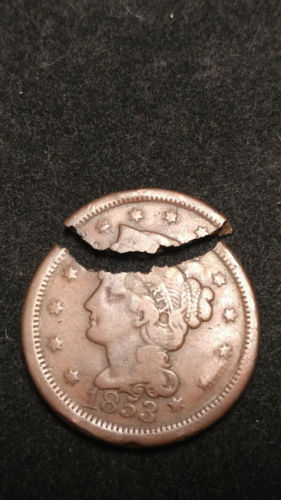 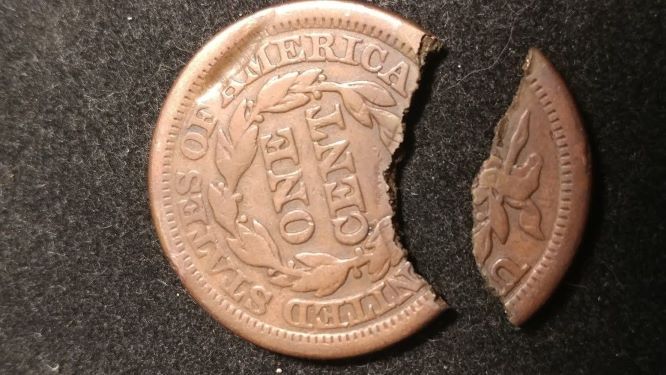 *** Moved by Staff to a more appropriate forum. *** *** Moved by Staff to a more appropriate forum. *** |
|
|
|
Bedrock of the Community
United States
20753 Posts |
Interesting type of break. I'm sure it's some type of PMD. |
|
Moderator
 United States
56855 Posts |
I wonder if Mike would want to see this one? John1  |
|
Valued Member
United States
150 Posts |
The bend going through America (likely where it was held), and the overall condition show it happened well after minting. Plus what are the odds it happened at the mint, and someone saved both pieces?
|
|
Bedrock of the Community
United States
17884 Posts |
The damage by AM is PSD, but it IS possible for a coin to crack and break like that. Cracks in the strip can happen during rolling if the strip was improperly annealed. It is also possible for the strip to be brittle and crack due to certain impurities in the metal. This coin may have been punched from on of these areas and been almost completely cracked in two, they someone finished the job damaging the AM area in the process. |
|
Valued Member
 United States
293 Posts |
Yeah, I'd love to know what Mike has to say about this. I wouldn't give it a second look if broken CC didn't exist, but we know it's at least possible for this to be a planchet error. Not to mention I have no clue how one would make pure copper brittle enough post-mint to crack it in half.
|
|
Bedrock of the Community
United States
78613 Posts |
I think it's an altered coin showing Post Strike Damage ( PSD), but I will contact Mike Diamond, so he can take a look at this one. Errers and Varietys.
|
|
Pillar of the Community
United States
2752 Posts |
There is a dent on the reverse and a corresponding bulge on the obverse that represent post-strike damage. However, the break itself doesn't look like it was assisted. As a result, I would tentatively conclude that this is a genuine "broken coin".
Error coin writer and researcher.
|
|
Valued Member
United States
293 Posts |
|
|
Bedrock of the Community
United States
17884 Posts |
Submersion in a liquid gas might do it but I think it would probably have to be colder than liquid nitrogen.
|
|
Bedrock of the Community
United States
36940 Posts |
|
|
Valued Member
United States
293 Posts |
Hey conder can you take a look at my other thread and help me out? thx
|
|
Pillar of the Community
United States
3402 Posts |
Do the interior edges look like there was any metal defect?
KK
|
|
Pillar of the Community
United States
6370 Posts |
I was doing some research into broken planchets, and I came across this thread. I am now the owner of this coin. I bought it to determine whether or not it was PMD. Here is my explanation: "This coin had a planchet defect that was hidden under the surface. It circulated for years until it was in F condition. Then one day something hit the reverse at 2:00. The coin was sitting on another coin, so there was a design transfer on the opposite side of the hit. This caused the coin to ring and resonate with such vigor that the planchet defect exacerbated and nearly broke the coin into two pieces. The two pieces hung by a thread, but a slight bending force caused the bridge to break. In an attempt to put the coin back into circulation, the owner tried to crimp the two pieces back together, but it did not hold. I find it truly amazing that the two pieces managed to stay together for 150 years." The surface along the break is crumbly like one would expect for a planchet flaw. There is no evidence that the failure was caused by bending, and there is absolutely no evidence of cutting. As for the liquid nitrogen theory, copper remains ductile well into cryogenic temperatures down to 20 K, so low temperatures did not cause this coin to become brittle and break. Edited by TypeCoin971793
04/04/2019 10:02 am
|
| |
Replies: 13 / Views: 2,080 |
|







 Posted 10/31/2018 08:20 am





