| Author |
 Replies: 7 / Views: 1,590 Replies: 7 / Views: 1,590 |
|
|
Valued Member
Canada
221 Posts |
I thing I see 3 things about this coin First the crescent groove Second the strike in the groove Third which I can't explain how the leaf and cent got doubled in the groove? Can anyone explain how this happened  One more thing can anyone care to give me a value on it? Edited by cdn44fan
01/02/2019 3:14 pm
|
|
|
|
Pillar of the Community
Canada
1505 Posts |
You have what looks like a coin that was struck though a pie e of loose metal or something hard. Basically something got stuck between the die and coin before it was struck, afterwards the loose piece came off, but left a gash and some of the design elements on the coin. Here is another example. 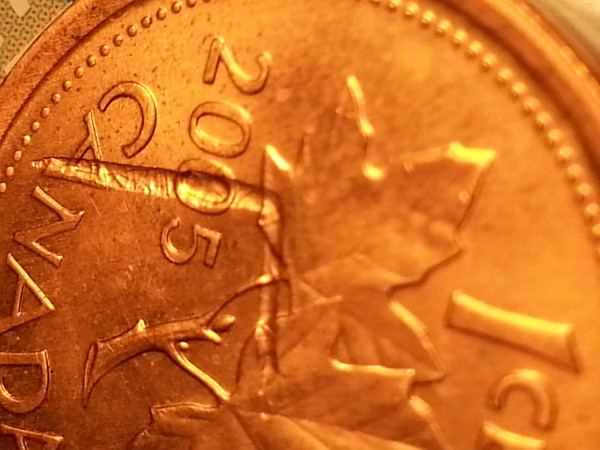 Edited by purelywasted
01/02/2019 1:55 pm
|
|
Moderator
 Canada
10473 Posts |
 Nice error. "Discovery follows discovery, each both raising and answering questions, each ending a long search, and each providing the new instruments for a new search." -- J. Robert OppenheimerContent of this post is licensed under a Creative Commons Attribution-NonCommercial 3.0 Unported License. See: http://creativecommons.org/licenses...0/deed.en_USMy eBay store
|
|
Valued Member
Canada
496 Posts |
Wonder why there is no date on this coin?
|
|
Valued Member
 Canada
221 Posts |
So Purelywasted if the piece of metal fell off after the last strike, shouldn't there be no design from it in the groove?
And to Dennman it's a year 1992.
|
|
Pillar of the Community
Canada
1505 Posts |
It depends on the thickness and type of metal/material that it was struck through. If the metal was relatively thin/soft, the design elements from the die will carry through the coin. If the metal was very thick/hard, you would likely not see much of the design elements
Imagine you are on the beach, and you have a smooth patch of sand, now put down a piece of paper and a Toronto phone book side by side. Punch the piece of paper with your fist, then punch the phone book. Remove both and look at the impressions.
Where the paper was, you should see your fist imprint (a little distorted) and where the phone book was, you should see a mostly rectangular imprint, maybe a slight impression where your fist hit.
It is all about how thick and hard the relative piece of each metal is, the die is very hard, the piece of metal that fell off was relatively thin and softer and the copper penny was the softest.
For the reverse example, try same thing on textured concrete, with paper you will likely dimple/tear it and have bloody/sore knuckles, with the phone book you will have an impression of the concrete on the phone book and a sore hand.
Nice example of a strike through.
Edited by purelywasted
01/02/2019 4:15 pm
|
|
Valued Member
Canada
221 Posts |
Thank's a lot for detailed description  |
|
Pillar of the Community
Canada
1463 Posts |
|
| |
Replies: 7 / Views: 1,590 |
|










 Posted 01/02/2019 2:20 pm


