| Author |
 Replies: 17 / Views: 2,626 Replies: 17 / Views: 2,626 |
|
New Member
United States
43 Posts |
Now I believe these to be what they are called Milk spots? But the combination of them is extremely odd to me that it almost looks like somebody had stuck duct tape to the coin and peeled it off leaving an odd residue 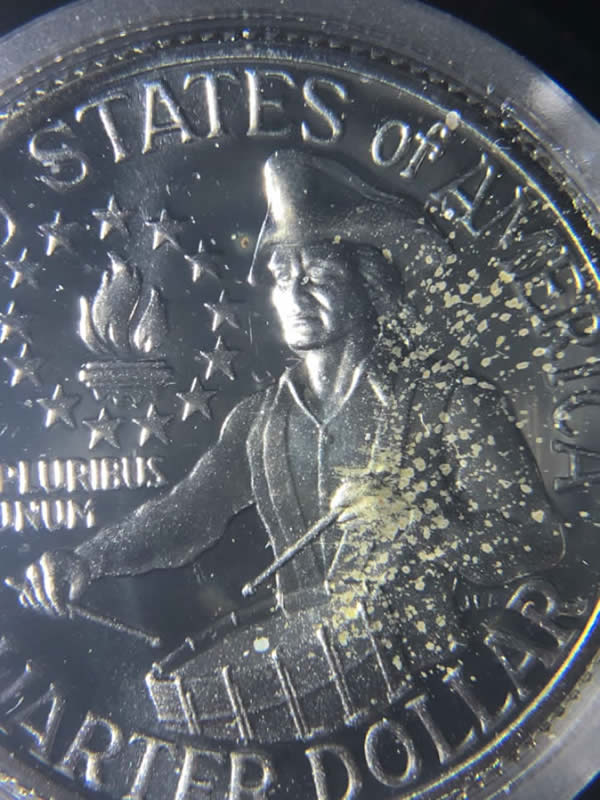 *** Moved by Staff to a more appropriate forum. *** *** Moved by Staff to a more appropriate forum. *** |
|
|
|
Pillar of the Community
United States
562 Posts |
Looks like some Mint worker wasn't wearing gloves! Appears to be a fingerprint on the coin. The oils left behind have caused the toning you now see.
|
|
Pillar of the Community
United States
4692 Posts |
Contamination of some sort, either on coin or packaging that transferred to the coin. Might as well remove and try acetone before it gets worse.
|
|
Pillar of the Community
United States
4901 Posts |
Yup...not milk spots. Definitely needs a long acetone bath
|
|
New Member
 United States
43 Posts |
atlas642 I think he just got done eatting lunch haha. but great info thank you
|
|
Moderator
 United States
191235 Posts |
Quote:
Yup...not milk spots. Definitely needs a long acetone bath I agree. Worth a shot.  |
|
Pillar of the Community
United States
1005 Posts |
Yep, mustard spots not milk
|
|
New Member
United States
43 Posts |
now I thought trying to clean a coin devalues it. any reason as why this may be diferent.
|
|
Pillar of the Community
United States
1005 Posts |
soaking in acetone or distilled water is normally considered acceptable because it doesn't damage the coin as long as you never touch or rub the surfaces. As soon as someone starts rubbing the surfaces with cloth or whatever and dipping their coin in weird acids is when the damage occurs, so the general rule given is to never clean the coin.
In this case, removing the contaminant could prevent further etching or damage of the coin's surface which is why it was recommended here to soak the coin and let air dry.
|
|
Pillar of the Community
United States
4692 Posts |
If the stain does not come off readily, while in the acetone using a Q-tip to gently rub may improve results without hurting the coin. This is my opinion, and others may differ. If left too long in the acetone and it evaporates, then debris usually redeposits on the coin as it comes out of solution.
|
|
New Member
United States
43 Posts |
thank you I will be trying this tomorrow morning and I will post before and after pictures.
|
|
Bedrock of the Community
United States
17884 Posts |
Quote:
now I thought trying to clean a coin devalues it. any reason as why this may be diferent. Because the value is already shot. You can't really hurt it, but IF the spots come off without leaving damage traces then it could restore the value. It is basically a "you have nothing to lose" situation. |
|
Pillar of the Community
United States
772 Posts |
Someone sneezed if you ask me, acetone as stated above isn't "cleaning" in the coin collecting sense. Conserving is a better word for it. Acetone will eat any organic materials on the coin, but it has no effect on the metal. Remember to only get PURE acetone, not the finger nail polish they will try to sell you sometimes. Good luck!
|
|
Pillar of the Community
 United States
6514 Posts |
...I know it's not but your original comment of it looking like duct tape residue is humorously accurate.
|
|
Moderator
United States
191235 Posts |
Quote:
Because the value is already shot. You can't really hurt it, but IF the spots come off without leaving damage traces then it could restore the value. It is basically a "you have nothing to lose" situation.  |
|
Bedrock of the Community
United States
17884 Posts |
Quote:
Someone sneezed if you ask me, The spots are too regular, it looks more like the weave of a cotton glove somebody put against their nose. The oil from their nose was left on the high points of the weave and then placed on the coin. Edited by Conder101
02/04/2019 01:59 am
|
| |
Replies: 17 / Views: 2,626 |







 Posted 02/01/2019 3:46 pm





