| Author |
 Replies: 10 / Views: 2,766 Replies: 10 / Views: 2,766 |
|
|
Pillar of the Community
United States
851 Posts |
Couldn't add photos to old post. Look forward to hearing your thoughts. 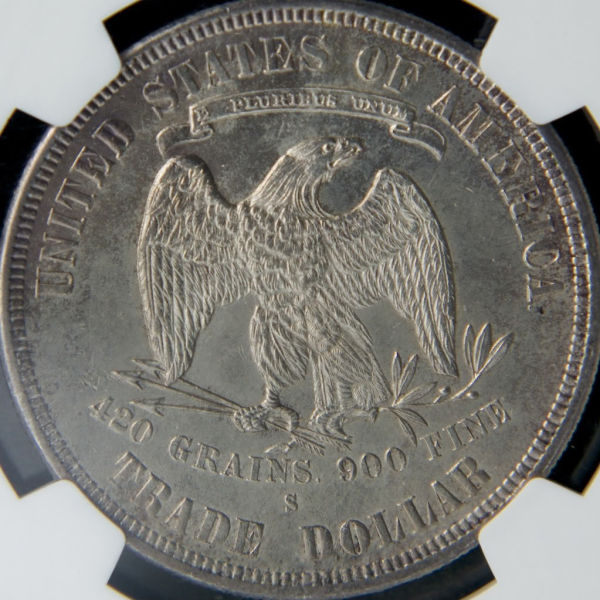 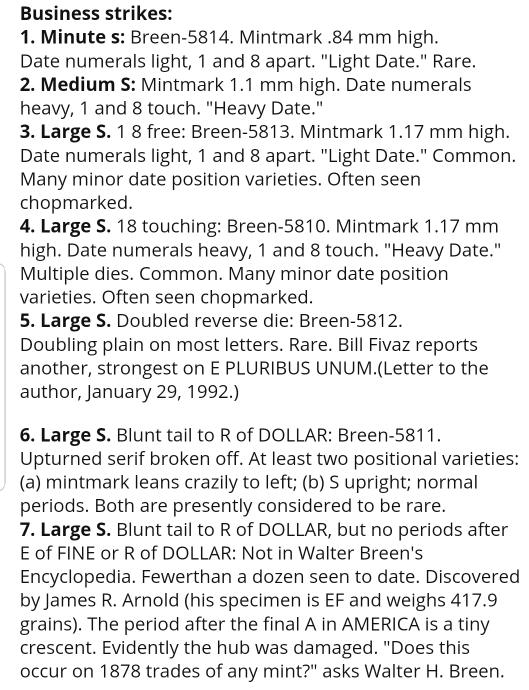 Edited by coins92
04/05/2019 11:02 pm
|
|
|
|
Pillar of the Community
United States
4409 Posts |
Since no one else has replied to this post, I'll give my best answer which will be most likely less than satisfactory for you. I know nothing of varieties when it comes to Trade dollars other than the Type I versus Type II. I wish I knew more about the varieties the main trouble is lack of reference books with good pictures to go along with written descriptions. The trouble with Breen's descriptions, at least in my opinion, is vagueness. Whether anyone in the near future will publish a new book on Trade dollars or their varieties is to be seen. Most collectors are content with a single example as a type. -MV |
|
Bedrock of the Community
United States
94367 Posts |
Well said. Breen, like so many others of his era, was simply a pioneer with a fantastic appetite for the hobby. A giant by any standard even if his observations seem oversimplified by today's knowledge.  Edited by Coinfrog
04/09/2019 8:25 pm
|
|
Pillar of the Community
 United States
851 Posts |
|
|
Pillar of the Community
 United States
900 Posts |
Which variety do you think this is? Most of these reference the date, which you have not shown.
|
|
Pillar of the Community
United States
851 Posts |
|
|
Pillar of the Community
United States
900 Posts |
I've never heard of Breen before, but I would agree that it matches his description. Out of curiousity, I scanned through some images from PCGS Coinfacts and found another that seems to match as well. It has no specific attribution though. Link to that coin certification here. Click the image to see the larger image. |
|
Pillar of the Community
United States
9807 Posts |
Just curious as to the title of this says PCGS, yet the coin is in a NGC holder? PCGS list a couple of varieties a DDR and a RPD. I don't see any doubling on this one, and would need to see the obverse to begin to try and nail down the attribution, most of the rare varieties have to do with the date size and position as well. "Buy the Book Before You Buy the Coin" - Aaron R. Feldman - "And read it" - Me 2013! ANA Life Member #3288 in good standing since 1981, ANS, Early American Coppers Member (EAC), Colonial Coin Collectors Club member (C4), Conder Token Collector Club member (CTCC), Civil War Token Society (CWTS) member, Liberty Seated Collectors Club (LSCC) & Numismatic Bibliomania Society member (NBS), USMex, Member in good standing, 2¢ variety collector. See my want page: http://goccf.com/t/140440 |
|
Pillar of the Community
United States
851 Posts |
Correct it is an NGC. Note the leg of the R in Dollar. Compare to R in America. Also the period after America is a crescent rather than a period. Also no period after Fine.
|
|
Pillar of the Community
United States
851 Posts |
Large S. Blunt tail to R of DOLLAR, but no periods after E of FINE or R of DOLLAR: Not in Walter Breen's Encyclopedia. Fewerthan a dozen seen to date. Discovered by James R. Arnold (his specimen is EF and weighs 417.9 grains). The period after the final A in AMERICA is a tiny crescent. Evidently the hub was damaged. "Does this occur on 1878 trades of any mint?" asks Walter H. Breen.
|
|
Valued Member
52 Posts |
|
| |
Replies: 10 / Views: 2,766 |
|









 Posted 04/09/2019 8:22 pm


