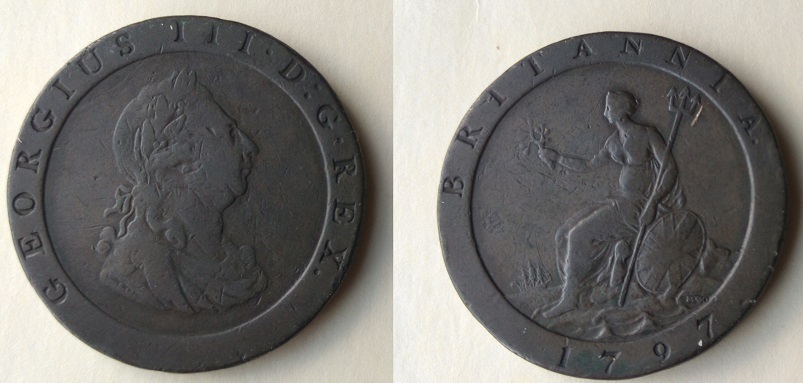
Those 1797 pennies and tuppences were known as "cartwheels" because of their size. They have a place in coin history as the first state coins produced by steam power. Boulton did make some tokens before that, however.
The cartwheels were sometimes used as weights for scales.
@jimbucks -
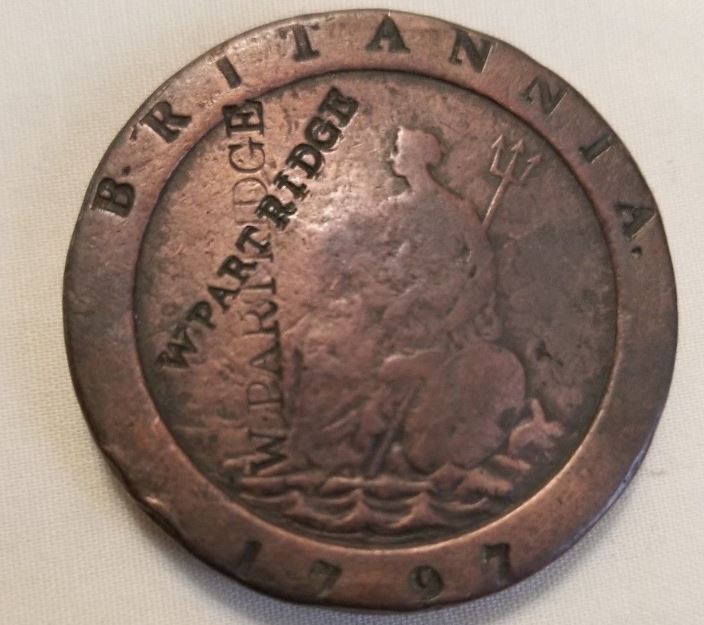
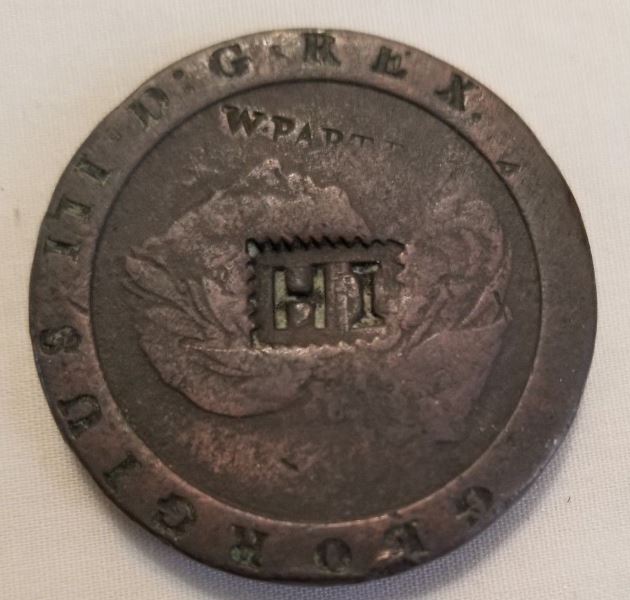
Here are my speculations about your countermarks.
In Britain in the 1830's and 40's British copper coins were increasingly countermarked as advertising pieces. This was made illegal by an Act of Parliament in 1853. In 1860 the whole lot of copper coins were demonetised and replaced by bronze coins. This introduced a loophole for the advertisers, as the 1853 Act only applied to current coins. So after the change advertising countermarks appeared on the pre 1860 coppers as well as foreign coins.
I looked up W PARTRIDGE in "British Countermarks on Copper and Bronze Coins" by J Gavin Scott, Spink 1975, but could find no mention. Internet searches produce ads which suggest West Indies connections, but with no details supporting the suggestions. Interestingly, I found an
ebay add with what appeared to be the same coin, down to the positioning of the countermarks. There is mention of a RICHARD PARTRIDGE advertising countermark but I cannot say if it is linked.
Here is my tuppence worth, or
Two Cents worth for US readers.
I don't think the countermarks relate to the West Indies for the following reasons. In Fred Pridmore's wonderful ( and costly ) work "Coins of the British Commonwealth of Nations, part 3 West Indies", he shows numerous examples of countermarks. They are all on non-British coins. The countermarks serve to identify the island of issue and/or the value, which this one does not.
The style of this countermark resembles more closely the later advertising countermarks which circulated in Britain. I note that W PARTRIDGE appears three times on the coin in what appears to be a haphazard manner. I wonder if it is a post-1860 test piece where somebody experimented with making the countermarks. I cannot account for the HI ( or IH ? ). Those initials don't seem to match any used for a West Indian island.
I hope my thoughts provoke further discussion. I would love to be enlightened.
@NumisRob
The cartwheel 2d was the largest regal coin circulated, but there was a larger token. The 1813 Birmingham workhouse 3d token is a behemoth!










 Posted 04/25/2019 3:50 pm