| Author |
 Replies: 7 / Views: 1,225 Replies: 7 / Views: 1,225 |
|
|
Valued Member
United States
148 Posts |
hello, maybe someone familiar with the minting process of The Royal Mint can help? they used to make holed coins in the center, am looking at the period of the early 40's and around the hole is sort of a raised ring. I wonder how was it actually processed ? I mean, did they drill it after the coin produce or the blanks had holes ? was it made out of sheet coils, similar to today's technology, when the sheet go in and the "cookie cutter" make the blanks ? am especially interested in how common are errors in the hole, how they happen, etc... Thank you much. |
|
|
|
Pillar of the Community
United States
5318 Posts |
Hi, since nobody has answered specifically to British coinage, I'll just add what I know about US experiments with holed coins.
The planchets were produced with the hole, and the die had a collar for both the inner hole and outer rim.
I'm unsure of the precise mechanics, especially since the US trials were done in the 19th Century.
I'm also curious if you have a specific coin in mind? Do you have one with an error around the hole?
The reason I ask is there are a series of "coins" bearing Shilling denominations that had hole errors.
These were made in the 40s as tokens/money for wartime internment camps in Australia.
|
|
Valued Member
 United States
148 Posts |
|
|
Pillar of the Community
United States
5318 Posts |
That error is really dramatic!  Very cool, thanks! I'm particularly interested how the original inside hole is distorted, either by the strike or the rim upset process, since there's that partial clip too.  Edited by KurtS
08/27/2008 4:59 pm
|
|
Valued Member
United States
148 Posts |
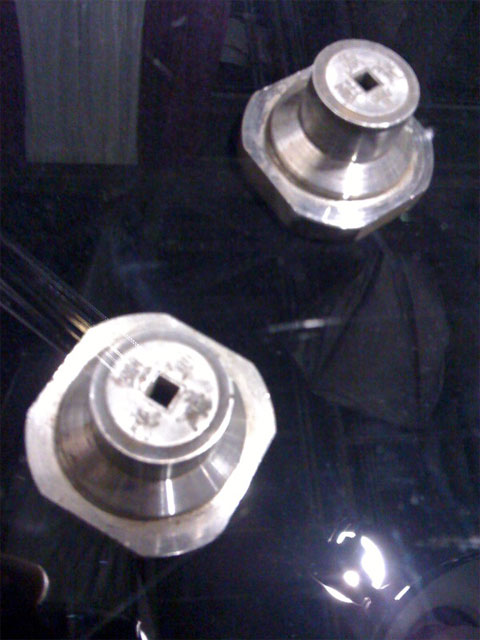 I should probably relocate this thread from the GB forum, if I knew how... In the Sep 08 long beach show, PCGS had a show case with bunch of counterfeits: Slabs, coins, and these Chinese dies. they caught my eye because of the hole, and it seem like they did/planed to punch a pre holed planchets, yet am not even sure if the GB holed coins were manufactured in the same method. Edited by leprecoin
09/25/2008 12:57 am
|
|
Moderator
 Australia
16982 Posts |
Quote:
I should probably relocate this thread from the GB forum, if I knew how... You can't, directly. Click on the "Send note to Staff" link at the bottom your thread and ask for it to be moved; the mods will move it for you. The fake Chinese cash dies are interesting, because genuine Chinese cash coins weren't struck from dies, they were cast from moulds. In that sense, struck cash coins ought to look "more fake" than cast copies. The holes in cash coins were present on the moulds, so those coins were "made with them". It's entirely possible these dies were intended to be used to "counterstamp" a common-type cash coin and turn it into a scarcer one. I can't read the bottom one, but the top one is an obverse for the Xian Feng emperor (1851-61). Traditional Chinese cash coins have a square hole in them (rather than a round one) for two reasons, aesthetic and practical. Aesthetic, because the combination of square and circle is thought to be harmonious. Practical, because bundles of roughly cast coins could be pushed onto a square rod, and the edges of the coins smoothed out by turning on a lathe; this way, entire strings of coins could be smoothed at once. Don't say "infinitely" when you mean "very"; otherwise, you'll have no word left when you want to talk about something really infinite. - C. S. Lewis
|
|
Pillar of the Community
United States
1415 Posts |
Quote:
Practical, because bundles of roughly cast coins could be pushed onto a square rod, and the edges of the coins smoothed out by turning on a lathe; this way, entire strings of coins could be smoothed at once.
Another interesting tidbit from SAP!  |
|
Pillar of the Community
United States
3499 Posts |
Sap- that is really interesting!
|
| |
Replies: 7 / Views: 1,225 |
|










 Posted 08/27/2008 4:49 pm


