|
This page may contain links that result in small commissions to keep this free site up and running.

Welcome Guest! Registering and/or logging in will remove the anchor (bottom) ads and the security checks. It's Free!
To participate in the forum you must log in or register. | Author |
 Replies: 156 / Views: 23,455 Replies: 156 / Views: 23,455 |
|
|
|
Pillar of the Community
 United States
6130 Posts |
Maximus Caesar, son of Maximinus Thrax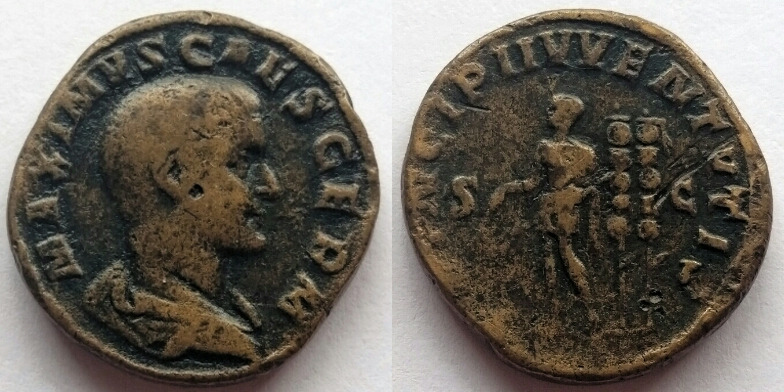 AE Sestertius MAXIMVS CAES GERM, Bare-headed draped bust right PRINCIPI IVVENTVTIS S C, Maximus standing next to two standards Maximus (usually called Maximus Caesar to distinguish him from a usurper who reigned 180 years later) was the son of Maximinus and Paulina. He was made Caesar probably upon his father's accession, and accompanied him on all of his campaigns. He was murdered along with his father in 238, aged about 14-18 based on his portrait on coins.
|
|
Pillar of the Community
United States
6130 Posts |
Pupienus, 22 April - 29 July 238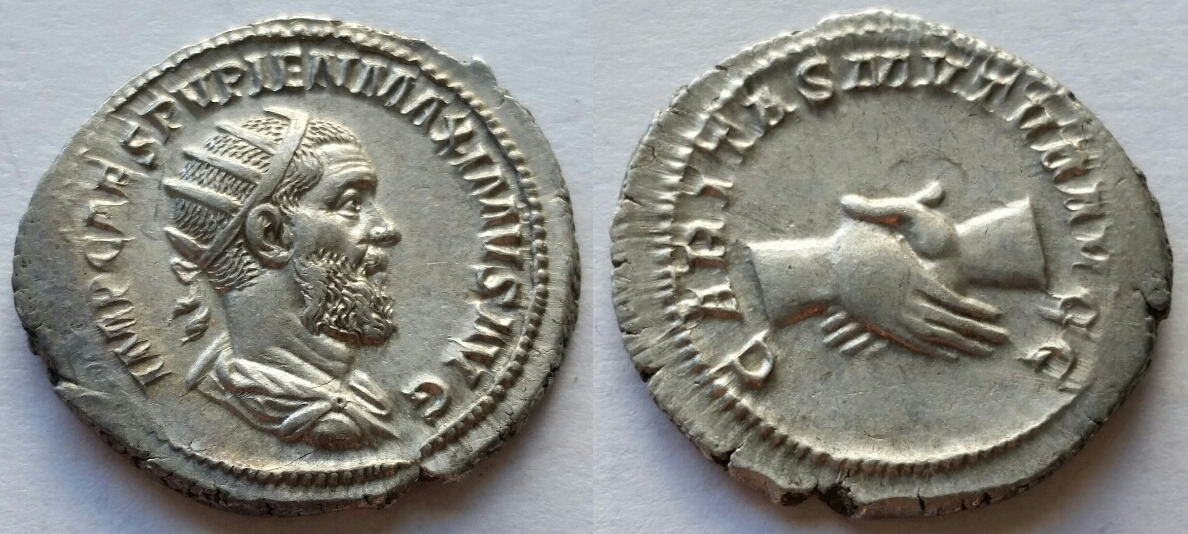 AR Antoninianus IMP CAES PVPIEN MAXIMVS AVG, Radiate, draped bust right CARITAS MVTVA AVGG, Clasped hands Born between 165-170, Pupienus and his colleague Balbinus were the last Roman emperors to have lived during the Nerva-Antonine period. Little is known with certainty of Pupienus' early life, except that he was a relatively minor member of the aristocratic class. Attaining maturity early in the Severan period, Pupienus was promoted through the ranks and was granted a suffect consulship in 207, after which he was sent to serve as the governor of Germania, where he secured victory over the Sarmatians and other minor tribes. He held the full consulship twice, in 222 and 234, and also served as Urban Prefect over Rome, where he was recognized for capable but at times excessively strict rule. He was among the senators wholly dissatisfied with the rule of Maximinus Thrax, and was an avid supporter of the Gordians, serving on a panel of twenty senior senators to safeguard the city as they waited for their emperors to arrive. Gordian and his son were killed, however, and Maximinus was now on the war path to Rome. In a near-panic, the senators elected Pupienus and Balbinus as co-emperors and granted them both the title of Pontifex Maximus. The memory of his harsh term as Urban Prefect still fresh in the minds of the populace, rioting broke out among the citizens of Rome. Leaving Balbinus in Rome to deal with the unrest, Pupienus marched to Ravenna to prepare for the arrival of Maximinus, but Maximinus and his son were murdered by their own soldiers the following month, leaving Pupienus and Balbinus unchallenged. Despite the lack of a competing Imperial claimant, the former armies of Maximinus had to be bought, and it is probably for this purpose that the Antoninianus was reintroduced, which had been abolished about 18-19 years prior under Elagabalus. The situation was no less deadly, however. Although little detail survives, there seems to have been a deeply seated rivalry between the disciplinarian Pupienus and his more amicable Balbinus, and both suspected the other of treachery; steps taken to safeguard one were seen as preparations for a coup by the other. Under pressure from the public and Senatorial factions who were loyal to the Gordians, both emperors adopted the teenaged Gordian III as their Caesar. The Praetorians meanwhile came to resent their aristocratic emperors, and hoped that the young Gordian would make a more suitable and pliable emperor. Pupienus begged Balbinus to call for the loyal German bodyguard, but Balbinus refused, suspecting that he would be murdered as soon as they arrived. The two emperors were arguing when the Praetorians burst in, dragged both of them away, and hacked them to bits. Pupienus was about 73 years old.
|
|
Pillar of the Community
United States
6130 Posts |
Balbinus, 22 April - 29 July 238 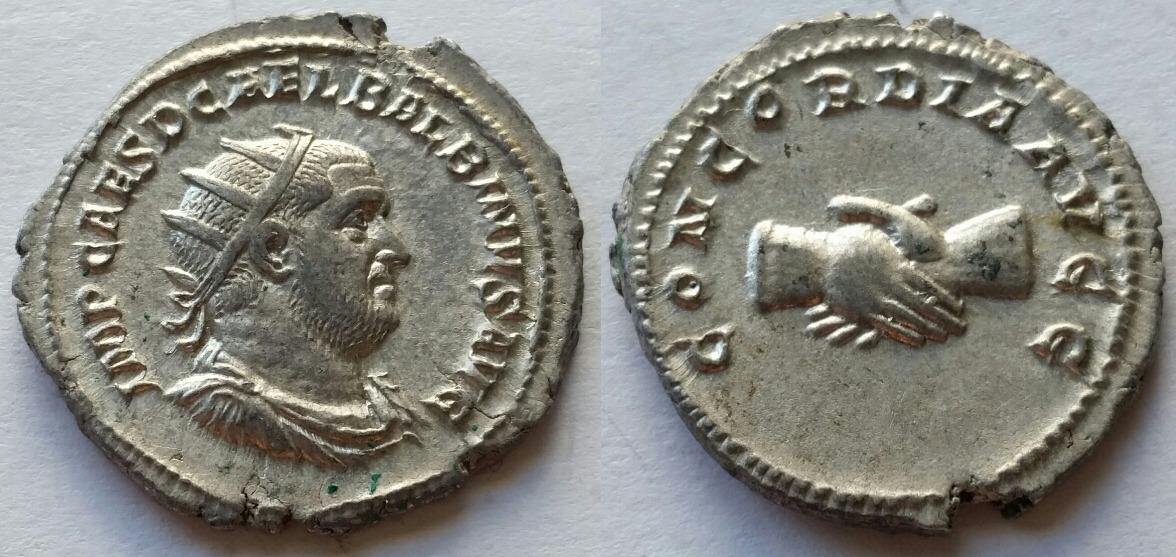 AR Antoninianus IMP CAES D C AEL BALBINVS AVG, Radiate draped bust right CONCORDIA AVGG, Clasped hands Born in about 178, little is known of Balbinus' origins and most sources are confused and contain clearly fabricated stories. Like Pupienus, Balbinus hailed from an aristocratic but unremarkable family, and distinguished himself with a long career in public service, serving as consul twice, first in 203 or 211, and again in 213 alongside Caracalla. Contrasting the austere Pupienus, Balbinus was popular and easygoing, being a noted orator, poet, and patron of the arts. He was wealthy and indulged in the luxuries of the Roman aristocracy, but he was a capable politician and never placed pleasure ahead of business. Along with Pupienus and eighteen other senators, Balbinus supported the rise of the Gordians and kept affairs in order in Rome while waiting for their emperors to arrive. They never did, as both died less than a month after accepting the position of Augustus against Maximinus. Desperate, the Senate appointed Balbinus as Augustus and Pontifex Maximus on 22 April 238, along with Pupienus. As Balbinus was more popular and had less military experience, Balbinus remained in Rome to deal with rioting over their accession, while Pupienus took his loyal forces to Ravenna to head off the bloodthirsty Maximinus. The threat resolved itself as Maximinus and his son were killed by their own troops about a month later. Despite his former popularity and his adopting the teenaged Gordian III as Caesar and heir, Balbinus could not rally loyalty from the populace of Rome. This was further exacerbated by an apparent rivalry between the two emperors, and Balbinus suspected that Pupienus was going to use his German bodyguard to murder him. This seemed confirmed when, on 29 July 238, Pupienus came to Balbinus in a near-panic and begged him to call for the German guards. Suspecting a plot, Balbinus refused and the two emperors began arguing when the Praetorian guard burst in, dragging both emperors off and hacking them to bits. Balbinus was about 60 years old.
|
|
Pillar of the Community
 Spain
2752 Posts |
Wow Steve!....Lovely portraits on the Balbinus and Pupienus 'pricey coins'!.Congrats on obtaining these tough rulers in such nice condition.....Like the run through on the Thrax coins too.. RIC 7A Minted AD 235-236 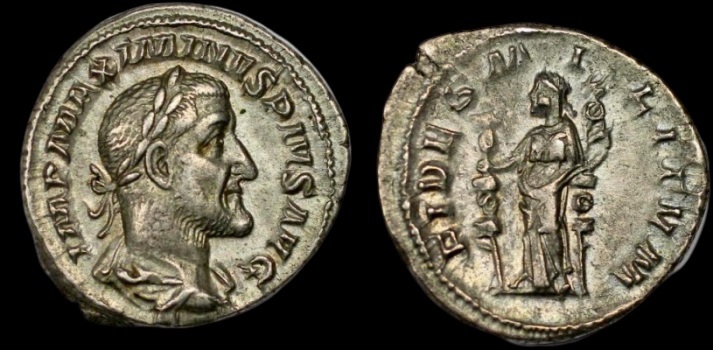 |
|
Pillar of the Community
United States
6130 Posts |
Chapter VIII
The Early Crisis, Gordian III - AemilianGordian III, 238 - 244As Caesar under Pupienus and Balbinus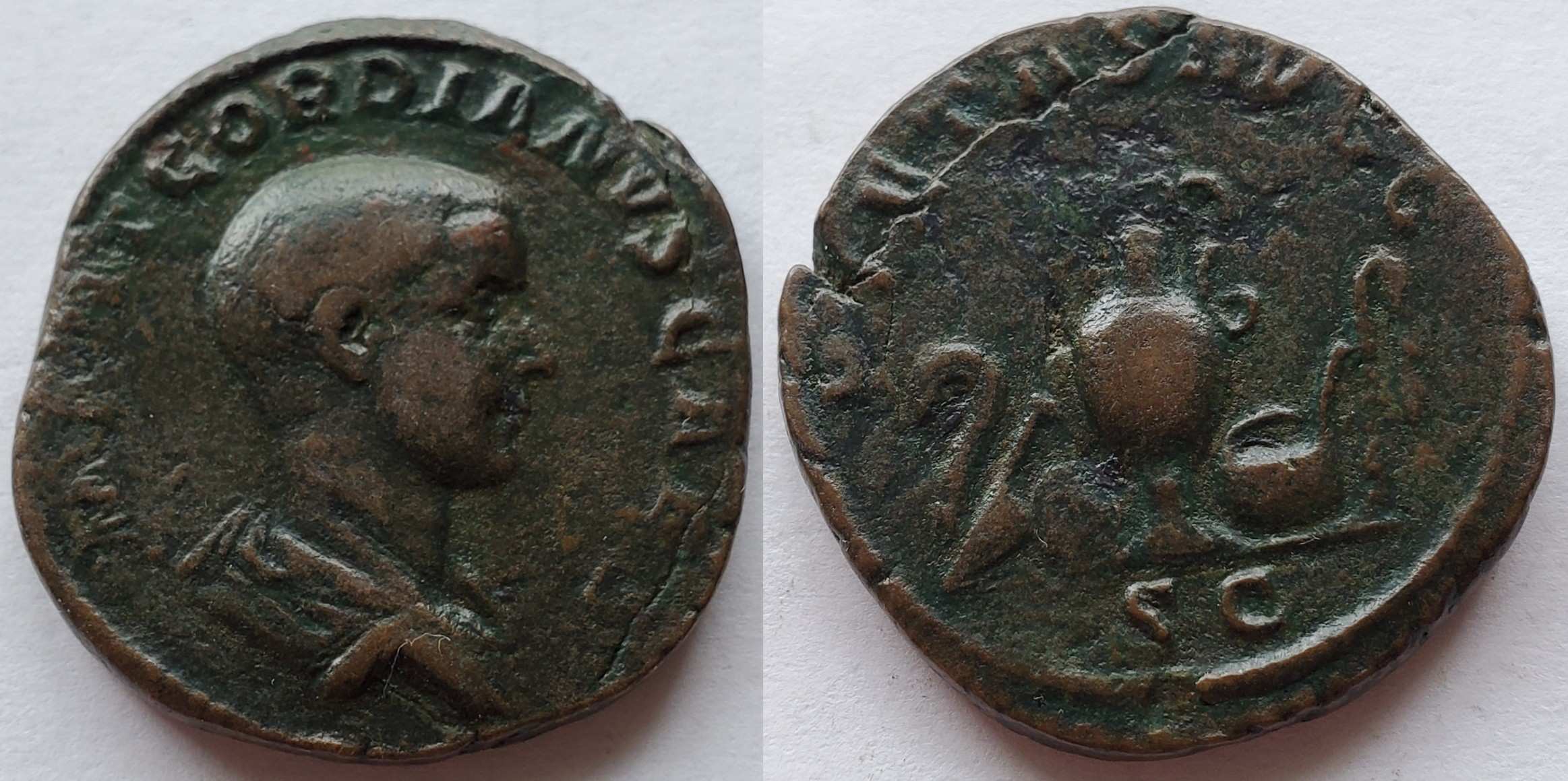 AE Sestertius M ANT GORDIANVS CAES, Draped, bare-headed bust right PIETAS AVGG SC, Priestly implements As Augustus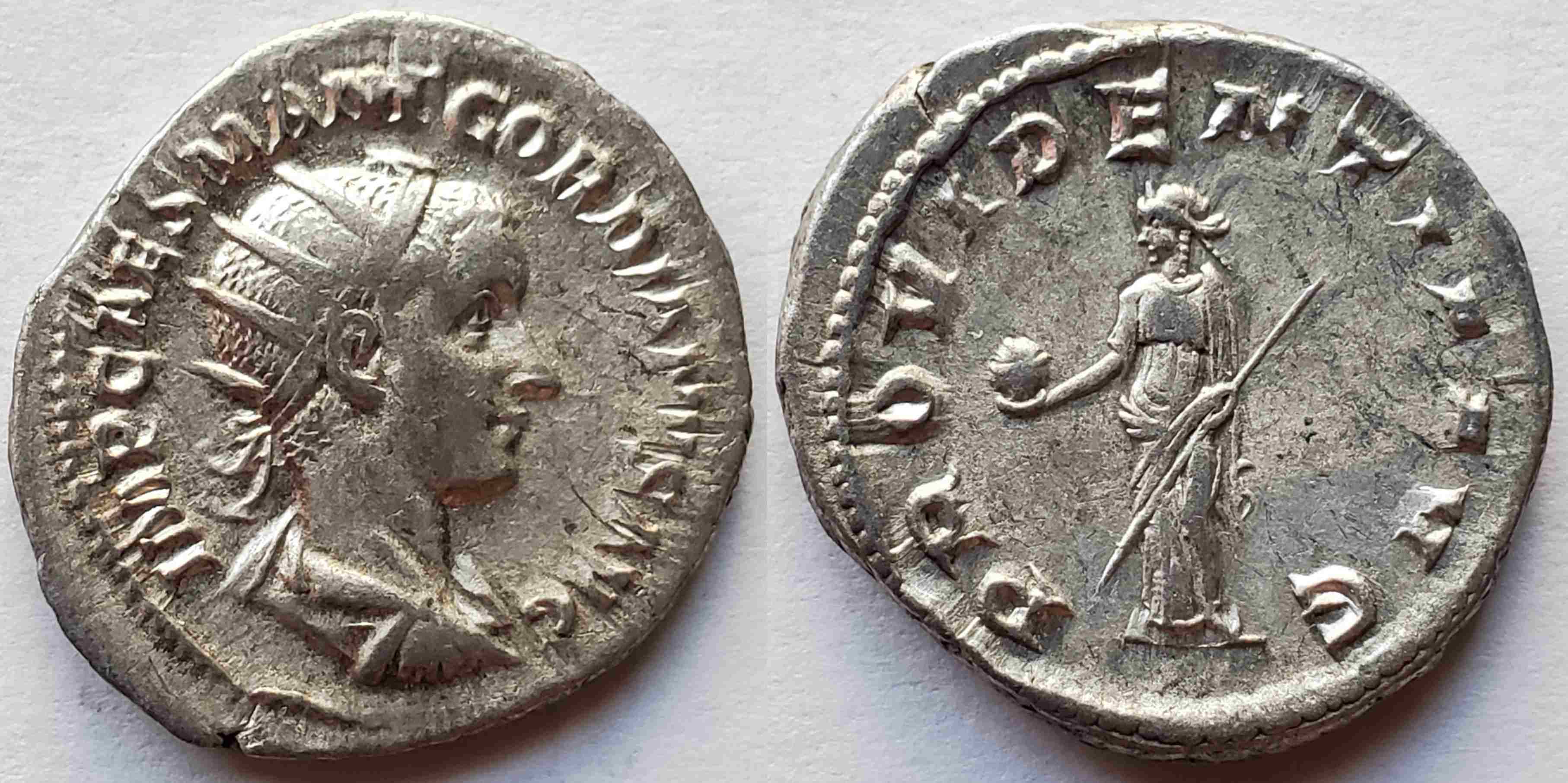 AR Antoninianus IMP CAES M ANT GORDIANVS AVG, Radiate, draped bust right PROVIDENTIA AVG, Providence standing left, holding globe and scepter (Note the passing similarities in this portrait to that of Balbinus, above - I believe these are among the earliest of Gordian's emissions from Rome, possibly using heavily modified recycled busts of Balbinus until new master portraits could be cut.) 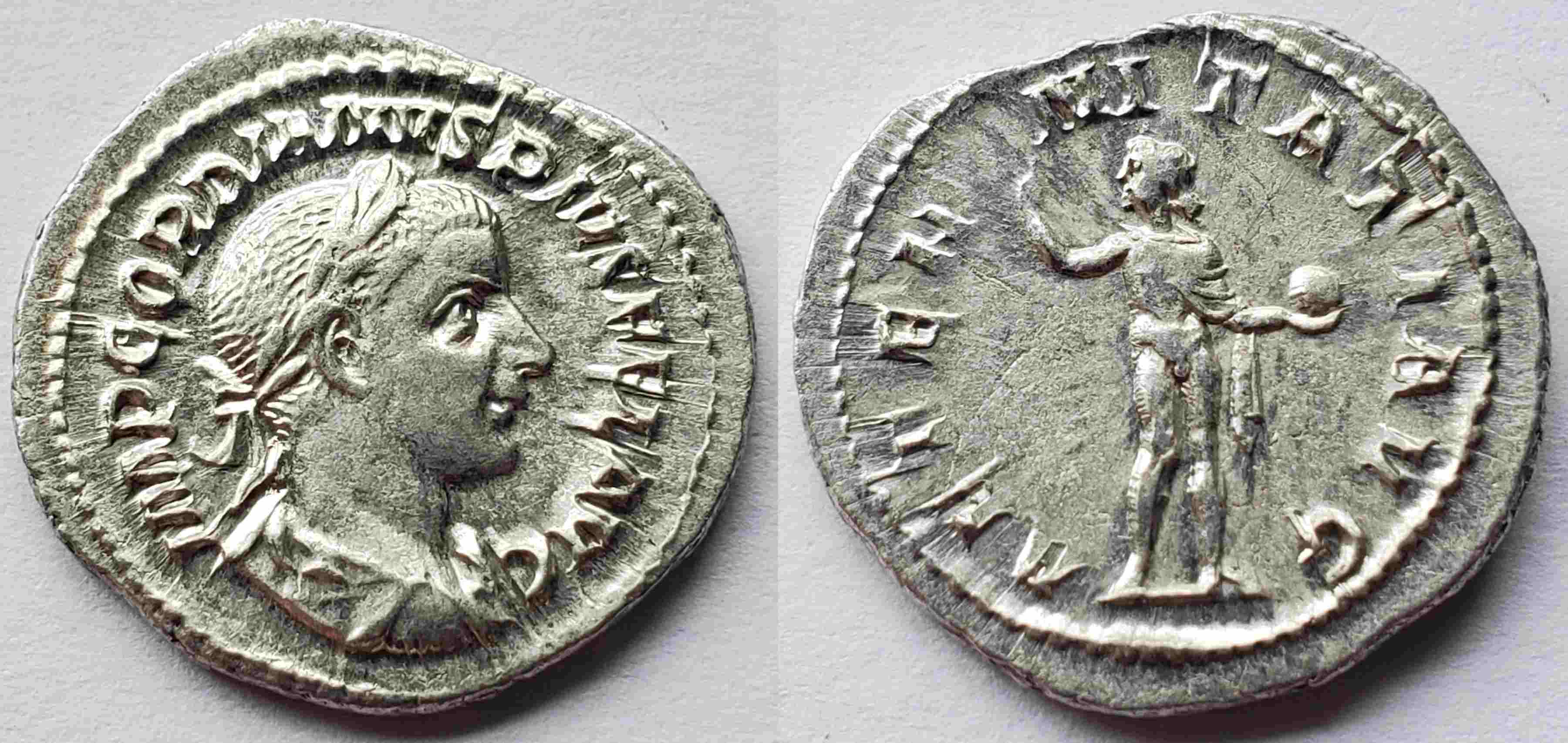 AR Denarius IMP GORDIANVS PIVS FEL AVG, Laureate, draped bust right AETERNITATI AVG, Sol standing left, holding globe and raising hand in salute 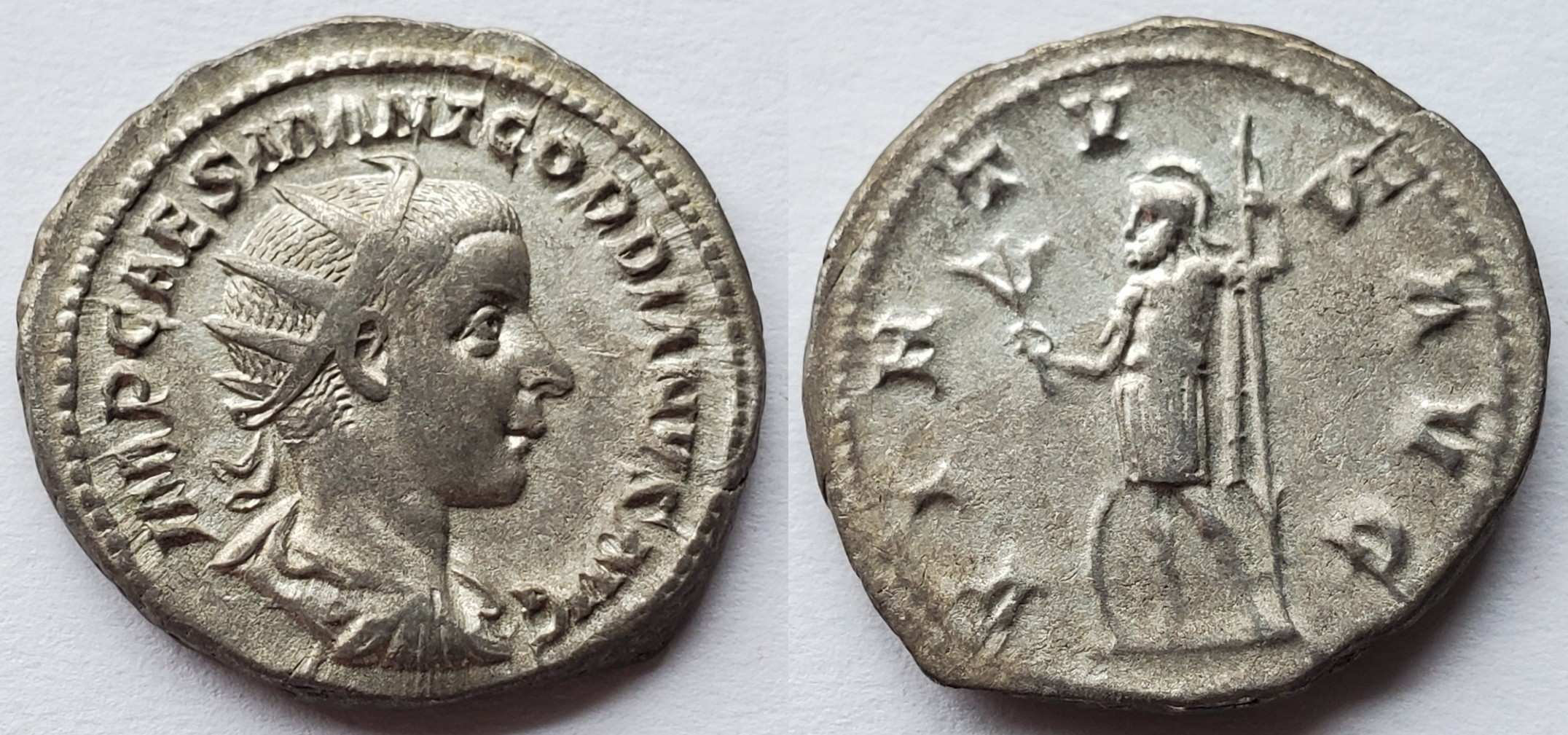 AR Antoninianus IMP CAES M ANT GORDIANVS AVG, Radiate, draped bust right VIRTVS AVG, Marti Pacifero (?) standing left, holding olive branch and inverse spear, shield at knees Born in 225, Gordian III was the nephew of Gordian II, grandson of Gordian I, and great-great-grandson of Aelius Caesar, Hadrian's original heir. He was elevated to Caesar in 238 at the age of 13 to placate the masses after discontent grew with Pupienus and Balbinus, and found himself as the sole emperor of Rome just a few months later. He was the youngest person to ever hold the offices of Emperor without a colleague. Not surprisingly, Gordian III exercised little real power during his early reign; he was largely a figurehead for the Senate and other powerful aristocrats, particularly his Praetorian Prefect, Timesitheus. In 241, during a brief lull in troubles for the empire, the teenaged Gordian III married the teenaged daughter of Timesitheus, Tranquillina. During the reign of Gordian III, the Roman economy began to slip; the denominations below the Sestertius became scarce, and the Antoninianus (reinstituted during the reigns of Pupienus and Balbinus) overtook the Denarius as the primary coin of Rome; Gordian III was the last emperor to produce denarii in substantial quantity--excepting Aurelian's brief attempt to reintroduce the denomination, denarii were produced only sporadically (probably for gifts or special events) and are generally quite rare today. In about 240, Shapur I came to power over the Sassanid empire, hellbent on fulfilling his father's dream of reclaiming the Achaemenid Empire, which included large portions of the Roman East. He invaded Roman territory, and Gordian III went on campaing to deal with the threat. He saw a resounding victory at Resaena in 243, and decided to pursue the Sassanians over the Euphrates to snuff out the threat. Around this time, Timesitheus died under uncertain circumstances, and Gordian III elevated Gaius Julius Priscus to replace him, but Priscus stepped down in favor of his brother, Philip the Arab. History becomes fuzzy at this point; Sassanian chronicles claim the Roman army was defeated and Gordian III killed in battle near modern-day Fallujah, whereas Roman historians maintain that Gordian III was killed by his own army for unclear reasons, possibly a coup by Philip the Arab. Regardless, Gordian III died in February 244, aged 19, clearing the way for Philip the Arab to assume the purple.
|
|
Pillar of the Community
United States
6130 Posts |
Tranquillina, wife of Gordian III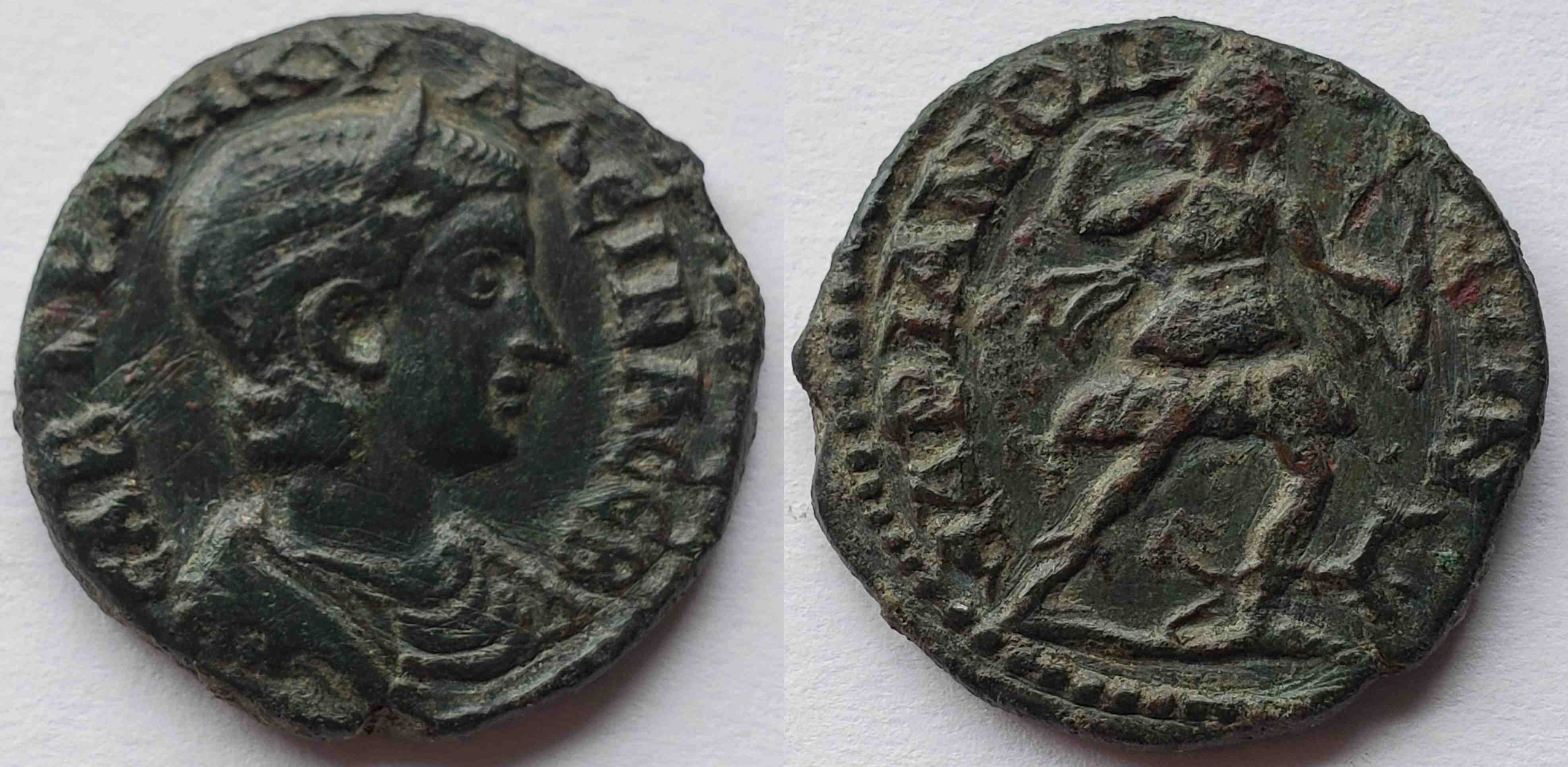 AE23 Hadrianopolis, Thrace CAB TRANKYΛΛEINA CEB, diademed and draped bust right AΔΡIANOΠOΛEITΩN, Artemis running right, holding bow, drawing arrow from quiver behind shoulder, dog running at her feet. 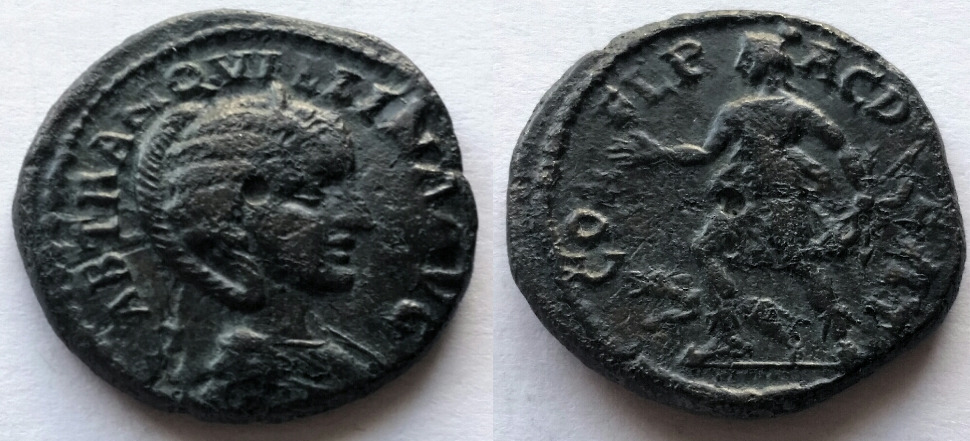 AE23 of Deultum, Thrace SAB TRANQVILLINA AVG, Draped bust right CO FL PAC DEVLT, Artemis advancing left, holding bow and arrows, dog at feet (Due to the extreme rarity of Tranquillina's imperial issues, these AEs of Deultum are about the closest we can get!) Tranquillina was the daughter of Praetorian Prefect Timesitheus, and married emperor Gordian III in 241, when they were both about 16 years old. Very little detail survives of her life, but their marriage of three years did not produce an heir. She and Gordian were still married when the latter died in 244, and she appears to have returned to life as a private citizen. Inexplicably, imperial coins of Tranquillina are among the rarest and most coveted of all Roman empresses, commanding thousands of dollars for even modest examples, which seldom appear more than once every few years. While not common by any means, provincial coins of Tranquillina are much more plentiful, and variously feature both the married couple and Tranquillina alone.
|
|
Pillar of the Community
Spain
2752 Posts |
Nice coins and write ups  That's a very interesting and uncommon VIRTVS AVG reverse. |
|
Pillar of the Community
United States
7067 Posts |
Good update, Steve. I know that busts on Gordian III ants are often of superior style, but that last coin of yours (the second ant) is exceptional. And the same can be said of the Balbinus and Pupienus ants from a couple weeks back. Wow.
|
|
Pillar of the Community
United States
6130 Posts |
Thanks guys! Funny thing about the Gordian III / Virtus, that was actually the first Gordian III I ever bought, and IIRC it only cost me $25 including shipping from ebay. It has a pretty soft reverse, so I've come close to selling it several times, but the quality of the portrait has kept it in my collection since 2016 - longer than most other coins from that time period. I believe that the chief engraver originally employed by Severus Alexander continued to work under Maximinus, Gordian I/II, Pupienus and Balbinus, and probably retired or died near the end of Gordian III's reign. The quality of the engraving goes down a bit toward the end of his reign; I believe that he had trained a successor who engraved for Gordian III, Philip, Decius, Gallus, and probably died or retired early in the reign of Valerian. |
|
Pillar of the Community
United States
6130 Posts |
Philip I "The Arab", 244-249 AR Antoninianus IMP C M IVL PHILIPPVS PF AVG P M, Radiate draped bust right PAX FVNDATA CVM PERSIS, Pax standing left, holding scepter and olive branch *Minted as propaganda following Philip's surrender to the Persians - urging the population to see the large indemnity paid not as tribute, but as the price of a lasting and amicable peace 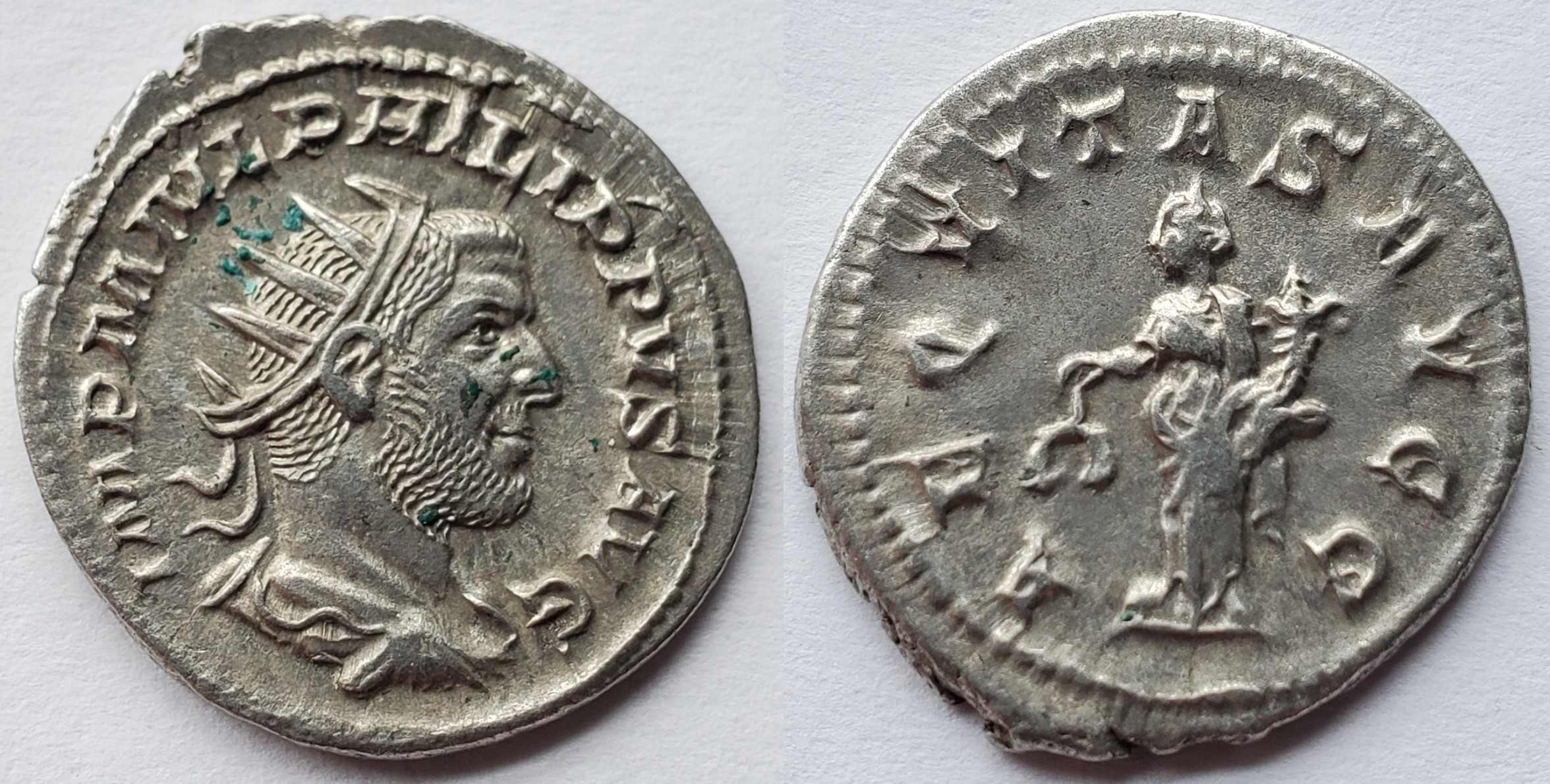 AR Antoninianus IMP M IVL PHILIPPVS AVG, Radiate, draped bust right AEQVITAS AVGG, Equity standing left, holding scales and cornucopia *Minted to celebrate the elevation of Philip II to Augustus  AE Sestertius IMP M IVL PHILIPPVS AVG, Laureate, draped bust right SAECVLARES AVGG SC, She-wolf suckling Romulus and Remus *Minted to celebrate the Ludi Saeculares, 248 AD to commemorate the 1,000th anniversary of the founding of Rome 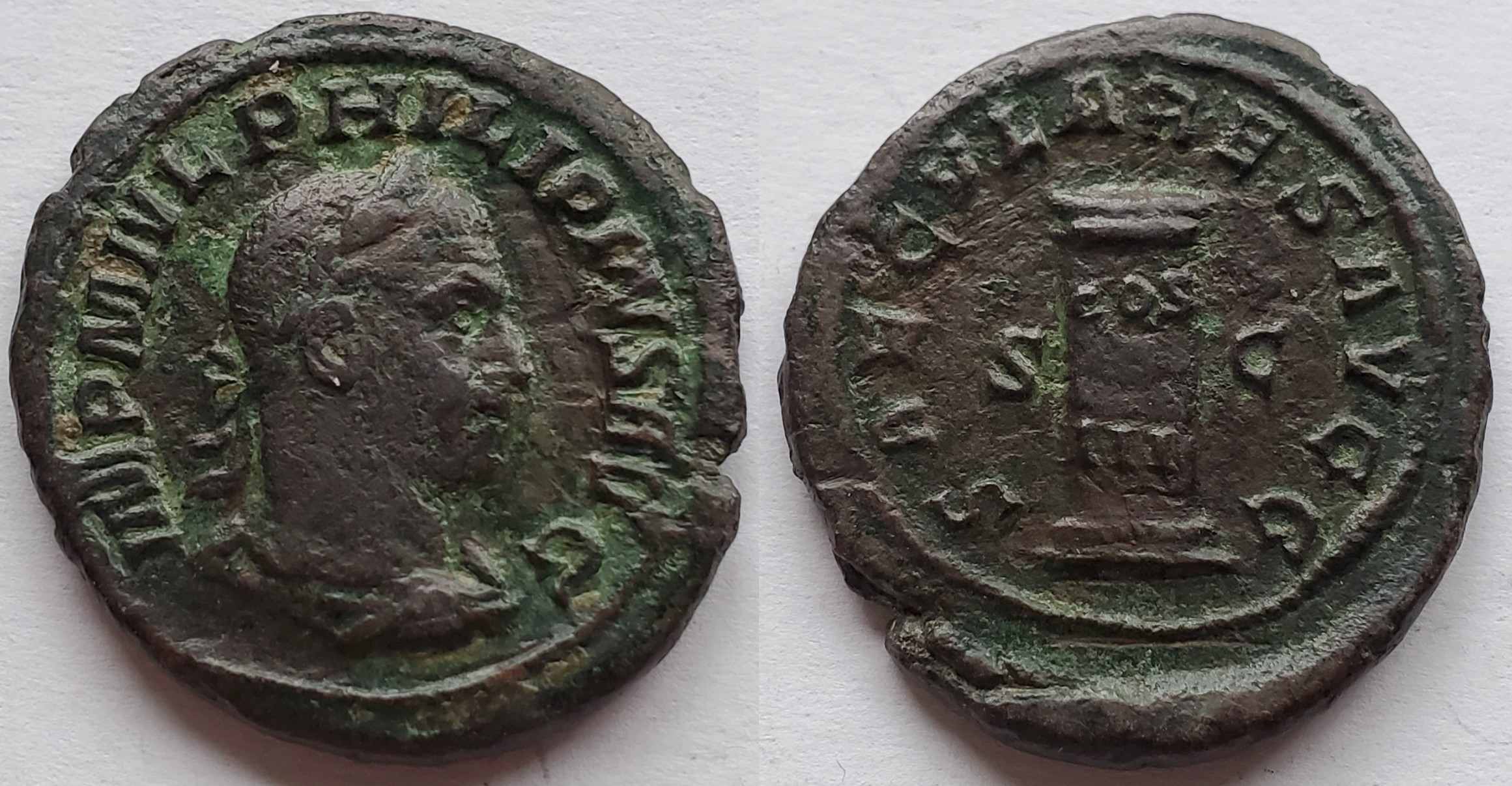 AE As IMP M IVL PHILIPPVS AVG, Larueate, draped bust right SAECVLARES AVGG S C, Cippus inscribed COS III *Also minted for the Secular Games, and likely distributed to the crowds as a prize, as the As was a nearly-worthless denomination by this point! Born in about 204 in Arabia Petraea, Philip I "The Arab" came from humble provincial origins. Coinage attests his father as Julius Marinus for whom a limited deification issue exists. He began his career as a soldier, and suddenly found himself as the emperor Gordian III's right hand man when his brother was elevated to the office of Praetorian Prefect, but stepped down in favor of Philip. Philip succeeded the teenaged Gordian III in early 244; historians are deeply divided on whether Philip was behind the death of his predecessor. At any rate, Philip saw the campaign against Shapur I as lost, and negotiated a peace treaty on terms humiliating to Rome: half a million aureii and severance of ties with Armenia in exchange for the cessation of hostilities. Sending the ashes of Gordian III ahead of him, Philip then made haste to Rome, to ensure he arrived before any potential rivals. On his arrival, he was ratified by the Senate, and elevated his young son Philip II to Caesar and his wife Otacilia Severa to Augusta. Already under great financial stress from the peace treaty, Philip futher stretched his money to re-found his home town as Philippopolis. He was in great need of revenue at this point, so he was forced to increase taxes across the empire, and stopped sending money to keep peace with the barbarian tribes to the north. He successfully pushed back invasions by the Carpi in 246 and 247 as a result of the cessation of subsidies. In 248 AD, Rome celebrated the 1000th anniversary of her founding by Romulus and Remus, and Philip organized lavish Secular games for the occasion. Things soon began to fall apart, however, as barbarian raids over the Limes became more frequent, and usurpers started coming out of the woodworks, with Pacatian and Jotapian being the most pressing threats. The revolt of Jotapian fizzled out due to a lack of funds, but Pacatian presented a major threat to Philip's power. Overwhelmed, Philip offered to abdicate power to the Senate, but was pressured into sending Decius to deal with the revolt of Pacatian. Decius was successful, and unexpectedly was proclaimed emperor by his troops. He reluctantly accepted, and in 249 marched on Rome. Philip was killed in the resulting battle near Verona, aged about 45. Philip is notable among the rulers of this time period for being extremely lenient towards Christians; he communicated openly with Origen, and is said to have attended at least one Easter mass. Some go on to claim Philip was the first Christian emperor, although his holding of the office of Pontifex Maximus seems to discredit that claim.
|
|
Pillar of the Community
United States
6130 Posts |
Philip II, Son of Philip I
Caesar 244-247
Augustus 247-249As Caesar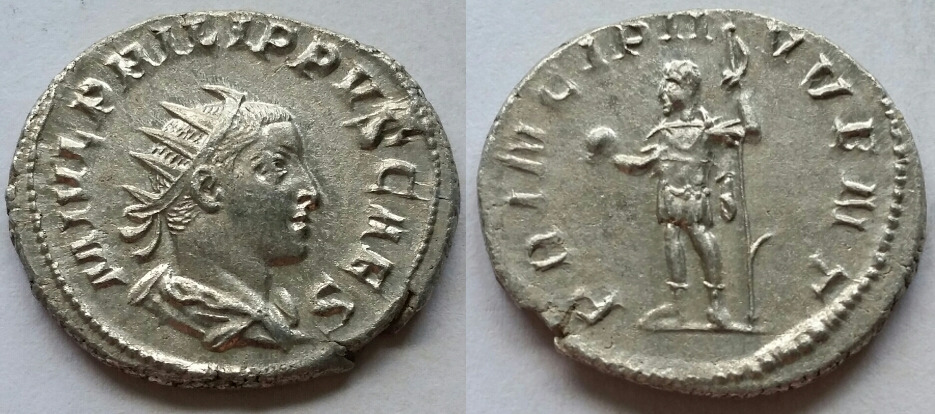 AR Antoninianus M IVL PHILIPPVS CAES, Radiate draped bust right PRINCIPI IVVENT, Philip II standing left, holding transverse spear and globe As Augustus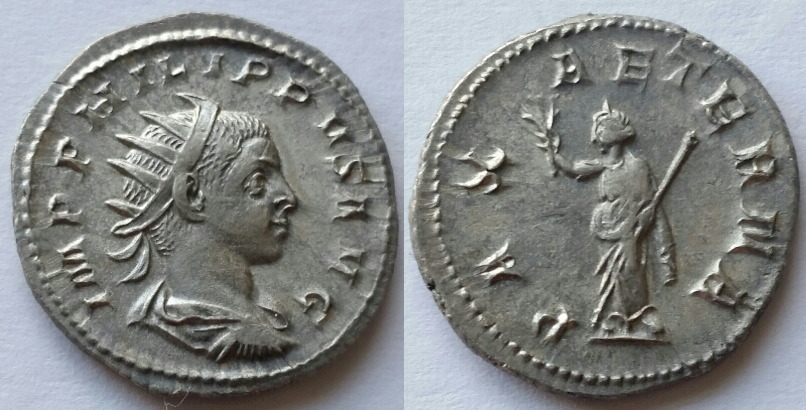 IMP PHILIPVS AVG, Radiate draped bust right PAX AETERNA, Pax standing left, holding scepter and branch Born in 237, Philip II was the young son of Philip I and Otacilia Severa, and would be the first emperor to have been born after the Severan period. He was made Caesar shortly after his father consolidated power in 244, and was elevated to co-Augustus with his father in 247 after holding his first consulship. He was in Rome with his mother when Philip I fell to the forces of Decius, and Philip II was stabbed and died in his mother's arms. He was 11 years old.
|
|
Pillar of the Community
United States
6130 Posts |
Otacilia Severa, wife of Philip I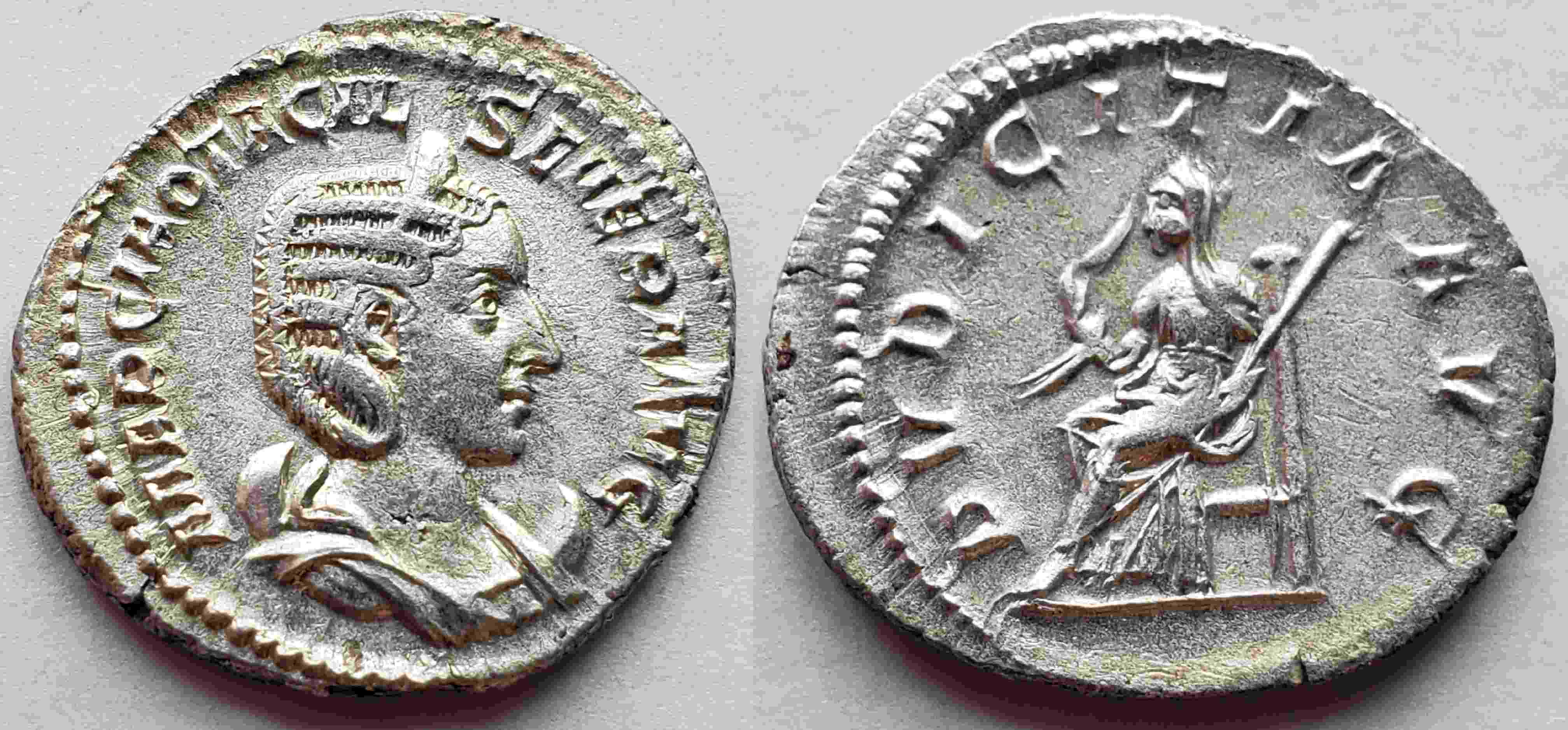 AR Antoninianus MARCIA OTACIL SEVERA AVG, Draped bust right, on crescent PVDICITIA AVG, Pudicitia (modesty) seated left, holding scepter and drawing veil away from face Hailing from an old and established Marcia family, Otacilia Severa was the daughter of Otacilius Severus, governor of Macedon and Moesia. She does not appear to have been related to the Severan dynasty, despite her name. She married Philip I in 234 and they had Philip II three years later in 237. Like her husband, it was rumored that she was a Christian, although evidence falls short of proving she was anything more than merely sympathetic toward the religion. Very little detail survives of her personality or life. After the death of her husband and son in 249, her life was spared and she retired to obscurity.
|
|
Pillar of the Community
United States
7067 Posts |
Terrific new set of uploads. Quote:
I believe that the chief engraver originally employed by Severus Alexander continued to work... Interesting. Speculation? I wish that the superior Roman engravers signed their dies as some Greeks did. |
|
Pillar of the Community
Spain
2752 Posts |
Yep a lovely run of coins Steve!.... Really do like the strong portrait on your first Ant of Philip I.. I don't know about you but imo Maximinus Thrax and Philip I coins, for anyone on a budget, are the best looking portraits you can find for the bucks.... Here's my Philip father-son combo.... 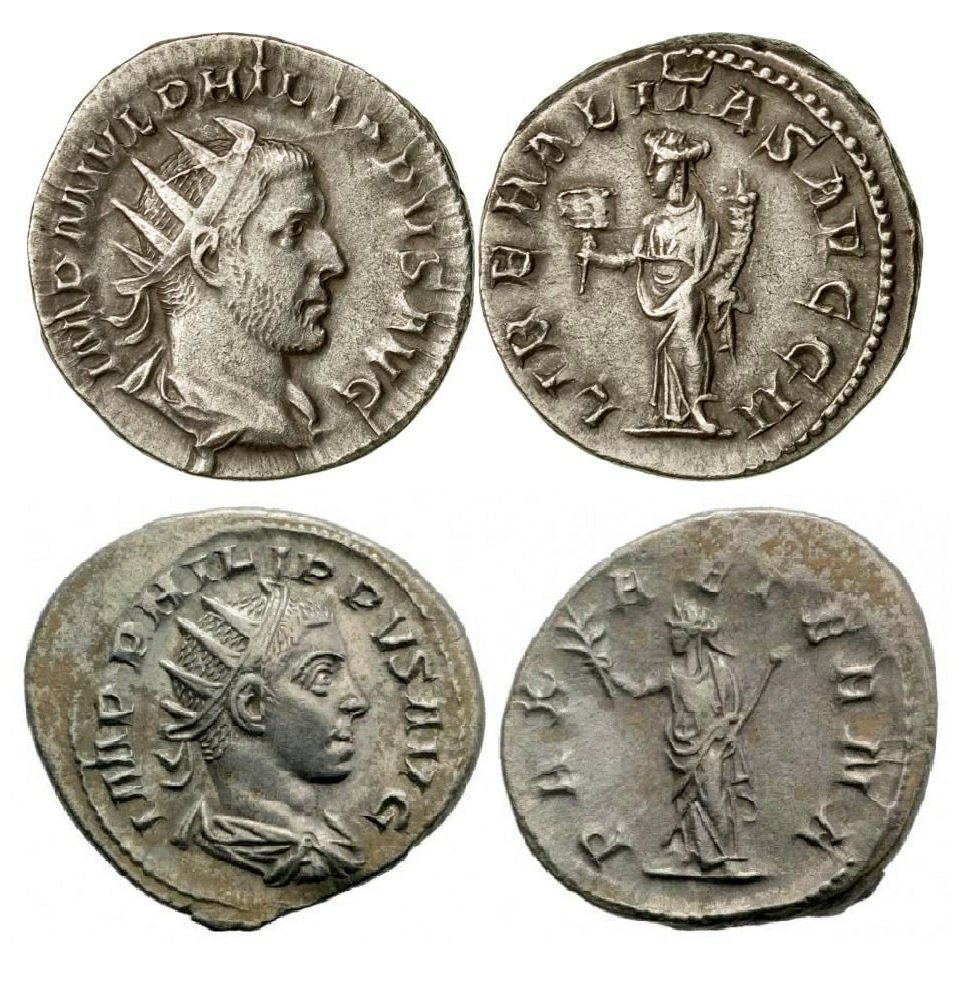 PS....Sweet looking OS too! |
|
Pillar of the Community
United States
6130 Posts |
Thanks guys! @Bob, Yes it is speculation on the part, although I know that some (more qualified than I) have done extensive studies on various Imperial portraiture found on coins and elsewhere - and at least a handful of individual engravers have been identified. The basis for my assumption that the same individual worked throughout the reigns of Alexander through Gordian is that after Gordian we can see a couple decades' worth of quality portraits, although the overall quality goes down slightly, becomes markedly less consistent, and the quality of manufacture of the coins also takes a hit, first with dies being used well past when they should have been retired (as seen on my Philip/Aequitas ant) - all signs of new management. And very nice coins, @Paul! I especially like the pleasing toning on that Philip I! |
| |
Replies: 156 / Views: 23,455 |
To participate in the forum you must log in or register.
Disclaimer: While a tremendous amount of effort goes into ensuring the accuracy of the information contained in this site, Coin Community assumes no liability for errors. Copyright 2005 - 2026 Coin Community Family- all rights reserved worldwide. Use of any images or content on this website without prior written permission of Coin Community or the original lender is strictly prohibited.
Contact Us | Advertise Here | Privacy Policy / Terms of Use
|
| Coin Community Forum |
© 2005 - 2026 Coin Community Forums |
| It took 0.58 seconds to rattle this change. |
 |
|
| |
| |







 First Page
 Previous Page


 Posted 10/09/2020 10:04 am


