| Author |
 Replies: 149 / Views: 16,058 Replies: 149 / Views: 16,058 |
|
|
|
Pillar of the Community
 United States
7067 Posts |
I've had the same thought, Paul. I have designed and assembled many shadow box frames through the years, so it's always an option. I may go that route for overflow from my collection when the new case fills.
|
|
Valued Member
United Kingdom
218 Posts |
The daggers with the three prongs are fascinating and I've spent a while wondering why I'd make something like that. I can see it being useful as a holder for some sort of pommel that has familial identification of who the dagger belongs to. When that person dies, the insert pommel is passed onto the next most senior member, and a new dagger made for them that fits it (the previous dagger 'dies' with the owner). The other thing I'm seeing is an almost bayonet type of situation. Use as a dagger most of the time, but twist&lock it onto a notched pole for those moments you need some long-range poky fun. Pure imagination, but it's always fun to speculate. Oh, and I saw this that raised at least one eyebrow.  Edited by Gainn
07/27/2022 6:38 pm
|
|
Pillar of the Community
United States
7067 Posts |
Some interesting speculation. There are definitely some mysteries associated with this collecting area.
|
|
Pillar of the Community
United States
7067 Posts |
Just received my second Ex-John Piscopo Collection piece. This new acquisition is a small sword, missing its pommel. (My other Ex-Piscopo is a modest bronze dagger blade.) John Piscopo was a passionate and highly respected collector of ancient weaponry and, in the words of a member of the Ancient Artifacts forum, he was "the father of the Internet antiquities community." Piscopo was 62 years old when he passed away in 2005. The collection of ancient weapons (Iranian, Southeast Asian, and European) that he amassed was one of the most important in the world. As a result, "Ex-Piscopo Collection" is significant provenance. I would say that, other than owning a deaccessioned specimen from a well-known museum collection, "Ex-Piscopo" is the most meaningful provenance one can hope for where ancient weapons are concerned. Of course, the most distinctive feature of my latest pickup is its penannular (crescent-shaped) guard. (Page 7 of this thread has another edged weapon with a crescent-shaped guard.) Such guards first appeared in western Iran toward the end of the Late Bronze Age. They come in lots of different varieties. They are categorized not just by their shapes, but by their find spots and age (which is sometimes determined by context at the dig sites). According to Babak Rafiei-Alavi in The Biography of a Dagger Type: The Diachronic Transformation of the Daggers with the Crescent-Shaped Guard: "In the Late Bronze Age (1600-1300 BC), the guard has a functional role, it is part of the hilt and holds the blade. In the Iron Age I (1300-1000 BC) the functional guard was in several cases changed to a non-functional and ornamental unit. (During) the Iron Age II (1000-800 BC), this non-functional attribute was mostly transformed back to its functional trait." Regarding such weapons, Christian Konrad Piller states (in Notes on the So-Called 'Daggers with a Crescent Guard'): "...daggers with such a guard do not form a homogenous type. In fact, there are several subtypes and variants which differ in their production technique and their general outline. Furthermore, there are a lot of variations concerning the shape and the cross-section of the blade and the hilt." Although the sword I won has some formal similarities to some Iron Age II Iranian swords of comparable size and with similar (though usually skinnier) elliptical penannular guards, it is possibly unique in its details and overall form - particularly in the boxiness of its crescent, and the way the blade's shoulders project slightly outward from the guard. That guard is definitely functional, holding the blade in place. (It isn't just a decorative feature.) So, this sword, while possibly unique, is clearly more akin to penannular edged weaponry of the Iron Age II than to earlier (Late Bronze Age and Iron Age I) examples. I think I can safely (though still broadly) date my sword to early first millennium BC. It was during this period that the crescent guards were occasionally used in combination with "double disk" (a.k.a. "cotton-reel") pommels. My example presumably had a pommel in antiquity, and it may have been the double disk type. 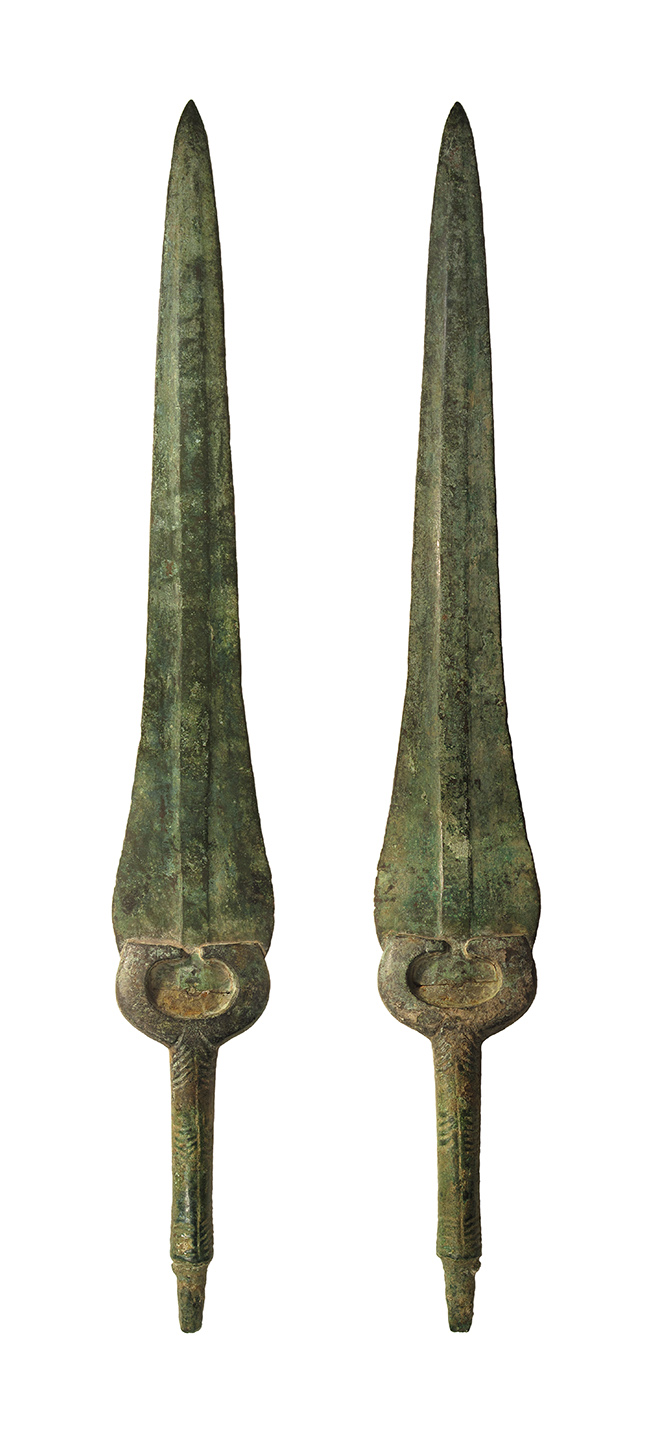 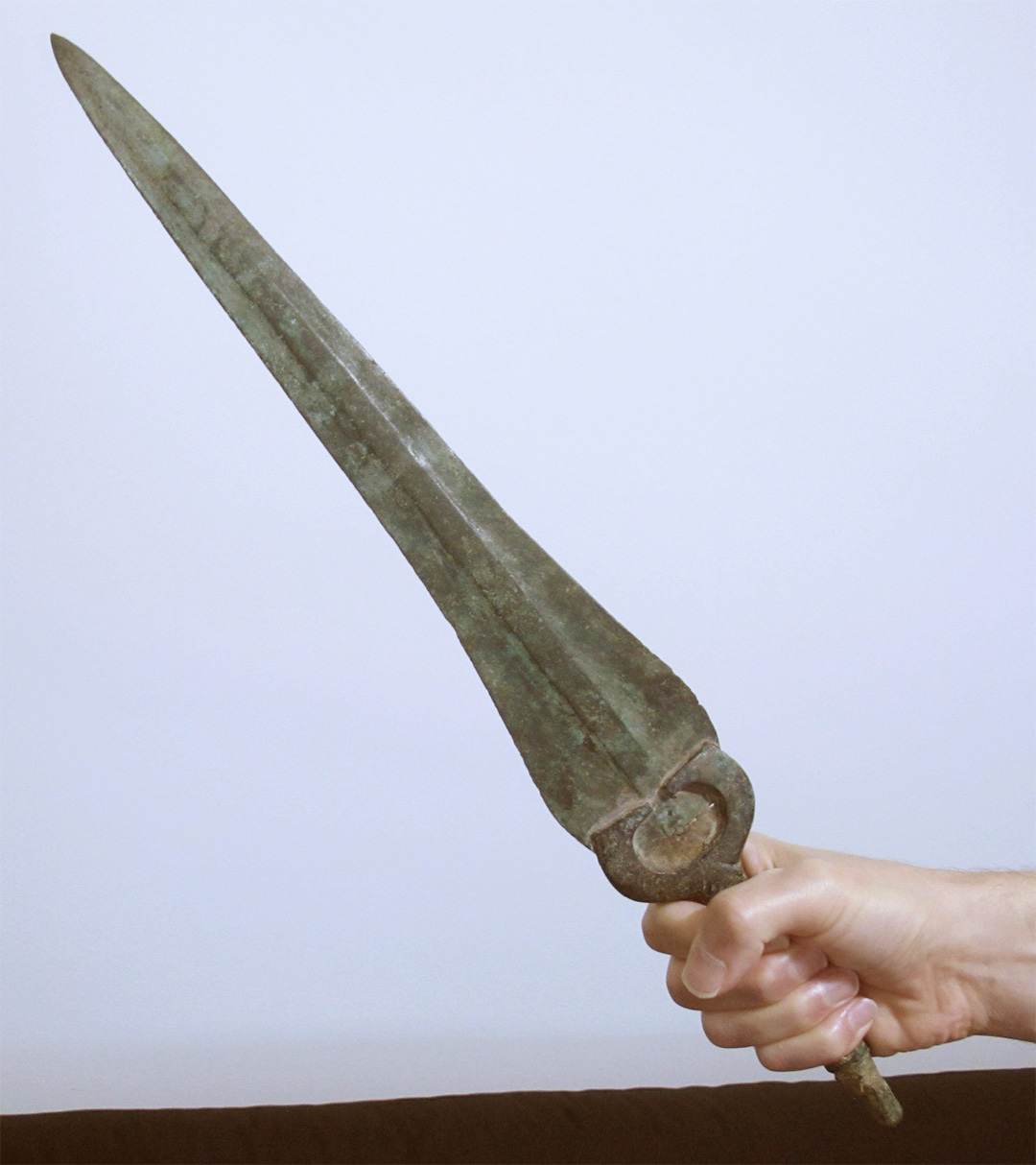 |
|
Moderator
 United States
23731 Posts |
Wow Bob!, that is a beautiful piece in fantastic condition. Do you have any idea what the pommel night have looked like?
|
|
Pillar of the Community
United Kingdom
1168 Posts |
Quote:
Wow Bob!, that is a beautiful piece in fantastic condition. @echizento hit the nail square on the head there. What a superbly well preserved blade. The Ex-John Piscopo Collection provenance is the icing on the cake.  Great write-up and photography as always. Congratulations, Bob. |
|
Pillar of the Community
United States
7067 Posts |
Thanks, gents. Quote:
...any idea what the pommel might have looked like? No way to know for sure, Ron. But many others of this period (Iron Age II in Iran) had variants of "double disk" (a.k.a. "cotton reel" pommels), like the following. 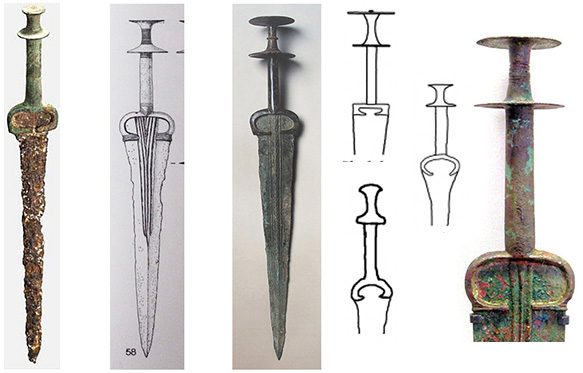 Edited by Kamnaskires
09/25/2022 09:03 am
|
|
Pillar of the Community
 Spain
2752 Posts |
What an excellent addition Bob!
Wonderful condition, beautiful patina and sound provenance.
Love the penannular guard shape and can see from your professional photos that there still are some grip lines left on the handle....Congrats on a cool piece Bob.
|
|
Pillar of the Community
United States
7067 Posts |
|
|
Pillar of the Community
United States
7067 Posts |
I'm quite pleased to add an important piece to my collection of ancient weaponry from Western Asia. This one is an intact short sword from ancient NW Iran, and it dates to the early first millennium BC. It is an iconic type with a distinctive "double-ear" pommel. 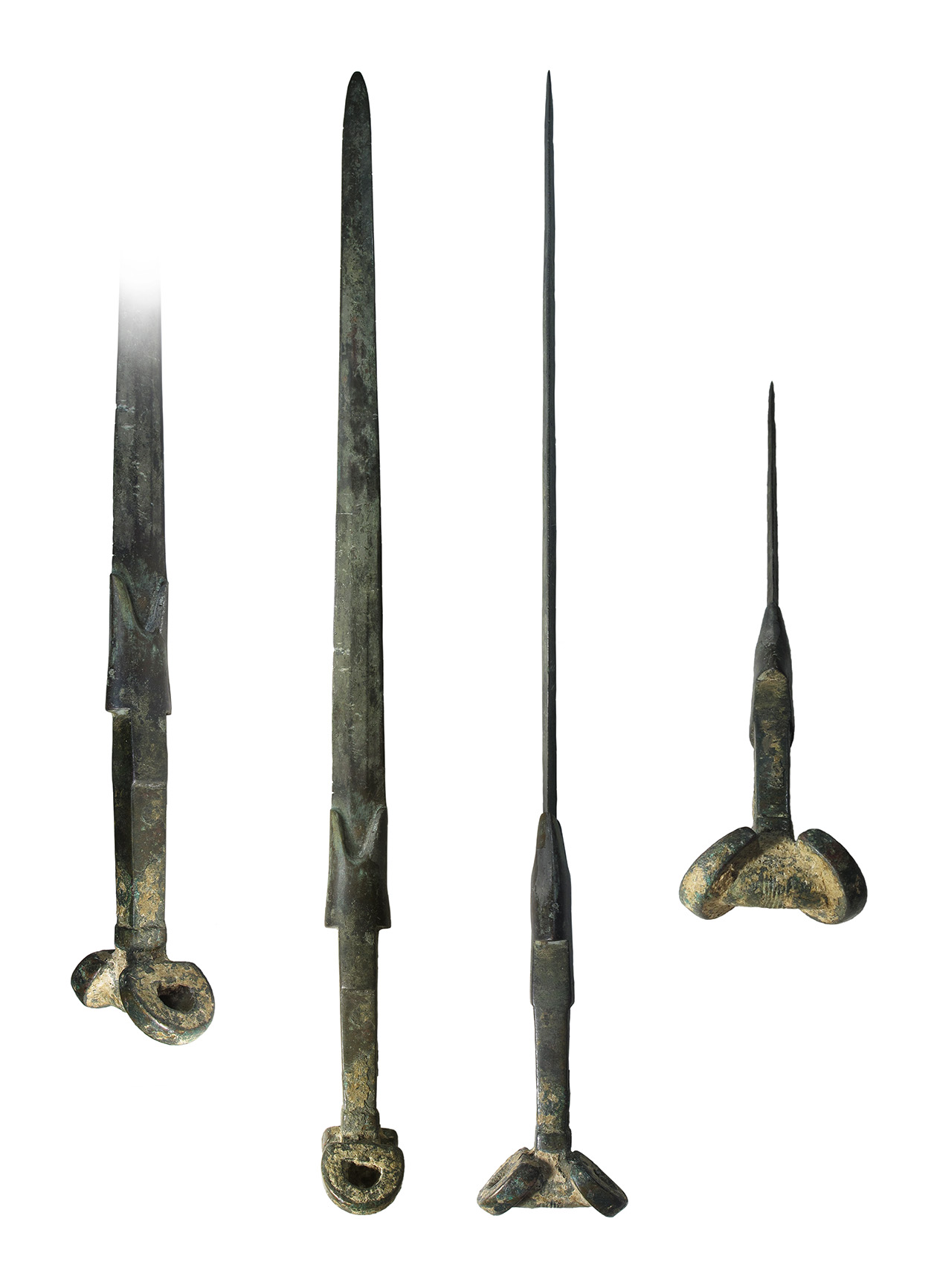 It measures 54.76 cm (21.56") - and thus makes the cut (sorry!) for being a sword and not a dirk. (If it had been 50 cm or less, it would technically be a dirk.) Here are images of similar swords from Art of Ancient Iran (by Houshang Mahboubian) and Bronze-Hilted Iron Swords from Western Asia at the Department of Archaeology, Hiroshima University (by Hisashi Nojima, Yui Arimatsu, Masahiro Fujii, Susumu Murata, Hakuhiro Ichikawa, Shohei Fujii, Naoto Morimoto). I've added the red arrows to indicate two examples from Mahboubian that are quite similar to mine. 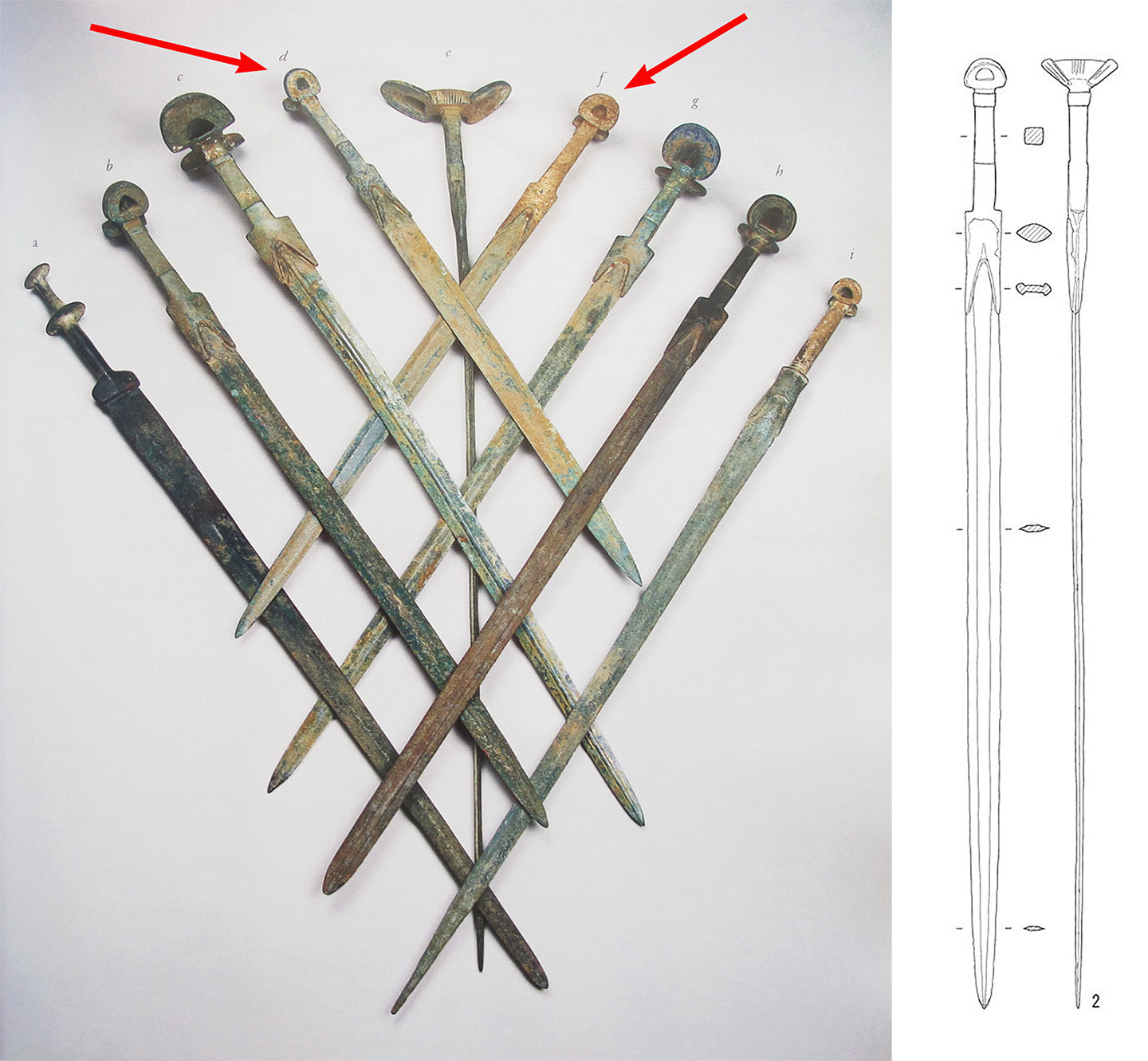 |
|
Moderator
United States
34564 Posts |
That pommel is fascinating. In between the ears there seems to be a series of parallel groves. Thoughts on whether these are decorative or else for some other purpose such as enhanced friction grip for a different part of the handle? So much to learn!
"If you climb a good tree, you get a push."
-----Ghanaian proverb
"The danger we all now face is distinguishing between what is authentic and what is performed."
-----King Adz
|
|
Pillar of the Community
United States
7067 Posts |
Thanks for contributing, Dave. Quote:
Thoughts on whether these are decorative or else for some other purpose such as enhanced friction grip for a different part of the handle? Since the grooves you mention are on the pommel, they are likely decorative rather than functional. Here's another "double ear" I own - this one is a bronze hilt that, in antiquity, was attached to an iron blade. It has many more ridges, some on the grip itself. As such, I would imagine the grooves on this example were both decorative and functional: 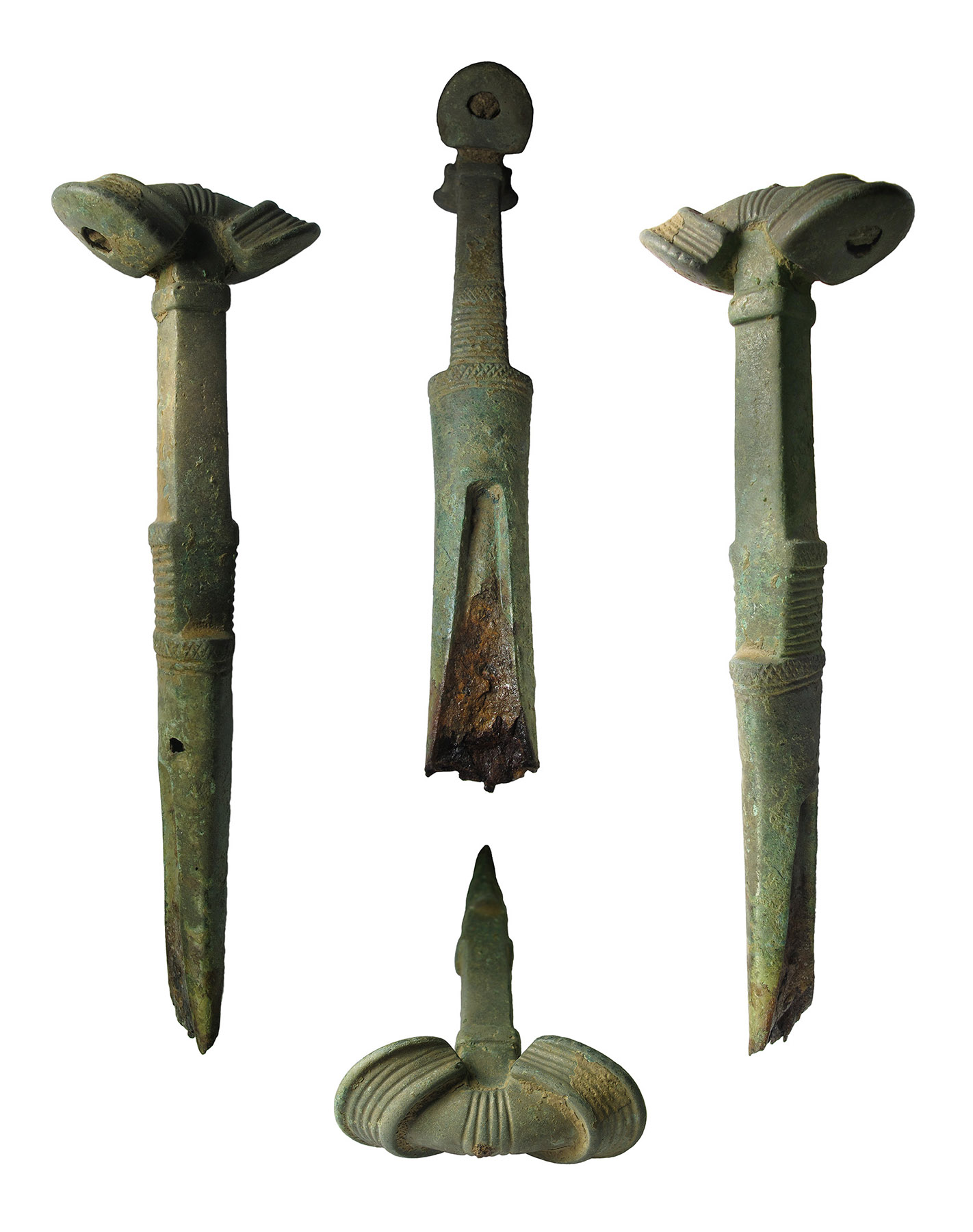 |
|
Pillar of the Community
United States
2360 Posts |
What an impressive collection of weaponry and pottery you have! It's your own museum. I only have small objects, a few oil lamps, a jug, a drinking mug, fibula, amulets, scarabs, a few roman arrowheads.
|
|
Pillar of the Community
United States
7067 Posts |
Thanks. I appreciate the comment.
|
|
Moderator
United States
23731 Posts |
Excellent addition to the collection Bob, Interesting pommel design similar to that of the Ottoman design on their Yathagan swords but 3,000 years later.
|
| |
Replies: 149 / Views: 16,058 |








 First Page
 Previous Page


 Posted 07/27/2022 6:36 pm


