| Author |
 Replies: 9 / Views: 1,218 Replies: 9 / Views: 1,218 |
|
|
Pillar of the Community
United States
1415 Posts |
A few weeks ago there was a post about scarcity and value of a coin. Here is a 1904 Bremen 2 Mark. I would grade as AU or even MS (grading advice is encouraged). 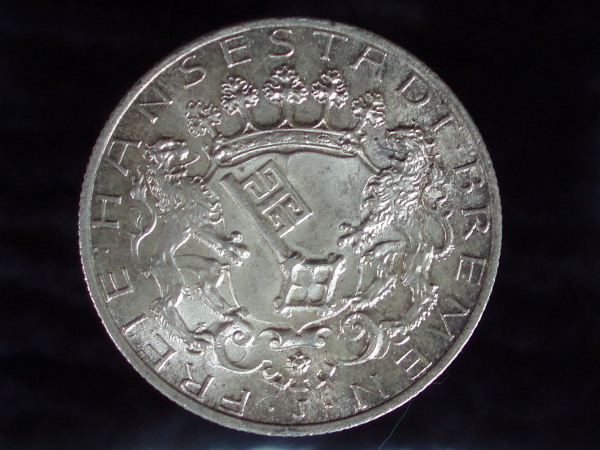 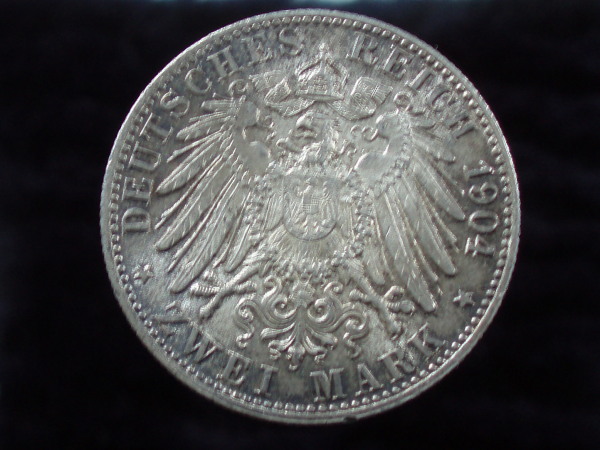 Assuming the best  I would be lucky to get $150 for it. Now only 100,000 were struck. If you compare to a US 1904S in which 550,000 were struck at a value of $1,525(AU) or 6,250(MS). It just don't make sense?  Especially to me who has the Mark and not the half dollar!  Edited by wwhitman
09/17/2008 11:22 pm
|
|
|
|
Pillar of the Community
United Kingdom
2931 Posts |
I have found that we Europeans don't get as excited about grade minutia as our US cousins. I think (?) that the whole scalar grading system is really an artificial form of rarety - introduced to encourage some activity in the coin collecting market, so there is probably an element of that going on. Also the bigger the market for a coin the higher the price - so it is also probable that the US coin is just more sought after (It does have a bigger population) - the free market at work.
I don't really grade any of my coins - I know what they are roughly worth and if they are in a broad VF or EF category and that is enough. This is probably a hangover from my focus on Ancients where formal grading doesn't really work. Way back when coins were sold by typed lists posted to collectors, a VF or a EF indicator gave a prospective buyer an idea of what he (usually a "he"!) would expect. With the ease of photography and the internet - this has really become un-necessary as you can see the picture yourself and not rely on someone elses viewpoint.
just some thoughts
|
|
Pillar of the Community
Australia
2830 Posts |
G'day, scarcity & grade are factors, but so is demand.
I collect by year, and I have noticed that American coins get much higher prices than older European coins of similar composition. I attribute this to the facts that there are lots of collectors in America; mostly they are preoccupied with their own country's coinage; and they enjoy a high disposable income.
You contrast the market value of two coins of 1904. In Australia, one of the most sought-after coins is a 1930 penny: mintage, about 3,000. In the lowest grade, this has a CV of $17,500. In the highest grade, one sold at auction a few years ago for $640,000. But there are half a dozen Australian coins that are scarcer, but have CV that is a small fraction of the 1930. The difference is that the 1930 penny has become an icon, and every two-bob lair has to have one, driving the price beyond the reach of genuine collectors. The other coins to which I referred have not been embraced with similar vigour.
Peter in Oz
|
|
Valued Member
United States
277 Posts |
My Two Cents... U.S. collectors collect U.S. coins mostly. Europeans and Australians collect local and U.S. coins. This creates more demand for the U.S. coins and therefore inflates the price. Fatcat |
|
Bedrock of the Community
United States
12437 Posts |
Quote:
Now only 100,000 were struck. If you compare to a US 1904S in which 550,000 were struck at a value of $1,525(AU) or 6,250(MS).
I am not sure where you got your mintage figures but the 1904S Morgan had a mintage of 2.3 million- definitely on the low side but not ultra rare like some dates. The problem is that mintage has nothing to do with it. Notice that it is not a terribly expensive coin through VF but it skyrockets in higher grades. More than 270 million Morgan dollars were melted by the Treasury Dept over the years, mainly due to the Pittman Act of 1918. Some years sustained heavy melting and have low survival rates due to that melting. The 1884S is one of the most glaring examples- very affordable in all circulated grades but high AU and up is very costly. It has been assumed that the vast majority of 1884S coins in mint state were melted, leaving the remaining population well circulated and common. Some other years would be 1892S, 1896S, 1901, 1903S, and the 1904S you referenced. The Treasury did not inventory any of the coins melted so many mintage figures for Morgans do not apply anymore for value. The value can only be correlated with known surviving populations on a grade by grade basis. The opposite end of this is some of the Carson City issues that sat in vaults untouched from the time of mintage to the 1960s. Some of the CCs have a surviving population in MS of greater than 50% of the total known population  but those mintages were small to being with. Demand/popularity is one component but not the most important when it comes to Morgan silver dollars. Edited by biokemist6
09/18/2008 12:49 pm
|
|
Valued Member
United States
201 Posts |
Quote:
I am not sure where you got your mintage figures but the 1904S Morgan had a mintage of 2.3 million- definitely on the low side but not ultra rare like some dates. I think he was referring to a 1904-S Barber half dollar which has a mintage of 553,000. |
|
Bedrock of the Community
United States
12437 Posts |
Oops, I do see that now  I do not know if Barber halves were melted in any significant quantity but the majority of survivors are VF and lower for all issues. Here is what Coin Facts has to say about the 1904S Barber half- 1904-S is not only the scarcest regular issue in the half dollar set, but it also has a far lower population than the 1901-S Quarter and 1895-O Dime. Its rarity is usually not appreciated until you try to assemble a set and you can't find one, even after years of looking. Trying to purchase one at auction is an eye-opening experience.
|
|
Pillar of the Community
 United States
1415 Posts |
 Sorry for not being clear about the Barber half. It just doesn't fit to me. I don't understand why humans in countries other than US would desire them so much. They are not particularity handsome. And the US in not looked upon with great affection (except for Brits and Aussies). Just curious and waiting for the revelation  |
|
Moderator
 Australia
17002 Posts |
Coin prices are the result of supply and demand. On the supply side, there's more than just raw mintage figures to consider - there's survival rates, and particularly the average condition of the surviving specimens. German coins struck in 1904 would have been hoarded up during WWI, and after the war they became obsolete - limiting their circulation time to just a decade, so many of the survivors would still be in pristine condition. US coins struck in 1904 would have been in circulation longer, with the result that a higher percentage of them would have become heavily worn and withdrawn. Quote:
I don't understand why humans in countries other than US would desire them so much. They don't. High prices for US coins are created purely by local (US) demand. Whatever demand exists for key date US coins outside of the US is normally generated by expatriate Americans living abroad. Demand for US coins is high because of two factors: - The population of the US is quite large; - The percentage of the population in the US that are coin collectors is much higher than in other countries. From what I can tell, I would classify Germany as a country that may be quite high in terms of percentage of population that collect coins, but still nowhere near the US, and the total population is lower, too. Add to this the fact that the German / German States series is much more complex than the US series, and the end result is far lower demand (and therefore lower price) for coins of equivalent scarcity. Don't say "infinitely" when you mean "very"; otherwise, you'll have no word left when you want to talk about something really infinite. - C. S. Lewis
|
|
Valued Member
Italy
244 Posts |
as already said, prices overall depend from market question and answer, I'll give also a couple of examples, last coins from western europe countries were low quoted, probably only local countriy collectrs collected them by year, after euro mintage the coins quotation in the same countries for new euro coins started higher, probably some speculation contributed; another example is related to coins quoted low but in auction they got always higher prices,an example is Romania gold coins, w/ the exception of a couple of 20 Lei dates, all the other in auctions close w/ at least double the base price, so look at catalogue prices but don't forget auction assignments.
|
| |
Replies: 9 / Views: 1,218 |
|










 Posted 09/18/2008 04:23 am


