| Author |
 Replies: 11 / Views: 2,187 Replies: 11 / Views: 2,187 |
|
|
Pillar of the Community
United States
3499 Posts |
|
|
|
|
Pillar of the Community
United States
1156 Posts |
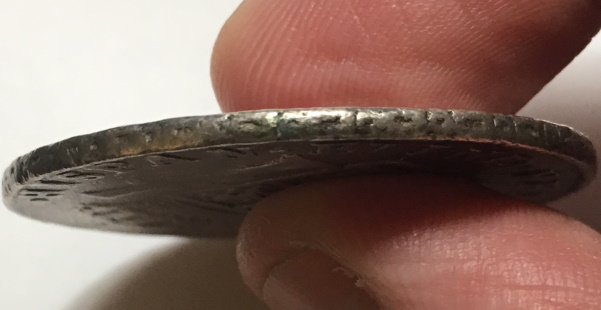
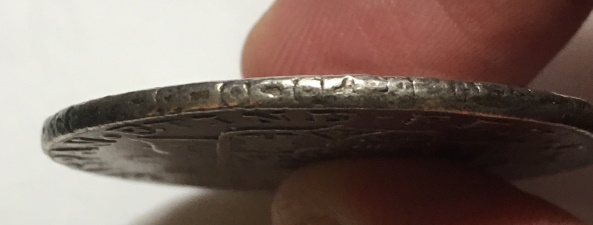
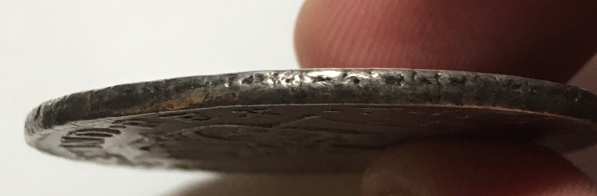
So what makes you certain it is a counterfeit? If it is 90% silver and very near the correct weight (which can be excused by light circulation wear) with the correct design elements, what are the defining counterfeit features? I can't tell from your pictures whether the edge design offsets are equal and at 180 degrees. Can you?
|
|
Bedrock of the Community
United States
12477 Posts |
I'm no expert, but I am also wondering what, more specifically, makes you think it's fake? It seems slightly different than one I found for sale, but that's all I know: 401818969962In Memory of Crazyb0 12-26-1951 to 7-27-2020
In Memory of Tootallious 3-31-1964 to 4-15-2020
In Memory of T-BOP 10-12-1949 to 1-19-2024
|
|
Pillar of the Community
 United States
3499 Posts |
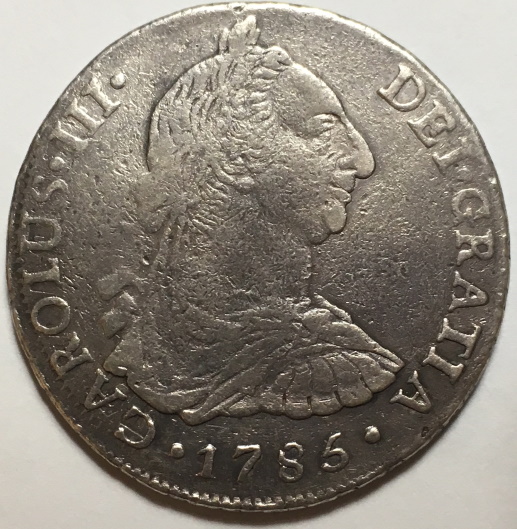
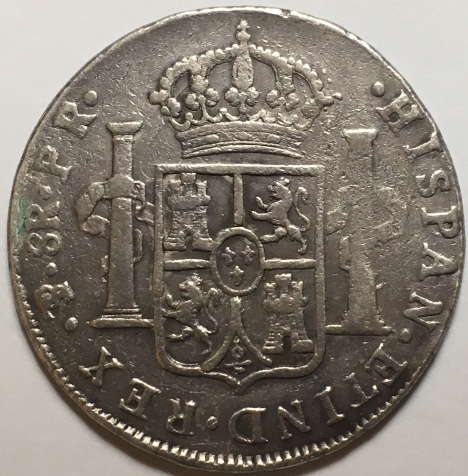
jgenn & spruett001 - thanks for the responses. Mostly I suspect that this coin is a counterfeit since the details of the kings head feel a bit "off", the lettering seems inconsistent (the very large "D" of "IND", "PR" on the reverse, etc), the weird denticals around "CAROLUS," and the overall roughness of the surface.
Regarding the overlaps, the edge seems to be too beaten up to properly locate the two overlaps 180 degrees across from one another.
Edited by Archraz
10/16/2019 10:24 am
|
|
Pillar of the Community
United States
1801 Posts |
Hard to tell from a photo but the coin looks to me like severely cleaned land burial coin. The weird surface looks like land burial corrosion and the coin looks scrubbed. As for the large D in IND, that is a common 8 reales feature. The denticles look like a small planchet that was struck slightly off center and only caught the denticles along the one edge.
|
|
Pillar of the Community
United States
3499 Posts |
jfransch - Thanks for your response. I suppose that there are some similarities between my coin and the slabbed example linked by spruett001. However, what do you make of the weird "PR" on the reverse and the weakness of the right pillar? Is this all just due to corrosion from being buried?
|
|
Pillar of the Community
 United States
8056 Posts |
Quote:
what do you make of the weird "PR" on the reverse and the weakness of the right pillar I am not an expert on this type, and have looked very hard at other examples near this date, and the blocky PR is the only thing I see that makes me wonder. There are examples with a weaker and lower right pillar that are certified: https://www.coinarchives.com/0ee44f...age22287.jpgI cant imagine that a forger would get everything else right but the PR? Edited by tdziemia
10/16/2019 10:44 pm
|
|
Pillar of the Community
United States
3499 Posts |
tdziemia - Thanks for the help. Yes, I too am now starting to think that this may be an authentic - albeit excavated - coin. However, as an authentic piece, how could we account for the weird, blocky PR? Could this be a damaged or re-cut die?
|
|
Pillar of the Community
United States
1156 Posts |
My observation is that the bottom third of the coin is in pretty good shape -- normal looking fonts and very little pitting of the surface.
I would expect a ground effect to be more uniform. Perhaps we are seeing a rusted die that is more pronounced at various spots in the top two thirds.
|
|
Pillar of the Community
United States
5362 Posts |
Archraz The coin is unlikely to be a circulating counterfeit if it is 90% silver. The only 90% silver counterfeits made in the 1800's were Mexican types. They commanded a very significant premium from Chinese markets. The other mints never commanded a premium that would have caused counterfeiters to start the presses. There must be a profit margin for any counterfeit to be made. That was a critical point I tried to make in my book. Here you have a mint (Potosi) that the Chinese did not trust. (Neither did the US by the way). There was NO premium paid for the Potosi coins by anyone. There is in fact no market at all for a 90% silver copy of a coin like this. So if it is not a likely target for counterfeiting what would it be? Today due to numismatic values there is adequate incentive for a forger to make a coin like this in 90% silver. So if it is not genuine it would have to be a Numismatic fraud. As a Numismatic fraud it would be a melt item. I am NOT aware of anyone having made or currently making a 90% silver copy of any Potosi coin. They certainly could be made but then there should be clues that support that contention. This coin is so damaged that the edge provides little clear data. It kind of looks like a two segment edge punch might have been used to make the edge die, but that is not conclusive because of damage. A two segment punch would likely be wrong (I have not researched the matrix blocks for Potosi) because all of the matrix blocks I have seen have a three segment punch set up. I would check to see if any pictures of the 8R matrix block still exist for Potosi. Regarding the "odd looking PR", I would only caution that of the major Spanish Colonial mints Potosi created the poorest dies. There is a lot of variation in spacing in particular. Looks like the die setters were not very good at all. The shield segments are poorly joined, letters tilted, details poorly applied etc. In the Heritage Archives I located a very poorly crafted die for a 1785 Potosi 8R. https://coins.ha.com/itm/bolivia/wo...nail-071515" target="_blank" rel="nofollow"> br / https://coins.ha.com/itm/bolivia/wo...bnail-071515Even though the die work of this coin is horrible the font of the letters P and R is consistent. So how do we account for the odd looking PR? And also the font used for the R in the denomination. Those three letters do not match the font. They may be re-set punches? They may be the result of die damage. They may be the product of die over use. The bases of many letters are bifurcated which most experts link to die wear caused by extended use. I would treat the coin as genuine/damaged until a more definitive test is done. I would at some point suggest a test using a lab XRF to see if arsenic is present as a trace contaminant. That test might give a more conclusive answer as to authenticity but the cost might exceed the value of the coin itself.
|
|
Pillar of the Community
United States
3499 Posts |
jgenn- Thanks for the help. I was starting to wonder if there were die issues.
swamperbob- as always, you have provided amazing info. Thank you very much! It is always appreciated.
|
|
Pillar of the Community
United States
4622 Posts |
Also of interest is this: https://archive.org/details/1861Min...ort/page/n37In the 1857 act that made foreign coin no longer legal tender, the mint director was directed to assay and report on the fineness of commonly found coins. (Note that not legal tender meant the US wouldn't pay the foreign coins back out, they could be turned in for silver value but would be recoined into federal issues of standard fineness) but they still circulated... -----Burton 50+ year / Life / Emeritus ANA member (joined 12/1/1973) Life member: Numismatics International, CONECA Member: TNA, FtWCC, NETCC, EveryCountry (online) coin club Owned by three cats and a wife of 40+ years (joined 1983) Author: 3rd Edition of the Sample Slabs book, https://www.sampleslabs.info/ |
| |
Replies: 11 / Views: 2,187 |
|












 Posted 10/16/2019 02:46 am


