| Author |
 Replies: 15 / Views: 1,953 Replies: 15 / Views: 1,953 |
|
|
Pillar of the Community
United Kingdom
1168 Posts |
This Constantius (15mm dia) coin was amongst some others. The obverse looks like a good clean strike, but the reverse looks rather odd. The legend and mint mark look "blobby", for want of a better word. Is this indicative of a worn die, or is it more likely to be an attempt at making a crude copy? Any ideas? Thanks, Jim 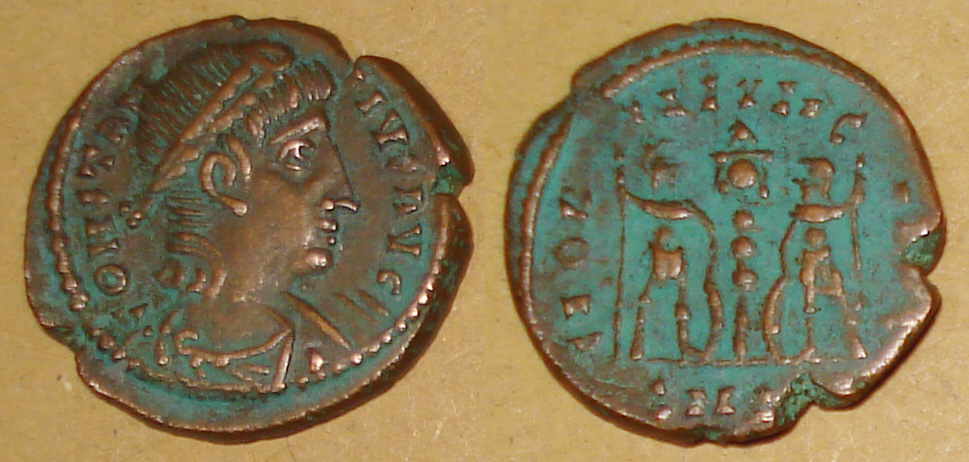 |
|
|
|
Moderator
 United States
23731 Posts |
Looks to be an unofficial strike .
|
|
Pillar of the Community
United States
1122 Posts |
I haven't seen a portrait quite like that. The legend also seems a bit off and unclear, in fact, the "N" runs right into the head.  I wouldn't say barbarous, but I agree with echizento - an unofficial issue. Edited by travelcoin
12/20/2019 8:16 pm
|
|
Pillar of the Community
 United Kingdom
1168 Posts |
Thank you for the replies @echizento and @travelcoin.
I'm really showing my ignorance here, but what is an unofficial strike?
Jim
|
|
Pillar of the Community
United States
1122 Posts |
|
|
Pillar of the Community
United States
1554 Posts |
In the context of 4th-century Roman bronzes, "barbarous" and "unofficial" have essentially the same meaning: 'contemporary counterfeit'. "Barbarous" should not be taken to imply "barbarian", only that the artistic style is un-Roman. "Unofficial" means the product of other than an official Roman mint. For a full discussion, see Pierre Bastien (1985), 'Imitations of Roman Bronze Coins, AD 318-363', American Numismatic Society Museum Notes 30, New York, pp. 143-177. Museum Notes and most other ANS publications can be accessed free of charge at http://www.hathitrust.org. Edited by Kushanshah
12/20/2019 8:51 pm
|
|
Pillar of the Community
United Kingdom
1168 Posts |
@travelcoin. Thanks again. Yes, that thread was really interesting and I have learned a lot too. (Well, that is what I hoped to do when I joined.) The coin was found in England, but I guess that it could have come from anywhere.
@Kushanshah. It is good to know that "barbarous" and "unofficial" have the same meaning as contemporary counterfeit, many thanks for that. Up till now I had thought they all had different meanings, and I did think that "barbarous" meant made by barbarians. It is much clearer now.
Thank you both for the links.
The coin did confuse me, as the portrait seemed very well executed, but the reverse was very crude in comparison. I am glad I posted the coin now, as it has been quite a leap forward.
Cheers, Jim
|
|
Pillar of the Community
United States
1554 Posts |
A couple of additional comments. Quote:
The coin was found in England, but I guess that it could have come from anywhere. Actually, according to Bastien, imitations of the 'Gloria Exercitus' type(s) are found almost exclusively in Britain and Gaul! Quote:
and I did think that "barbarous" meant made by barbarians. It is much clearer now. That was also much of the early thinking. By the mid-20th century, however, it became clear that imitations of this period were the result of economic forces within the empire. The barbarians north of the limes would have had little use for coined money until a later period. That being said, the citizens of the empire in the 4th century (outside of Italy itself) were largely of 'barbarian' stock: Britons, Gauls, etc. So to that extent, "barbarians" as participants in the imperial economy must have played some role in the illicit minting of unofficial of coins. The imaginative attributions one sometimes sees in the trade attached to 4th-century imitative bronzes, e.g. "Uncertain Germanic Tribes", are more marketing than science. Edited by Kushanshah
12/21/2019 12:15 am
|
|
Valued Member
United States
66 Posts |
Official strike or not, Constantius II (rather than his grandfather, Constantius). (I like the greenish-blue color and the detailed, good-looking portrait.)
|
|
Pillar of the Community
United Kingdom
1168 Posts |
@Kushanshah Thanks for the additional information, and it is interesting that most of these imitations were found in Britain and Gaul. Trust the Brits to be amongst the early forgers! I can understand that anyone not of Roman stock would be classed as barbarian, and that sense of elitism survived in many forms over the next couple of millennia.
As the French say, "The more things change, the more they remain the same."
@pilegicvs I too was surprised at the detail in the portrait, but on turning the coin over it was obvious that something wasn't quite right. I still like the coin, and will have to add another category to my collection for unauthorised strikes.
|
|
Pillar of the Community
United States
3495 Posts |
I believe we must remember the economic system of the Late Roman Period
The primary method of money entering the local economies had always been the payrolls made to the soldiers and imperial bureaucracy
But by the late empire the gulf between the guys on top and the people doing the laboring had grown immense
Immensely wealthy land owners had legions of peasants to pay and could not always count on coinage from outside sources
So they did what was expedient
They issued their own
As long as the coins gave the emperor his due I would doubt anyone was too offended
Remember that the emperor took his tax payments in gold
No fool he !
These coins were probably more like German Notgeld
Not counterfeits per se
Local issues meeting the local needs
|
|
New Member
Australia
18 Posts |
I think it is an offical coin from the Alexandria mint; its 'blobby' lettering is quite distinct and unique for this period
|
|
Pillar of the Community
United Kingdom
1168 Posts |
@FVRIVS RVFVS A salient point, and one we must consider. Taking his tax payments in gold was the sensible thing to do.  @kiaora Another interesting point, though I don't have much from the Alexandria mint to compare it to. The coin below came from another lot, and the inscription appears to end with IVNN. I haven't seen any other coin with a inscription ending like that, so possibly another unofficial issue? 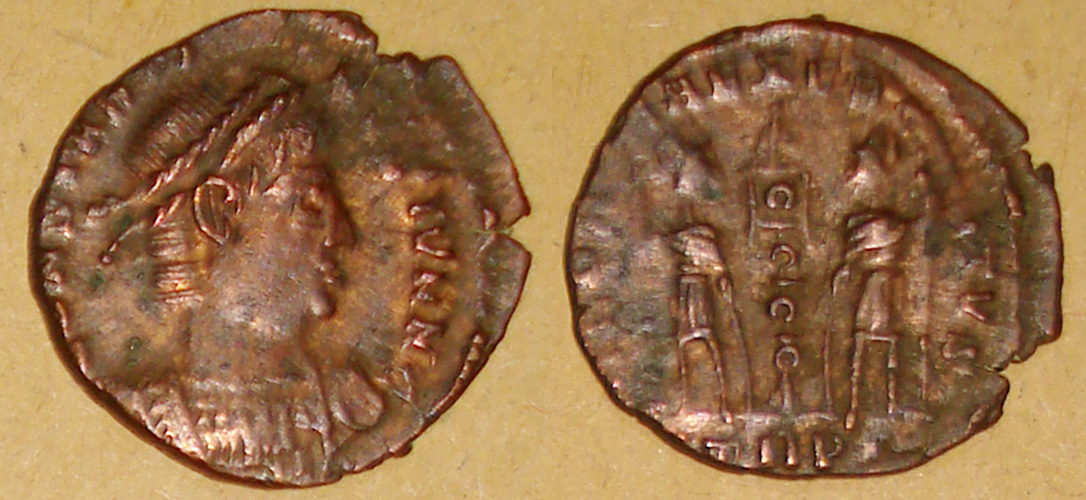 |
|
New Member
Australia
18 Posts |
I'll post my example of your first coin once I take a photo.
Your second coin is from Trier. The ending IVN NC is a standard variant for Constantine II before 337, when he was Caesar (IVN = Junior, NC short for Noble Caesar). After Constantine's death in 337 the titles for his sons Constantine II, Constantius II and Constans changes from Caesar to Augustus (= AVG like on your first coin of Constantius II)
Edited by kiaora
12/24/2019 11:20 pm
|
|
New Member
Australia
18 Posts |
Here's my example of your first coin, reference is RIC volume 8, number 19. The style of the obverse in particular is very similar 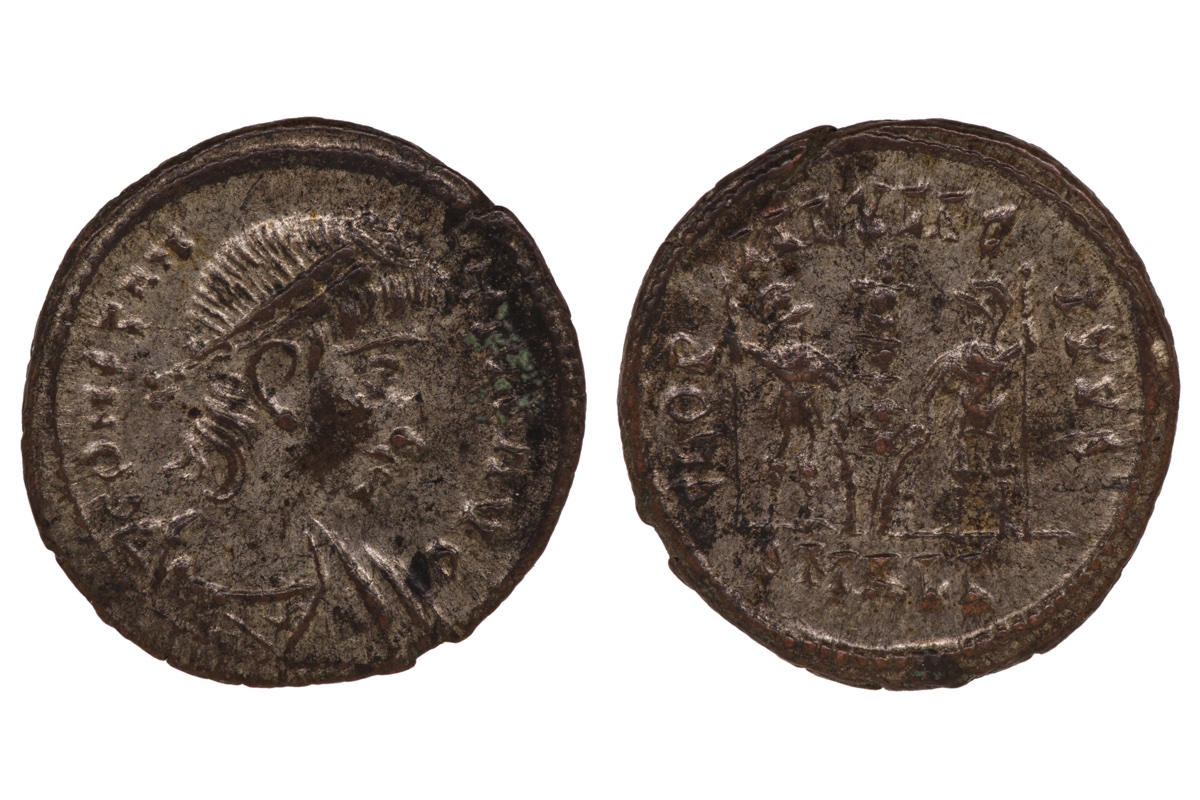 |
|
Pillar of the Community
United Kingdom
1168 Posts |
@kiaora I completely missed the fact that there was a "C" at the end of the legend on the second coin. (My coin is pretty worn.) Thanks for pointing it out. I have just been looking at a coin of Constantine II Junior on ebay with an SMANS mint mark, and it does have a similar "blobby" reverse inscription. I hadn't noticed any coins like this before. Thanks, Jim |
| |
Replies: 15 / Views: 1,953 |
|










 Posted 12/20/2019 8:15 pm


