| Author |
 Replies: 31 / Views: 3,661 Replies: 31 / Views: 3,661 |
|
|
|
Pillar of the Community
 United States
7123 Posts |
LOL The point is that an MS coin even with dings and scuffs from bags and handling cannot fall from the catagory based on those things alone .
it takes wear on the details to move the coin down into the AU details and then further wear to move the coin down into the Extra fine details catagory and so on down the line .
MY point is if the details of a particular coin show it to be a certian level at what point would it be correct to pull it down into the next lower bracket based on something outside the wear on the devices on the coin ?
are a couple of dings on a coin which has obviously circulated and should have some dings enough to move it down or should the coin be judged on the wear on the devices ,, by the way if you believe PCGS this is what they do in their guide .
they use a device wear pattern to determine the grade .
do you agree with that methodology ?
|
|
Pillar of the Community
United States
812 Posts |
The ever popular "net grading" question, eh?
In my opinion an AU-50 with a couple small gouges next to the date is "an AU-50 with a couple small gouges next to the date," not "EF-45."
Net grading is too whim and opinion driven for my taste. 'Regular' grading has enough of that already.
|
|
Bedrock of the Community
United States
20057 Posts |
Quote:
are a couple of dings on a coin which has obviously circulated and should have some dings enough to move it down or should the coin be judged on the wear on the devices ,, by the way if you believe PCGS this is what they do in their guide .
they use a device wear pattern to determine the grade .
do you agree with that methodology ?
Great discussion! You have to look at the problem PCGS and other TGP's have. They must be as consistent as possible so they have no choice but to technical grade. From what I've seen, they start with typical device wear to determine the grade category (G, VG, F, VF, EF, etc), then they further adjust within that category based on dings, scratches, color, etc. I don't think I've seen an example where they've dropped an entire category based on those. However, us collectors grading tend to adjust our grade category based on what we see. Personally, I have no problem dropping down a category if the coin warrants it.....especially when I'm the buyer. LOLOLOLOLOLOL  |
|
Pillar of the Community
United States
7123 Posts |
I think that the normal collector of raw coins face the same problems as the professional , I mean trying not to interject budgetary considerations into the grading of a key date (Market grading ) trying to keep personally unappealing attributes of a certain circulated coin (net grading) from tainting the science and art of grading is difficult for everyone , I know it is for me .
This discussion is more for myself as I work to refine my own grading experience and I appreciate all the comments .
Thad ,I really appreciate you here on the forum your desire and approach to grading and collecting serves as a pattern which is without a doubt having an affect on the collectors here and the hobby as a whole .
|
|
Pillar of the Community
United States
2600 Posts |
Help me with my thinking on this.
We grade coins, not to create heated discussions about the slight wear on the wheat grains on a coin but rather to establish a consistent analytical baseline for comparison. It's purpose is to help establish worth. I have consistently heard advise here on the forum to this effect " it is technically a MS-63 but because of a weak strike or color or eye appeal or what ever your choice" the suggested course is wait and find a better example. If these attributes are that important, should they not more directly affect the grade? I am sure I grade too harshly, but for me, if one of these secondary considerations is changing the coins value it also changes it's grade, even from one category to the next (MS to AU).
Jim
|
|
Pillar of the Community
United States
812 Posts |
Jim, I see the merit in the "net grading" concept, as it relates to value; but here's my problem with that concept: Assume Two Cents, a 1914-S and a 1931-S, both in a technical AU-50 grade. In AU-50, they are worth approximately the same. Let's assume they have the exact same problem, perhaps a distracting scratch, and we think that this scratch makes the coin half as valuable. Using net grading, the 14-S would be net graded VF-30 or EF-40 (around half the value of the AU-50); the 31-S would need to be net graded AG-3 or lower to cut its value in half. That sums up my problem with "net grading." While it can be reasonably applied in some cases, it falls apart in other cases. |
|
Pillar of the Community
United States
2600 Posts |
Thx, Bilbo. Your example brings things to light and I need to spend some more time thinking on this, now.
Jim
|
|
Pillar of the Community
United States
7123 Posts |
Jim This is more about circulated coins than Mint state coins but some of the principles apply to both . for circulated grades it is wear on the devices which determine the grade , most other attributes of the coin aside , trying to pin down a grade when personal opinion on color ,strike (which by the way loses its power at a certain point in circulation ) is very hard . the more clinical the approach the better the less person preference which is interjected into the grading practice the more consistent the outcome and thus the more consistent the market becomes . net grading is almost always influenced by personal opinion ,that nick in the field the dent in the letters etc. my point is if the coin has a technical grade of EF-45 based on the wear of the devices then the grade should not be able to fall from the EF category based on a couple of dings in the field . it may fall to EF-40 but for it to fall into the VF range then it does a dis service to the technical aspect of device wear grading standard which we use constantly and in fact is what is published in guides such as PCGS grading guide and other sources like photo grade which use a device wear baseline . what this does to the market is create rarities of coins in certain grades and causes the value system to be skewed to a certain degree within each series . take my coin which started this discussion . the coin exhibits text book EF-45 wear patterns , it did not take long for it to be down stepped because of the couple of dings in the field now the different between an EF-45 and an EF-40 for this particular coin is nominal and not really an issue ,but we all know that the issue becomes much more apparent on the big brothers of this coin . and if we extend the concept to the 16-D Mercury dime then the difference is huge about 3000.00 by RedBook pricing and we know that that coin in the market trades by demand and RedBook has no adjustment for such market place phenomena. Having said all that what I'm really trying to say is buy the coin based on the personality of the coin , but grade the coin based on the clinical aspects interjecting as little of that buyer into it as possible . consistency counts and affects the hobby in more ways than we can know . |
|
Bedrock of the Community
United States
20057 Posts |
Metalman, thanks for the comment my friend, I appreciate it. Now...lets throw another couple varibles into this grading equation: die wear and strike. These two things make grading a helluv a lot harder than most any other aspect of grading IMO. From what I've seen from the TGP's die wear and strike once again mostly only come into play to tweek the grade within the category. It really seem to come into play at the Gem level (MS65 up). This is a HUGE problem in grading Lincolns. Let's take the Denver issues for example: Every 1922D I've seen TGP graded is purely technical. They are not graded on wear at all, but "apparent wear". IMO, it's not fair to grade this series on die wear. To be consistent in grading, a coin should only be assigned a grade category based on actual, physical wear. A coin that leaves the mint and is immediately stashed away by a collector is MINT STATE. However, if extreme die wear is present, i.e. the details on the obverse are lacking, the wheathead lines are non-existent and the wheat stalks are nearly smooth with no detail....DOES THAT JUSTIFY A GRADE OF VG?  Look at this coin for me people. Tell me what grade it is and what grade you think PCGS would assign: Image Insert: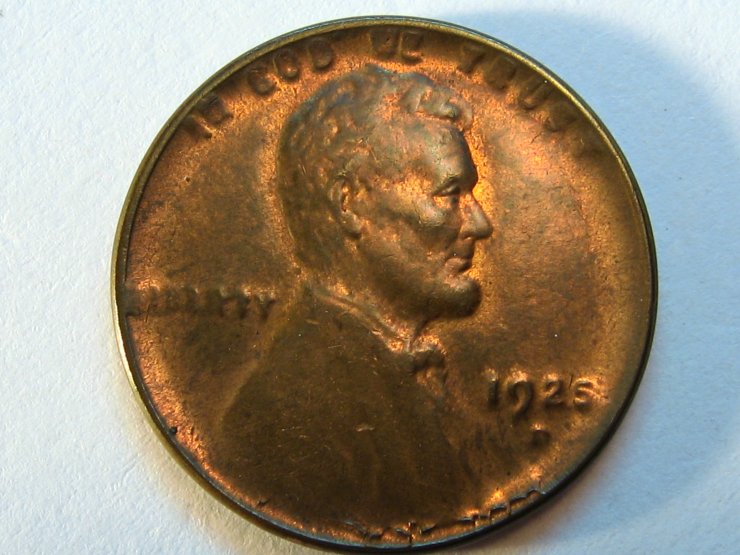 |
|
Pillar of the Community
United States
7123 Posts |
Thad while I can appreciate your point the die state of a coin plays significantly into the technical aspect of a coins grade , but mostly and largely in the Mint state grades and ever so much more signifcantly into the very high mint state grades . the pudding is all in the details of the devices . you know and I know and most others know all to well how the minute details begin to deteriorate from the first coin struck ,each new set of dies may only produce what could technically be called fully struck coins for about the first 25 or 50 coins before some of the minute detals begin to smooth ,,this is true even in proof production . as for your coin PCGS is one of the worst IMHO for not grading consistently they are the major player in market grading and that skews their numbers (which by the way I believe is part of their business plan ) to keep pops either low or high depending on the date ,mint and submitter of the coin. this coin that you have pictured while its only the obverse shot shows a very late die state obverse ,this does not mean that the reverse is the same which was the case with the 22-D /no D ,,thus several different die pairs with only one obverse die displaying no D at all and several different reverses which affect the value of the no D at all obverse die which they were paired with . but this 1925 , while I know that the die state was not good from the start does show wear on the high points of the devices My grade would be AU-50 PCGS because of their grading and details assessment for a coin which is not a key date and not one generally associated with a die weakness and the 2 seconds which the graders take to determine the grade and morethan likely not sufficiently versed on every date and every series would give this coin based on the obverse alone a VF-35 grade . Now here is one for you ! LOL I bought this mint set specifically for this visual and they fall directly into your die state conversation . these coins were contained within the same mint set what grades would could you give to them . 1991 -P and D Lincoln cents . 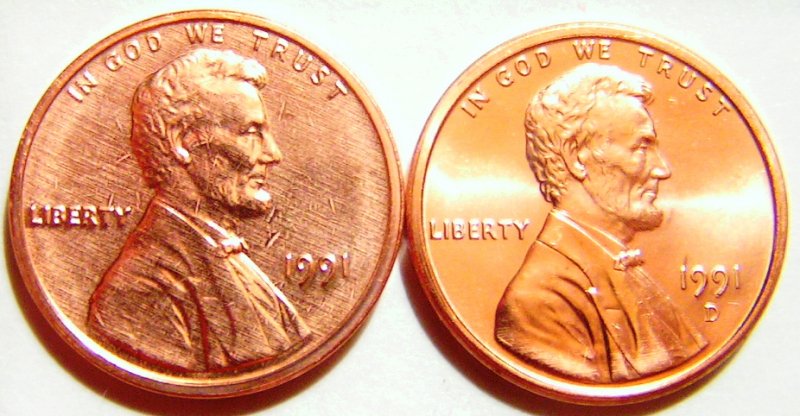 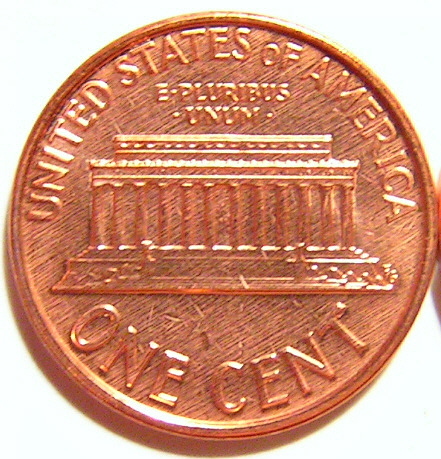 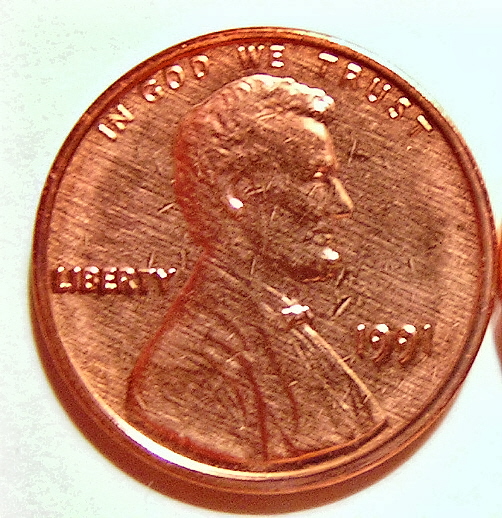 |
|
Pillar of the Community
United States
666 Posts |
61 and 66+ respectively (once it gets above 63 I'm at a total loss... I only see a couple of minute scratches on it... If you said 69 I'd believe it, if you said 66 I'd believe it)
|
|
Bedrock of the Community
United States
20057 Posts |
OMG at the 1991's! LOLOLOLOLOL
How strange that the P mint coin is worse than the D mint! With Lincolns (all years) the P mint coins are normally superior. The P I'd probably grade between 60-62 and the D mint is a minimum 65. What a funny example of inter-mint set coins you have there!
Lincoln Cent Lover!VERDI-CARE™ INVENTOR https://verdi.care/
|
|
Rest in Peace
United States
5375 Posts |
Why would the 91 grade any better than MS-60? It looks like it was put through a coinstar machine 500 times....
|
|
Pillar of the Community
United States
666 Posts |
I gave it a 61 for remaining luster. In hand it might go lower.
|
|
Valued Member
United States
131 Posts |
A great discussion that I wish I had seen earlier. I think there's a distinction between knocking a coin down from MS to AU compared to from AU to EF. MS means no wear, all other grades means circulated so there is a specific boundary between circulated and uncirculated that does not exist between different circulated grades. I think I follow the comments between net grading and technical grading but to me, I believe ignoring nicks and dings and scratches in determining whether a coin falls on the AU side or the XF side simply does not make sense. Wear may be the most important factor in assigning a grade but it should not be the only one in determining whether a coin falls AU or XF or whether a coin falls XF or VF. Maybe it is a flaw in the 70-point system and we could assign one number for wear and a separate number for flaws, strike, etc....
|
| |
Replies: 31 / Views: 3,661 |








 First Page


 Posted 10/16/2008 1:34 pm


