| Author |
 Replies: 8 / Views: 1,551 Replies: 8 / Views: 1,551 |
|
|
Pillar of the Community
United States
581 Posts |
1797 Great Britain Penny SOHO Mint Cartwheel KM# 618 Found this giant coin by dumb luck. I did not know these existed. Requesting some help from those in the know. Did I identify it correctly? Any info would be great. Thanks in advance folks! Pics are not good and they are extreme high resolution. Will post quality pics ASAP. 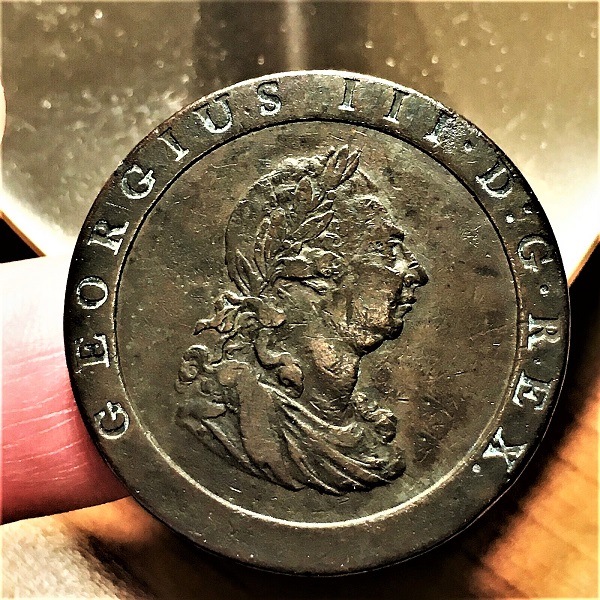 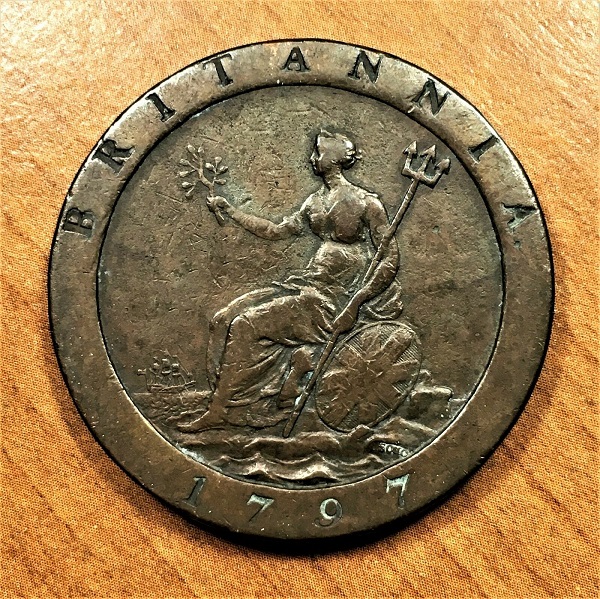 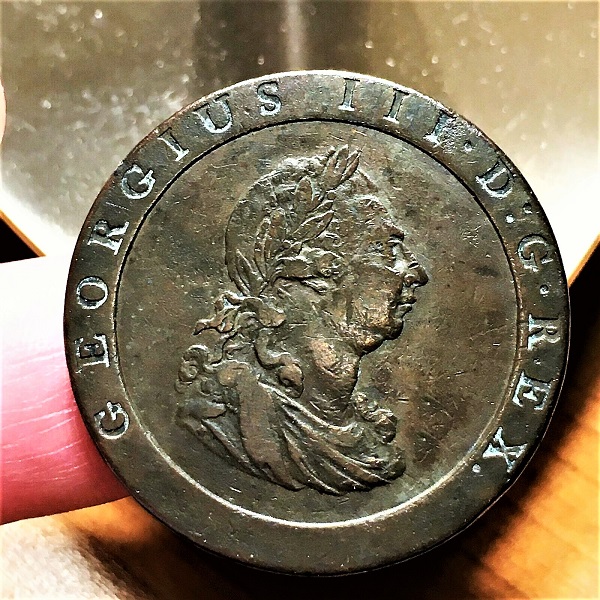 |
|
|
|
Pillar of the Community
United Kingdom
945 Posts |
Nice coin!
Does appear to be the 1797 Penny, although the size and weight would confirm. The twopence from the year looks very similar, but by the proportions of your one, Penny looks to be right. The twopence is double the weight, so even bigger and more impressive!
Yours is in pretty decent condition. They are not scarce coins but saw circulation until 1860, so most are very worn.
There are two principal variations - 10 or 11 leaves in the wreath on the obverse. (I can't be sure, but I think yours is the slightly scarcer 11 leaf variety.)
I hope that helps.
|
|
Pillar of the Community
 United States
581 Posts |
It certainly does help and thank you PaddyB.
That's pretty incredible that the twopence weights twice as much. I did not know that.
|
|
Bedrock of the Community
Australia
21792 Posts |
Despite the obvious dings and wear, this coin is in well above average condition for the type. Rims in excellent condition, and that is unusual.
They were made out of pure copper, and pure copper is soft. Thus, the coins are more prone to damage and wear than bronze coins.
Matthew Bolton of the Soho Mint in Birmingham (UK) intended that these coins be used for standard weights of 1 ounce and 2 ounces, and have true intrinsic value for weight.
The reason for true intrinsic value for weight is that no one would be able to counterfeit underweight coins for a profit
The copper price rose, and so the next issue in 1806-08 had to be reduced in weight.
|
|
Pillar of the Community
United States
581 Posts |
Awesome sel_69l and thank you.
I have been reading your posts for years now and you really know your stuff in this arena so you're probably the best person to ask the following question.
In regards to the subject focus of your response was this a precursor and/or a stop-gap measure prior to the Great Recoinage of 1816?
P.S. - Yes. The pun was intended.
|
|
Bedrock of the Community
Australia
21792 Posts |
The Great Recoinage was in response due to the fact that during the previous 100 years Coinage of the Realm was badly neglected. The proportion of very worn and underweight genuine coins was almost 100%. Businesses, in response to this started making their own ( mostly underweight tokens, which became to be accepted by the public in general. Besides the tokens, counterfeit coins also proliferated in general circulation.
A comprehensive Government reform of the coinage became a necessity, hence the Great Recoinage of 1816.
|
|
Moderator
 Australia
17006 Posts |
The issue of these "cartwheel" coins was a response to the British having a chronic shortage of small-change coinage, or coinage of any kind, due to decades of being on a war footing - they had the American Revolution, then the French Revolution, then the Napoleonic Empire. These coins were an attempt to restore both quality and quantity to British coinage, thanks to the impressive capabilities of the James Watt steam-powered press. Boulton had been lobbying the government for years for permission to use his machines to strike official coins, using token production as one means of convincing people that their product would be more than satisfactory.
Don't say "infinitely" when you mean "very"; otherwise, you'll have no word left when you want to talk about something really infinite. - C. S. Lewis
|
|
Pillar of the Community
United States
581 Posts |
Thank you both very much.
Well I am certainly glad I created this post.
Since I had never seen one of these before combined with the circumstances in which I found it I almost tossed it away. Until I (literally) picked it up.
Thanks again and I most certainly appreciate you both sharing your knowledge.
|
|
Pillar of the Community
4628 Posts |
Beautiful coin - I would say VF to gVF condition, which makes it fairly scarce.
Agree with others about Great recoinage. Until the 1750s, the coinage of silver and gold at least was fairly regular, but after the 1757/8 era issues of all coins except Fractional guineas for some reason became spasmodic.
For instance in George III's reign, the 6d was only issued in 1787 and then 1816 onwards. A one off issue of shillings came out in 1763 known as the "Northumberland shillings" possibly as the Duke bankrolled it. Then more shillings in 1787 and the scarce Dorien Magens one in 1798.
Even copper was spasmodic with halfpennies only really being issued in 1771/6 and again in 1799, 1806 and 1807. The cartwheels came at a time, when no Crowns or Halfcrowns had been issued since 1750/51. It was the equivalent now of using coins dated no later than 1972!
French revolution, the loss of America and then the threat of Napoleon did not make anything easier for coining. In 1798 and 1804 Spanish pieces of 8 were overstruck with a cameo of King George and so called "Bank Tokens" appeared in 1811 for odd amounts like 5d, 10d (Ireland), 1/6, 3/- and 5/6 value Bank of England dollars and counterstruck Spanish pieces of 8.
Even Maundy coins were affected with them appearing only every 3 to 4 years on average.
Then in 1816 it all changed - Napoleon's threat was gone, the country was expanding and getting wealthy - there was access to silver deposits mostly in Africa and they finally splashed out on new steam coin presses and a new mint at Tower Hill and in the 1816 - 1820 period you had 5 times as many coins issued than in the whole 1760 - 1815 period.
I wish there was a book about this.
Also I notice issues of copper coin before 1860 were not that reliable anyway. I think only a few coppers were issued in most years of KGIV and KWIV and most of the Victorian copper coins I see are 1842 - 1846 and 1853 - 1855. By copper I am not referring to the "Bun head bronze coins of 1860 - 1901 which were incredibly common in comparison"
Edited by Princetane
04/06/2020 8:54 pm
|
| |
Replies: 8 / Views: 1,551 |
|








 Posted 03/31/2020 04:48 am


