| Author |
 Replies: 10 / Views: 1,585 Replies: 10 / Views: 1,585 |
|
|
Pillar of the Community
United Kingdom
1168 Posts |
This coin was listed as; "Unknown Ancient Greek Coin AE 21 circa 100-50 BC - Seleucid kingdom". The mention of Seleucid caught my attention, and as the coin was inexpensive, and there was no interest being shown, I bid and won it. It has turned out to be an interesting coin to me, being minted in Seleucia in Pieria, and having both Roman and Seleucid connection. After a brief search, this one in the British Museum was the closest match in design, size and weight. https://www.britishmuseum.org/colle...06-1103-2658This one on VCoins was a close match too. https://www.vcoins.com/en/stores/ma...Default.aspx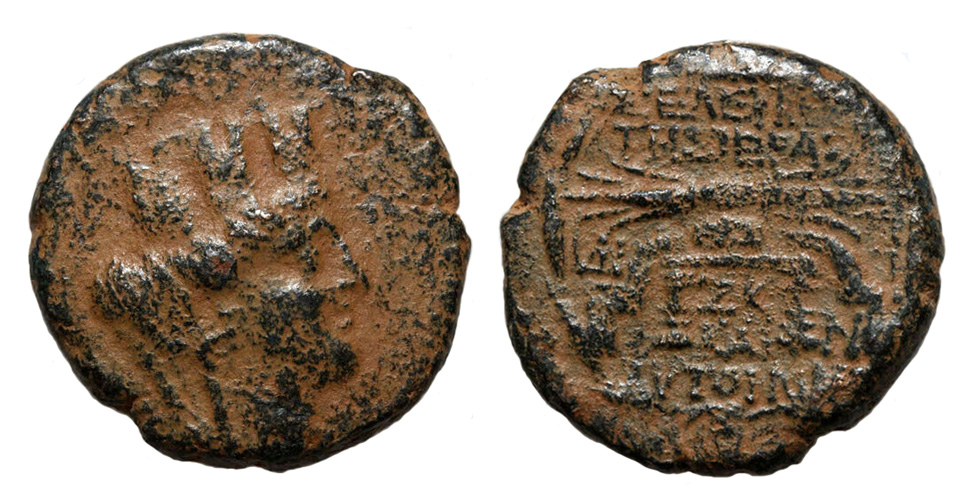 Roman Provincial, issued under Governor Commodus. Date - 157 (Year 188). Obverse: Bust of Tyche, right; wearing turreted head-dress and veil; palm-branch behind head; border of dots. Reverse: Thunderbolt on cushion placed on stool, bead and reel border. Minted in: Seleucia in Pieria. Diameter: 21 millimetres. Weight: 7.12 grammes. |
|
|
|
Moderator
 United States
23731 Posts |
Interesting coin with a nice genuine sad patina, nice find.
|
|
Pillar of the Community
 Spain
2752 Posts |
Great find and nice looking coin Jim  .....I'm sure @echizento means SAND  Found this one on wildwinds..Not an exact match but maybe gives a bit more info at least on the legends. Syria, Seleucia AE 21 mm. 6.30 grams.Year 188 of the local era = 157 AD. Obv: EPI KOMODOU PR, female bust (Tyche of Seleucia) right, wearing turreted head-dress and veil, palm-branch behind head, border of dots.CELEUKEWN THC IERAC KAI AUTONOMOY in four lines above and beneath thunderbolt, with fillet attached, on cushion placed on stool Note: The Commodus mentioned on the obverse is the legate of Syria, C. Julius Commodus Orfitianus.  |
|
Moderator
United States
34538 Posts |
Quote:
I'm sure @echizento means SAND Yes the patina is quite happy actually. Seriously though, nice coin! "If you climb a good tree, you get a push."
-----Ghanaian proverb
"The danger we all now face is distinguishing between what is authentic and what is performed."
-----King Adz
|
|
Bedrock of the Community
Australia
21789 Posts |
VCoins tends, on average to have what is for sale, priced a bit high.
Nevertheless, if you bear this in mind, it can be what is probably the best guide for current market pricing, for what is currently for sale, for a similar coin that you may be considering to buy.
|
|
Pillar of the Community
 United Kingdom
1168 Posts |
Thanks for the replies everyone. Yes, I did read "sand patina" in echizento's post, so no worries. Thank you for the additional information Paul. I did a search for C. Julius Commodus Orfitianus, and his name was mentioned in quite a few books. The extract below was taken from a book relating to Roman inscriptions found on the East coast of Bulgaria. I am learning all the time. Quote:
"A record of how C. Julius Commodus Orfitianus, a known official, made in 155 A.D. burgos et praesidia to protect Thrace - the first occurrence of the word burgos, curiously enough found at Burgas." |
|
Pillar of the Community
Spain
2752 Posts |
One thing I have noticed Jim is that the BMC, VCoins and wildwinds examples all seem to show a blank space under the stool whereas your OP coin shows what seems to be 2 letters maybe a Zk?...The silver Tets on wildwinds reference a date?
Might be something to follow?
|
|
Pillar of the Community
United Kingdom
1168 Posts |
Yes Paul, the silver Tetradrachms do appear to have text or symbols below the stool. All the reverses I've seen for the bronze coins have a blank space below the stool, apart from the one below on VCoins. https://www.vcoins.com/cn/stores/sh...Default.aspxThe lettering appears to be ro above ka. The lettering on the coin I have looks like zk over ka. I agree that it looks like some form of date reference, but I've not been able to find any data to compare it with so far. Jim |
|
Pillar of the Community
United Kingdom
1168 Posts |
I found a site called Seleucid Traces, and the image below is a snapshot of another similar coin - type 24. There is a list of date periods, and it would appear that it is only the upper two characters under the stool that are concerned with the date. 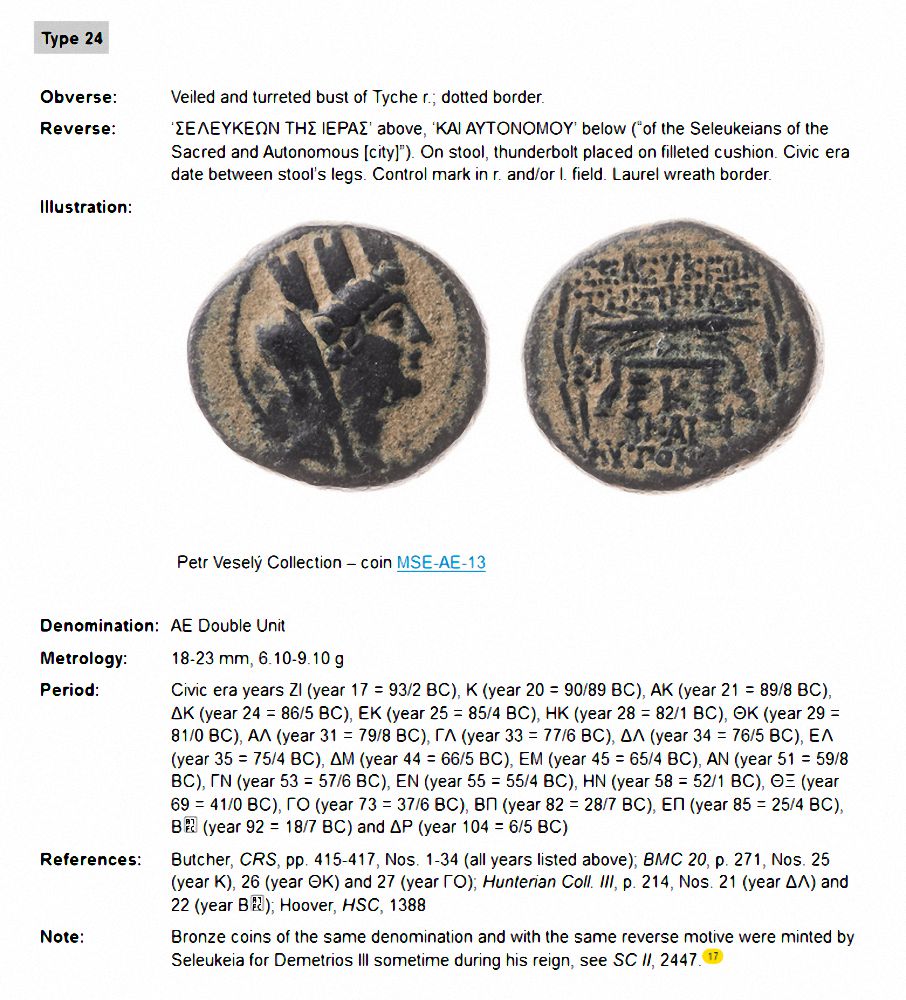 |
|
Pillar of the Community
Spain
2752 Posts |
Good find Jim...I agree it's only the two symbols directly under the stool that depict the date.. Here's a couple of spreadsheets I'm using in my quest for the 12 gods maybe this will be helpful in determining the OP coin....Good luck....Paul The Ancient Greeks had two numeric systems: the Acrophonic or Attic system used the letters iota, delta, gamma, eta, nu and mu in various combinations. These letters were used as they represented the first letters of the number names, with the exception of iota: Γ#941;ντε (gente) for 5, which became Π#941;ντε (pente); Δ#941;κα (Deka) for 10, Η#7953;κατ#972;ν (Hektaton) for 100, Χ#943;λιοι (Khilioi) for 1,000 and Μ#973;ριον (Myrion) for 10,000. This system was used until the first century BC. Acrophonic/Attic Greek numerals 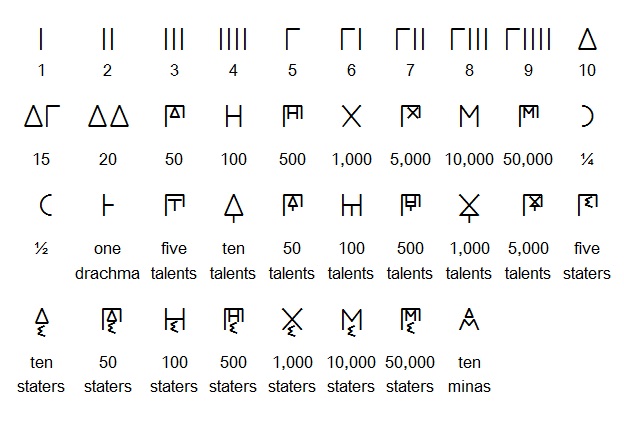 The Acrophonic system was replaced by an alphabetic system that assigned numerical values to all the letters of the alphabet. Three obsolete letters, digamma, koppa and sampi, were used in addition to the standard Greek letters, and a apostrophe-like numeral sign was used to indicate that letters were being used as numerals. Greek numerals (Alphabetic system) 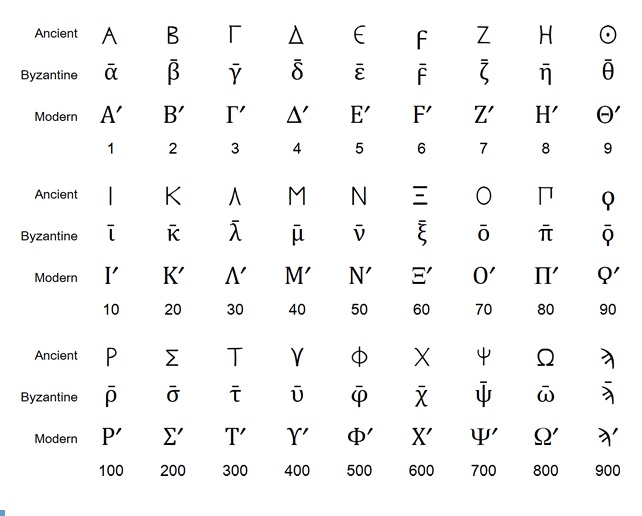 |
|
Pillar of the Community
United Kingdom
1168 Posts |
Thanks again for the info Paul. |
| |
Replies: 10 / Views: 1,585 |
|










 Posted 05/20/2020 03:20 am


